
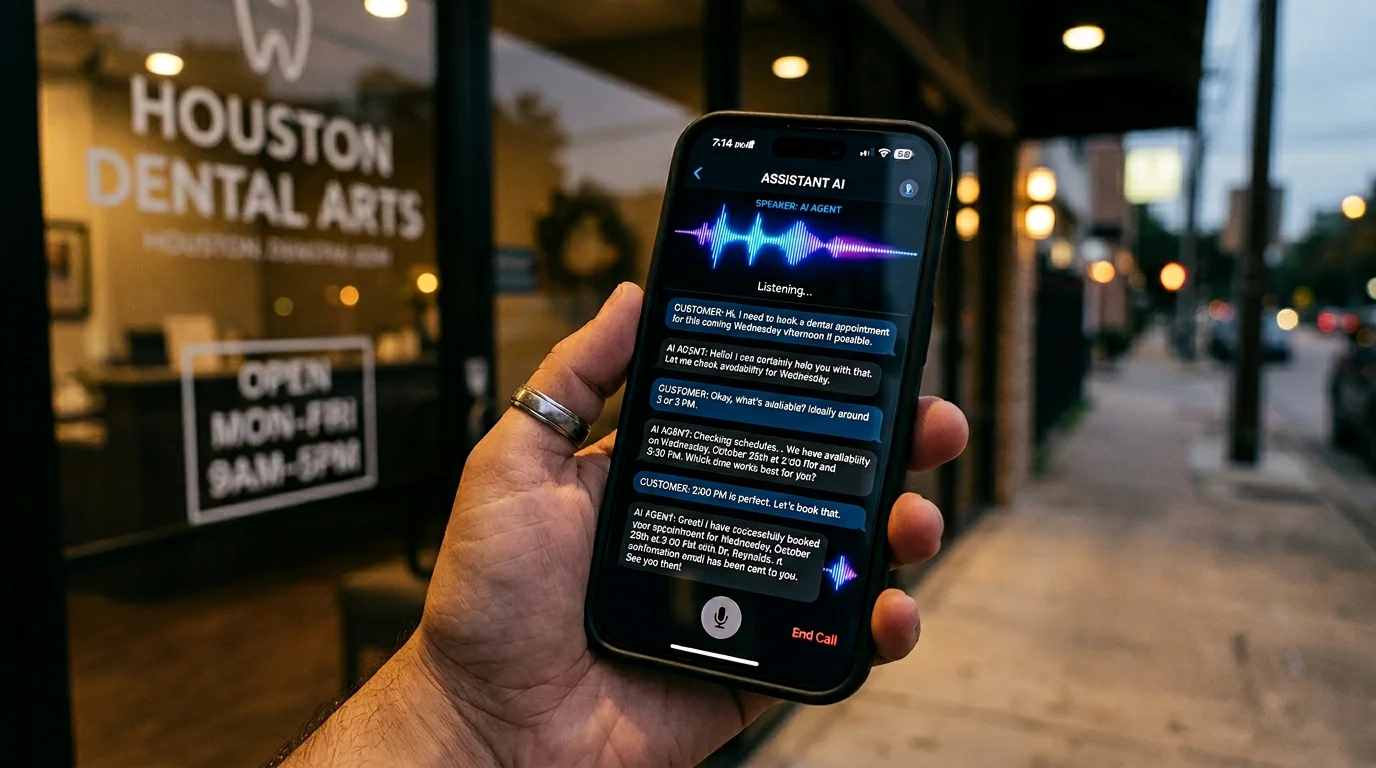
An AI voice agent is a software system that conducts natural spoken conversations with customers — understanding what they say through natural language processing, generating intelligent responses via large language models, and delivering replies in synthesized speech in real time. Unlike traditional phone menu systems that route by button press, AI voice agents respond to the actual content and intent of what a customer says, handling inquiries, booking appointments, and capturing lead information at any hour without human staff involvement.
Most businesses have encountered the problem that AI voice agents solve: a prospect calls after 6 PM, reaches a generic voicemail, and never calls back. Or a customer has a straightforward question during peak hours when every staff line is occupied, waits five minutes on hold, and hangs up frustrated. These interactions — previously invisible losses — are precisely what AI chatbot and voice agent solutions are designed to capture.
This article explains how AI voice agent technology works at the architectural level, which business scenarios produce the highest ROI from voice deployment, and how AI voice differs from both traditional phone systems and standard text-based chatbots.
How AI Voice Agent Technology Works
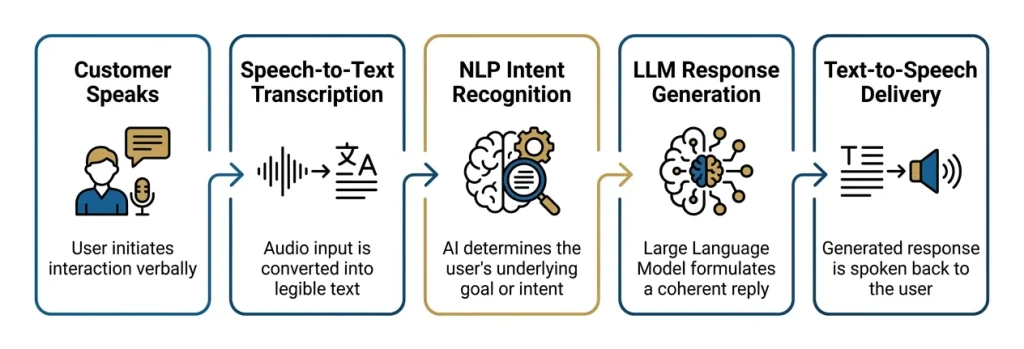
An AI voice agent processes customer input through a five-stage pipeline: speech-to-text transcription converts spoken audio to text, natural language processing extracts the customer's intent from that text, a large language model generates a contextually appropriate response, text-to-speech synthesis delivers the response as natural-sounding spoken audio, and a dialogue manager maintains conversation context across the full multi-turn exchange. Each stage has advanced substantially in the past 24 months, producing voice interactions that customers consistently rate as natural and helpful rather than robotic.
Understanding the pipeline matters for evaluating what AI voice agents can and can't do — and for separating legitimate capability claims from vendor exaggeration:
Stage 1: Speech-to-Text (STT) Transcription
Modern STT systems — OpenAI Whisper, Google Speech-to-Text, AWS Transcribe — achieve transcription accuracy above 95% in standard acoustic environments. Google's Speech-to-Text platform benchmarks word error rates below 5% across major English accent variants under typical call conditions. They handle accents, varied speaking paces, and moderate background noise reliably — meaningfully higher accuracy than most business owners expect based on frustrating early-generation voice recognition experiences from five to ten years ago.
Stage 2: Natural Language Processing and Intent Recognition
NLP analysis takes the transcribed text and determines what the customer is actually asking — extracting intent (book an appointment, get pricing information, speak to a human), entities (specific service, date, location), and sentiment (frustrated, satisfied, neutral). Intent recognition accuracy in well-configured AI voice systems exceeds 90% for intents the system has been trained to handle.
Stage 3: Large Language Model Response Generation
The LLM generates a contextually appropriate response to the identified intent, drawing from a knowledge base of business-specific information (services offered, pricing parameters, availability, FAQs) and the conversation history accumulated in the current session. This is the layer that enables AI voice agents to handle novel phrasings and follow-up questions that rigid script-based systems can't address.
Stage 4: Text-to-Speech (TTS) Synthesis
Modern TTS systems — ElevenLabs, OpenAI TTS, Google WaveNet — produce speech indistinguishable from human voice in most listening contexts. Response delivery latency has dropped to under one second for short responses in optimized implementations, producing conversation pacing that feels natural rather than mechanically delayed.
Stage 5: Dialogue Management
The dialogue manager maintains conversation state across the full exchange — tracking what has been said, what information has been provided, what remains unresolved, and where the conversation is in a defined workflow (e.g., appointment booking flow). Without this layer, each customer utterance would be processed in isolation, making coherent multi-turn conversation impossible.
| Technology Component | Current Capability Standard | Business Implication |
| Speech-to-Text (STT) | 95%+ accuracy in standard environments | Reliable transcription across typical customer call conditions |
| Intent Recognition (NLP) | 90%+ for trained intents | Handles the vast majority of common customer inquiry types correctly |
| Response Generation (LLM) | Context-aware, novel-input capable | Addresses questions outside rigid scripts without failure loops |
| Text-to-Speech (TTS) | Human-equivalent naturalness | Customers engage without the friction of obviously robotic voice |
| Dialogue Management | Full multi-turn context retention | Coherent conversations that feel like speaking with a knowledgeable representative |
AI Voice Agents vs. Traditional IVR Systems: What Actually Changed
Traditional IVR (Interactive Voice Response) systems navigate customers through pre-defined menu trees using keypress or limited keyword recognition — "Press 1 for billing, say 'appointments' for scheduling." AI voice agents conduct open-ended natural conversations, understanding any phrasing the customer uses to express their intent. The practical consequence is the difference between a system that forces customers to adapt to its structure versus one that adapts to the customer's natural communication style.
The IVR failure mode is familiar to every business owner and every customer: the caller's actual need doesn't map cleanly to any menu option, they cycle through the tree trying to find the closest match, they get routed incorrectly, and they either hang up in frustration or reach a staff member who then has to restart the conversation from the beginning. IVR systems were designed for call routing efficiency, not customer experience quality.
AI voice agents solve the structural problem that IVR cannot: they don't require menu design because they don't use menus. A customer can say "I need to reschedule my appointment from Thursday because something came up" and receive an intelligent response that checks the booking system, identifies the appointment, and initiates the rescheduling workflow — without the customer having to navigate to a "Reschedule" option that may or may not exist in the IVR menu tree.
The business scenarios where this architectural difference produces the most measurable impact:
After-hours inquiry capture: IVR typically routes after-hours callers to voicemail. AI voice agents handle the full inquiry — answering questions, capturing contact information, booking appointments — at any hour. For businesses where a meaningful percentage of inbound calls arrive outside staffed hours, this is a direct revenue capture improvement.
High call volume periods: When staff lines are full, IVR puts callers on hold or routes to voicemail. AI voice agents handle unlimited simultaneous conversations with zero wait time — capturing demand that staffing constraints previously forced into abandonment.
Multilingual customer service: Configuring IVR for multiple languages requires building parallel menu structures. AI voice agents handle language detection and multilingual response through the same LLM architecture, with no separate system required per language.
FAQ deflection: Questions that would consume 2–5 minutes of staff time per call — service area coverage, pricing ranges, hours of operation, service descriptions — are handled instantly by AI voice agents, freeing staff capacity for interactions requiring genuine human judgment.
Where AI Voice Agents Deliver the Highest Business ROI
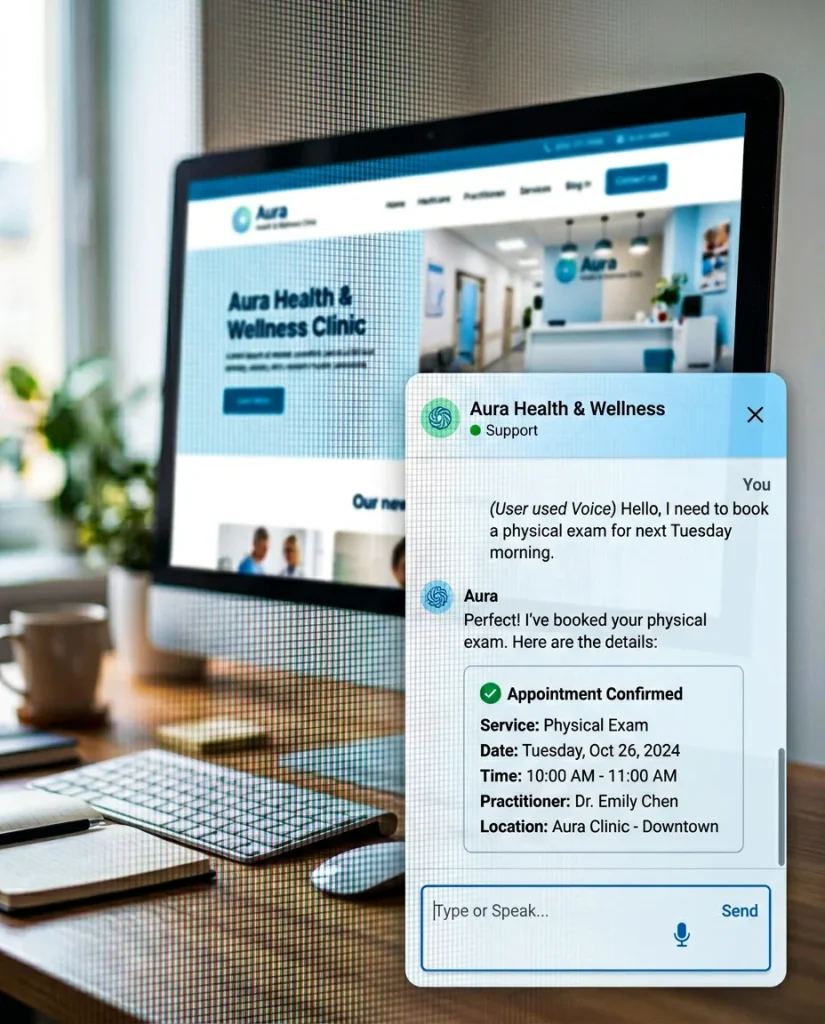
The highest-ROI deployment contexts for AI voice agents are after-hours call handling (capturing revenue previously lost to voicemail abandonment), high-volume FAQ deflection (recovering staff time from repetitive informational calls), appointment booking automation (eliminating the scheduling coordination overhead that consumes disproportionate staff attention), and missed call recovery (following up automatically with callers who didn't leave messages through outbound voice or SMS).
Calculating the ROI case for voice agent deployment starts with a single number: what percentage of your inbound calls currently arrive when no staff is available to answer? For most service businesses with standard operating hours, this figure is 25–40% of total call volume — representing a quarter to nearly half of all inbound opportunities currently being routed to voicemail and lost.
If your business receives 100 inbound calls monthly and 30% arrive after hours, that's 30 calls per month reaching voicemail. If even 40% of voicemail callers don't leave a message or don't respond to a return call, that's 12 lost inquiries per month — every month, as a structural consequence of staffing constraints rather than any quality failure.
An AI voice agent handling those 30 after-hours calls captures all 30. The revenue calculation from that single deployment use case typically justifies implementation cost within 60–90 days for businesses with average transaction values above $300.
Beyond after-hours capture, the staff time recovery calculation adds additional ROI: if your team currently handles 40 FAQ calls per month averaging five minutes each, that's over three hours of weekly staff capacity consumed by informational inquiries an AI voice agent handles in under a minute. At a fully loaded labor cost of $25/hour, that's $75/week in recovered capacity — ongoing, every week, once the system is live.
Key Takeaways
- AI voice agents use a five-stage pipeline — STT transcription, NLP intent recognition, LLM response generation, TTS synthesis, and dialogue management — each operating at accuracy levels that produce natural, reliable customer conversations.
- The core architectural difference from IVR: AI voice agents adapt to customer phrasing; IVR forces customers to adapt to menu structure — a fundamental experience and conversion rate distinction.
- After-hours call capture is typically the highest-ROI first deployment: businesses receiving 25–40% of call volume outside staffed hours can recover that revenue immediately with voice agent deployment.
- Simultaneous conversation capacity is unlimited: AI voice agents handle any volume of concurrent calls with zero wait time — eliminating the peak-period abandonment that IVR and hold queues produce.
- ROI calculation starts with three inputs: after-hours call percentage, average transaction value, and FAQ call volume — these three figures typically produce a payback period of 60–90 days for qualifying businesses.
- Modern TTS produces human-equivalent voice quality: customer engagement rates with AI voice agents have improved substantially as TTS naturalness has advanced, removing the friction that degraded early voice bot deployments.
Conclusion
AI voice agents represent a fundamentally different approach to phone-based customer engagement — one built on conversation intelligence rather than menu navigation. The technology stack powering modern voice agents has reached the quality threshold where customers engage naturally, appointment booking and inquiry resolution happen automatically, and the after-hours revenue that previously leaked through voicemail is captured systematically.
For service businesses evaluating voice AI, the starting point is an audit of current call patterns — volume by hour, FAQ inquiry frequency, after-hours percentage — to quantify the revenue opportunity an AI voice agent addresses. Authority Solutions® designs and deploys AI voice agent solutions integrated directly with your booking system, CRM, and communication infrastructure. Contact our team to discuss what voice AI can capture for your specific business model, or explore the full AI chatbot and voice agent services overview to see the complete implementation scope.
Frequently Asked Questions
What is an AI voice agent and how does it differ from a regular chatbot?
An AI voice agent handles spoken conversations through a speech-to-text and text-to-speech pipeline, enabling customers to interact through natural speech rather than typing. A chatbot handles text-based conversations. Both use the same underlying NLP and LLM intelligence layer; the difference is the input and output modality — voice versus text. Authority Solutions® builds unified systems where the same AI intelligence handles both channels.
Can an AI voice agent actually understand what customers say?
Yes. Modern AI voice agents achieve 90%+ intent recognition accuracy for the inquiry types they're configured to handle, and handle novel phrasings — the full variety of ways real customers express the same intent — without failing into "I didn't understand" loops. The key configuration requirement is training the system on the specific intents, entities, and knowledge base relevant to your business.
What kinds of customer inquiries can an AI voice agent handle?
AI voice agents reliably handle: appointment scheduling and rescheduling, FAQ responses (hours, pricing, service area, service descriptions), lead qualification and contact information capture, appointment confirmation and reminder calls, and routing to the appropriate human staff member for complex inquiries. Interactions requiring nuanced human judgment — contract negotiations, complex complaints, high-stakes consultations — should escalate to human agents.
How does an AI voice agent handle a question it can't answer?
Well-configured AI voice agents use escalation logic for queries outside their knowledge base — acknowledging the limitation, offering the most relevant available information, and routing to a human agent or follow-up callback if the inquiry can't be resolved automatically. Full conversation context is passed to the human agent, so the customer doesn't repeat their situation from the beginning.
How long does it take to deploy an AI voice agent for a business?
Standard AI voice agent deployments — covering appointment booking, FAQ handling, and after-hours inquiry capture — typically complete in 2–4 weeks. This includes knowledge base configuration, integration with booking and CRM systems, conversation flow design, voice selection and brand alignment, and pre-launch testing. Custom integrations with proprietary systems extend the timeline to 4–8 weeks.