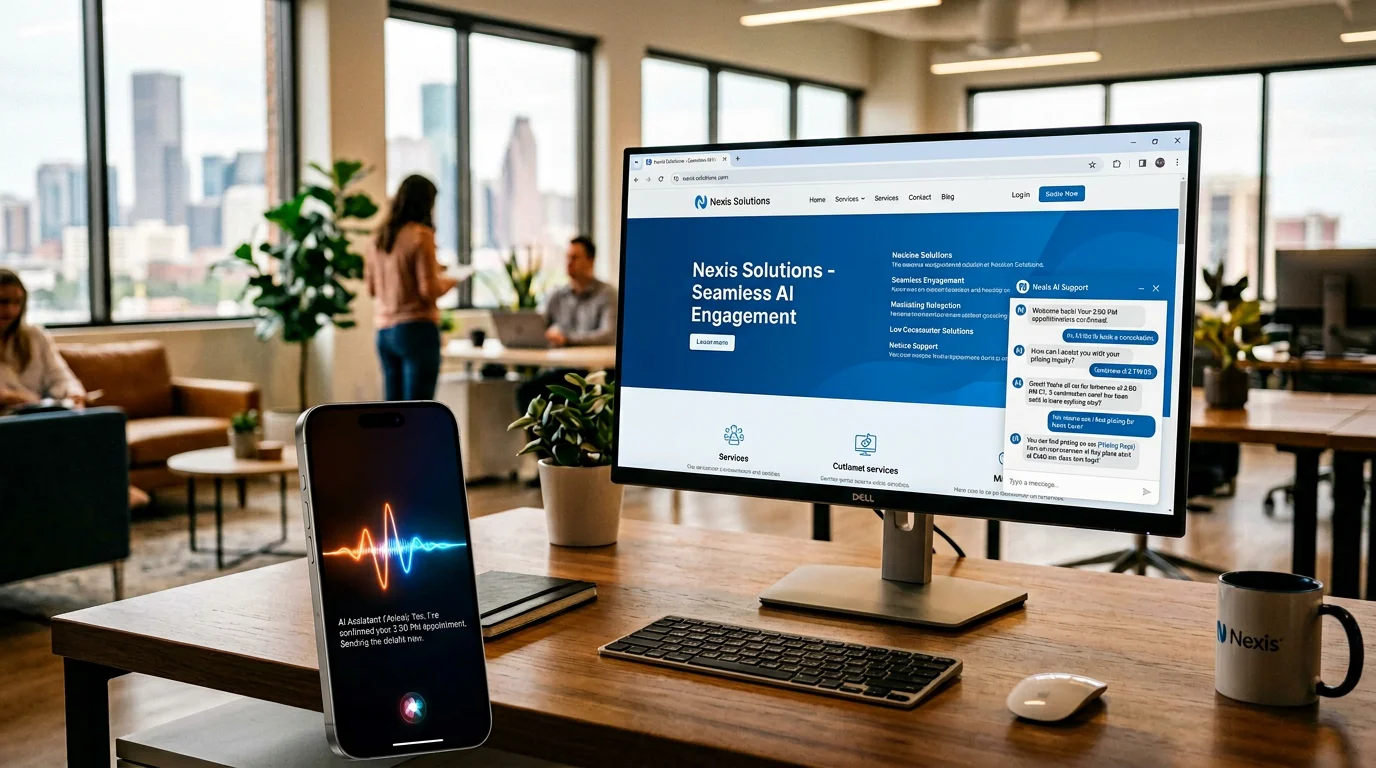
AI voice agents and chatbot solutions deliver instant, intelligent customer engagement around the clock — answering inquiries, qualifying leads, booking appointments, and resolving support requests through natural language conversations without human staff involvement. For businesses losing revenue to after-hours missed contacts and slow response times, an AI voice agent agency builds the conversational infrastructure that captures every customer interaction, at any hour, at any scale.
The economics of customer engagement have shifted permanently. A prospect who lands on your website at 11 PM and doesn't get a response until 9 AM the next morning has almost certainly contacted a competitor in the intervening hours — or simply moved on. AI chatbot and voice agent solutions eliminate that gap entirely: every inquiry receives an immediate, intelligent response regardless of when it arrives, what channel it comes through, or how many simultaneous conversations are occurring.
This guide covers how AI voice agents and chatbots work, which customer engagement scenarios each handles best, the conversation design principles that separate high-performing bots from frustrating ones, and how to evaluate an AI voice agent agency capable of building solutions that genuinely reflect your brand rather than generic scripts that erode customer trust.
How AI Voice Agents and Chatbots Work: Beyond Scripted Responses
Modern AI voice agents and chatbots use natural language processing — specifically large language models — to understand customer intent in context, maintain conversation history across multiple turns, and generate responses that address the actual question rather than pattern-matching to a fixed script. This architecture produces conversations that feel human because they respond to meaning, not keyword triggers.
The generational difference between legacy chatbots and modern AI chatbot solutions is the difference between a decision tree and a conversation. Legacy bots match keywords to pre-programmed responses — ask something slightly outside the script, and the bot fails. Modern AI chatbots built on LLM architecture understand semantic intent: "What does it cost?" and "How much do you charge?" and "Give me a ballpark on pricing" all trigger the same intelligent response, regardless of which phrasing the customer uses.
The mechanics behind this capability matter for understanding what you're deploying:
Natural language processing (NLP): The AI parses customer input to extract intent, entities (specific topics or requests), and sentiment — determining not just what was said, but what was meant and how the customer feels about it.
Context retention across turns: Unlike scripted bots that treat each message as isolated, AI chatbots maintain conversation history — so "tell me more about that" works correctly because the system knows what "that" refers to from two messages earlier.
Escalation intelligence: Well-designed AI customer service systems recognize when a conversation requires human involvement — emotional distress signals, complex complaints, high-value prospects requesting specific human interaction — and route accordingly rather than continuing to deflect.
Continuous learning: Usage data improves model responses over time. Conversations that result in escalation or negative sentiment signals are analyzed to improve handling of similar future queries.
| Chatbot Generation | Architecture | Language Understanding | Context Retention | Handling of Novel Inputs |
| Rule-Based (Legacy) | Decision tree with keyword triggers | Keyword matching only | None — each message isolated | Fails — "I don't understand" loops |
| Hybrid (Transitional) | Decision tree + basic NLP | Intent classification | Limited — single turn | Partial — scripted fallbacks |
| AI-Powered (Modern) | LLM-based with NLP pipeline | Semantic understanding | Full multi-turn context | Handles naturally — generates appropriate response |
| AI + Human Handoff | LLM + escalation routing | Full semantic + sentiment | Full context passed to human agent | Escalates intelligently when limits reached |
AI Voice Agents: Conversational Engagement Through Spoken Dialogue
AI voice agents extend chatbot capability into spoken conversation — enabling customers to interact with your business through natural speech rather than text input. The practical application for most businesses isn't replacing phone calls: it's capturing interactions that would otherwise go unhandled at 2 AM, during peak hours when staff lines are full, or through web interfaces where voice feels more natural than typing.
Authority Solutions® builds AI voice agents that integrate with website chat widgets, enabling customers to speak their questions rather than type them — a particularly high-value capability for mobile visitors and service businesses where the customer is often multitasking. Voice input is transcribed, processed by the same LLM powering the text chatbot, and responded to in natural synthesized speech or text depending on the customer's device and preference.
AI Chatbot vs AI Voice Agent: Matching the Tool to the Engagement Context
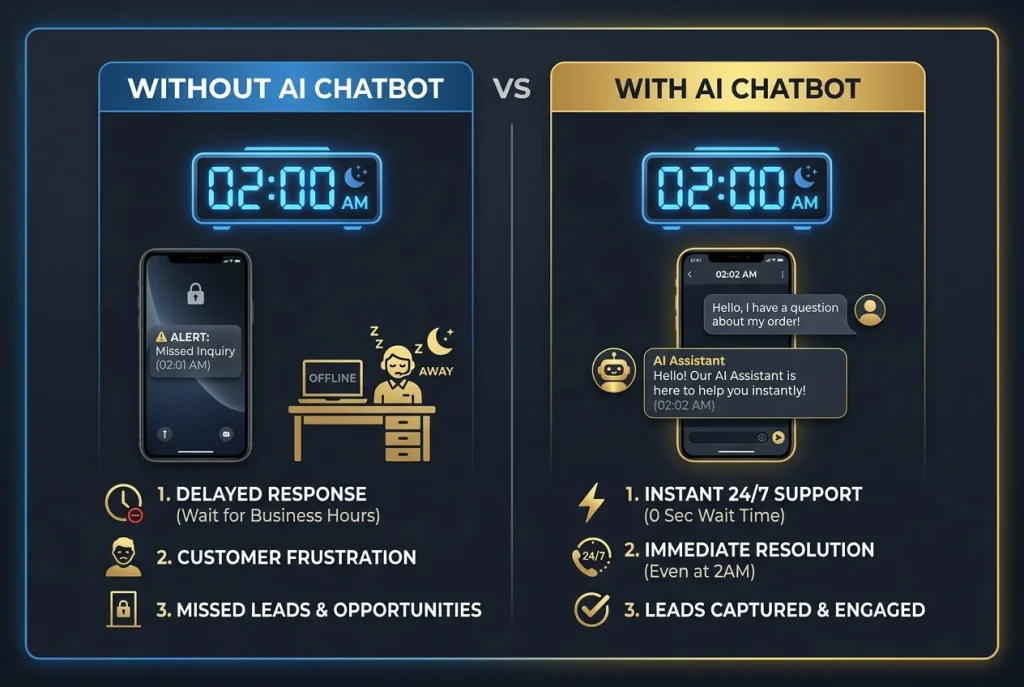
AI chatbot solutions and AI voice agents address different customer engagement contexts — chatbots excel at text-based, asynchronous, and multi-query support interactions; voice agents perform best for appointment-setting flows, FAQ resolution by phone, and hands-free customer engagement. The right deployment strategy for most businesses is a unified AI system handling both channels through a single intelligence layer, not separate tools for each channel.
Choosing between chatbot and voice agent deployment isn't an either/or decision for most businesses — it's a channel strategy question. Understanding where each format delivers the highest engagement rate and resolution quality guides architecture decisions:
When AI Chatbots Deliver Higher Performance
- Website lead qualification: Text-based chatbots convert at higher rates for qualification flows because customers can read, review, and respond at their own pace — voice creates time pressure
- Multi-query support: Customers researching multiple questions simultaneously prefer text — they can scroll back, copy information, and reference previous answers
- High-sensitivity interactions: Complaint handling, billing inquiries, and account issues perform better in text where customers feel less on-the-spot
- Mobile-web interactions: Text chatbots are native to mobile interfaces and require no microphone permission requests that create friction
When AI Voice Agents Deliver Higher Performance
- Appointment booking: Voice flows for scheduling outperform text chatbots because the conversational cadence mirrors familiar phone-booking behavior
- After-hours inquiry capture: Voice agents on missed-call routing capture contacts who called expecting a person but reached voicemail — a recovery mechanism text chatbots can't access
- Hands-free customer contexts: Customers driving, cooking, or otherwise occupied engage more readily through voice
- Older customer demographics: Voice interaction reduces the friction of text-based interfaces for customer segments less comfortable with chat interfaces
| Engagement Scenario | Best Channel | Why | Expected Resolution Rate |
| Lead Qualification | AI Chatbot | Paced, reviewable, less pressure | 65–80% self-serve |
| Appointment Booking | AI Voice Agent | Mirrors familiar phone behavior | 70–85% booked without human |
| FAQ Resolution | AI Chatbot | Scannable, referenceable | 75–90% deflection from human |
| After-Hours Inquiry | Either (unified system) | Presence when staff unavailable | 60–75% captured vs. 0% voicemail |
| Complex Support | Escalation → Human | AI routes, human resolves | 100% with proper escalation design |
| Product Information | AI Chatbot | Multi-detail, scrollable | 80–90% self-serve |
The Case for Unified Architecture
Deploying separate chatbot and voice systems creates fragmentation — different conversation histories, different escalation paths, and duplicate maintenance overhead. Authority Solutions® builds on unified AI architecture where a single intelligence layer handles text and voice input, maintaining a single conversation record per customer regardless of which channel they use. This produces the experience of speaking with a business that actually remembers previous interactions — a differentiator that directly impacts customer satisfaction scores.
Conversation Design: The Factor That Determines Chatbot Success or Failure

Conversation design — the architecture of how an AI chatbot or voice agent guides customers through interactions — determines customer satisfaction outcomes more than the underlying AI technology. A sophisticated LLM with poor conversation design produces worse results than a simpler system with thoughtfully designed dialogue flows, escalation triggers, and brand-aligned response patterns. Most chatbot disappointments trace back to conversation design failures, not technology limitations.
And this is where most chatbot deployments underperform. The technology is sophisticated. The conversation design is an afterthought — generic templates, robotic phrasing, unclear escalation logic, and a brand voice that doesn't match the rest of the business's communication. Customers notice immediately, and their confidence in the business drops proportionally.
Effective conversation design for AI chatbot solutions requires deliberate decisions across five dimensions:
1. Intent Architecture
Map the specific intents your customers arrive with — the actual questions and requests that drive 80% of your conversation volume. For a service business in Houston, these might be: "What do you charge?", "How do I book an appointment?", "Are you available this week?", "What areas do you serve?", and "Do you offer [specific service]?" Each intent requires a dedicated response path optimized for that specific query — not a generic "I can help you with that" redirect.
2. Brand Voice and Personality
Your chatbot should sound like your business, not like a generic AI assistant. This requires a brand voice document that defines tone (formal vs. conversational), vocabulary (industry terms your customers use vs. jargon they don't), and personality traits the bot expresses consistently. Authority Solutions® conducts brand voice workshops before building any chatbot dialogue architecture — the conversation design phase is as important as the technical deployment phase.
3. Escalation Trigger Design
Every effective AI chatbot needs clear escalation triggers: conditions under which the bot hands off to a human agent with full conversation context. Poor escalation design — either too aggressive (handing off too quickly, defeating the purpose) or too resistant (refusing to escalate when customers clearly need human help) — is the most common chatbot failure mode. Well-designed triggers include: explicit human request, negative sentiment signals above a defined threshold, unresolvable queries after two clarification attempts, and high-value prospect signals requiring white-glove engagement.
4. Fallback and Recovery Responses
When the AI doesn't understand a customer input — which will happen — the fallback response determines whether the conversation recovers or breaks down entirely. Generic "I didn't understand that, please try again" responses erode trust quickly. Effective fallbacks acknowledge the limitation, offer the most likely relevant alternative, and maintain forward momentum: "I want to make sure I get this right — are you asking about [Option A] or [Option B]?"
5. Post-Conversation Actions
The conversation isn't over when the chat window closes. Effective chatbot architecture triggers post-conversation actions automatically: CRM lead creation with conversation summary, follow-up email to unresolved inquiries, appointment confirmation emails, internal notifications for high-priority escalations. These actions are configured during design and execute without human intervention — extending the automation value beyond the conversation itself.
Key Takeaways
- Modern AI chatbots use LLM architecture that understands semantic intent — not keyword matching — producing conversations that handle novel customer inputs naturally rather than breaking into scripted failure loops.
- Chatbots and voice agents address different engagement contexts: text chatbots excel at lead qualification and multi-query support; voice agents deliver highest performance for appointment booking and after-hours inquiry capture.
- Unified architecture outperforms separate channel deployment: a single AI intelligence layer handling both text and voice maintains consistent customer conversation history across channels, driving measurably higher satisfaction scores.
- Conversation design determines chatbot performance more than technology: intent architecture, brand voice alignment, and escalation trigger design separate high-performing implementations from generic bots that damage brand trust.
- Escalation trigger design is the most critical and most neglected element: the conditions under which the AI hands off to a human — with full context — determine whether complex situations resolve successfully or escalate into customer complaints.
- Post-conversation automation multiplies chatbot ROI: CRM lead capture, follow-up sequences, and internal notifications triggered automatically after each conversation extend the value of AI customer engagement beyond the conversation itself.
Why AI Customer Engagement Delivers Measurable Business ROI
The ROI case for AI voice agent and chatbot deployment rests on four quantifiable impact categories: after-hours inquiry capture (revenue previously lost to voicemail), support ticket deflection (labor cost eliminated through self-service resolution), response time reduction (conversion rate improvement from faster first contact), and sales qualification efficiency (rep time recovered from manual initial qualification). Together, these typically deliver full investment payback within 60–120 days for businesses processing 50+ customer inquiries per month.
The revenue recovery calculation for after-hours inquiry capture alone often justifies deployment. Consider a service business that receives 30% of its website inquiries between 6 PM and 9 AM — hours when no staff is available to respond. Without a chatbot, those inquiries land in an email queue and receive a response the following business day — at which point a meaningful percentage of prospects have already moved on. With an AI chatbot, every after-hours inquiry receives an immediate response, lead qualification proceeds automatically, and appointments are booked in real time.
The support deflection calculation is equally concrete. If your support team handles 200 inquiries per month, and an AI chatbot resolves 60–75% of them without human intervention, that's 120–150 support interactions per month removed from staff workload — recaptured as capacity for higher-value activity.
Response time directly affects conversion rate in ways most businesses underestimate. Research across service industries consistently shows that responding to a lead within five minutes of initial contact produces conversion rates dramatically higher than responding within an hour — and the gap widens further at longer response delays. An AI chatbot that responds in under three seconds, at any hour, represents a conversion rate improvement that compounds every month it operates.
Authority Solutions® has delivered AI chatbot and voice agent implementations for businesses across legal, medical, home services, and B2B sectors in Houston and nationally — building systems that reflect each client's brand voice, integrate directly with their CRM and booking systems, and deliver measurable ROI benchmarks within the first 90 days. Contact our team to discuss what intelligent customer engagement infrastructure can deliver for your specific business model.
Conclusion
AI voice agents and chatbot solutions solve a fundamental business problem: customers want immediate, helpful responses at any hour, but staffing to deliver that 24/7 is economically prohibitive for most businesses. AI customer engagement closes that gap permanently — capturing after-hours leads, qualifying prospects automatically, booking appointments without human coordination, and deflecting routine support inquiries from staff workload. The compound effect across revenue capture, cost reduction, and customer satisfaction improvement makes this one of the highest-ROI AI investments available to service businesses today.
The right AI chatbot implementation starts with understanding your specific customer engagement patterns — which inquiries arrive most often, at what hours, and with what resolution expectations. Contact Authority Solutions® to discuss a custom AI chatbot and voice agent solution designed for your customer base and business model, with measurable performance benchmarks established before deployment begins.
Frequently Asked Questions
What is an AI chatbot for business?
An AI chatbot for business is a software system that conducts natural language conversations with customers through your website, messaging platforms, or voice channels — answering questions, qualifying leads, booking appointments, and resolving support inquiries automatically, without human staff involvement. Modern AI chatbots use large language model architecture to understand customer intent rather than match keywords to scripted responses.
How does an AI voice agent differ from a traditional phone system?
A traditional phone system (IVR) uses rigid menu-based navigation — "Press 1 for billing, press 2 for support." An AI voice agent conducts natural spoken conversation, understanding what the customer says rather than requiring them to navigate predefined options. AI voice agents can answer specific questions, book appointments, and resolve inquiries dynamically rather than routing to hold queues.
What types of businesses benefit most from AI chatbot solutions?
Service businesses with high inquiry volume benefit most — legal practices, medical offices, HVAC and home services, real estate agencies, marketing agencies, and any business that receives significant after-hours website traffic or phone inquiries. AI chatbots deliver the highest ROI for businesses where after-hours lead capture and rapid response times directly impact conversion rates.
How does an AI chatbot handle questions it can't answer?
Well-designed AI chatbots use escalation triggers to route conversations to human agents when they encounter questions outside their resolution capability, detect customer frustration signals, or receive explicit human-contact requests. The handoff passes full conversation context to the human agent — eliminating the customer frustration of re-explaining their situation from scratch.
Can an AI chatbot book appointments directly into my calendar?
Yes. AI chatbots can integrate with booking platforms (Calendly, Acuity, custom calendar APIs) to check real-time availability, offer open slots, and confirm appointments directly within the conversation — without any human coordination. Confirmation emails and CRM records are created automatically as part of the booking flow.
What is conversational AI and how does it relate to chatbots?
Conversational AI is the underlying technology — natural language processing, large language models, and dialogue management — that powers modern chatbots and voice agents. The chatbot or voice agent is the customer-facing interface; conversational AI is the intelligence engine that enables natural, context-aware dialogue. Most references to "AI chatbots" imply conversational AI architecture.
How do AI chatbots reduce customer support costs?
AI chatbots reduce support costs through ticket deflection — resolving customer inquiries automatically without human agent involvement. Deflection rates of 60–75% are standard for well-designed implementations. The labor cost of each deflected ticket, multiplied by monthly ticket volume, typically produces a clear ROI calculation that justifies deployment within 60–90 days.
Do customers know they're talking to an AI chatbot?
Transparency is both an ethical standard and a legal requirement in some jurisdictions. Authority Solutions® designs chatbots that identify themselves as AI at the start of conversation while delivering responses of high enough quality that the identification doesn't diminish engagement. The goal is a bot that's honest about what it is but so helpful that customers prefer it to a long hold queue.
How long does AI chatbot implementation take?
Standard AI chatbot implementations with pre-built integrations (website chat widget, CRM connection, basic booking flow) deploy in 2–4 weeks. Custom implementations with complex integration requirements, proprietary platform connections, or multilingual support take 4–8 weeks. Authority Solutions® includes conversation design, brand voice alignment, and post-launch optimization in every engagement.
What's the difference between a rule-based chatbot and an AI chatbot?
A rule-based chatbot follows fixed decision trees — if the customer says X, respond with Y. It fails when customers phrase questions in ways the script doesn't anticipate. An AI chatbot uses natural language processing to understand the intent behind any phrasing — making it capable of handling the full variety of ways real customers actually communicate, not just the ways a script designer predicted they would.