The 4:47 A.M. Call That Booked Itself
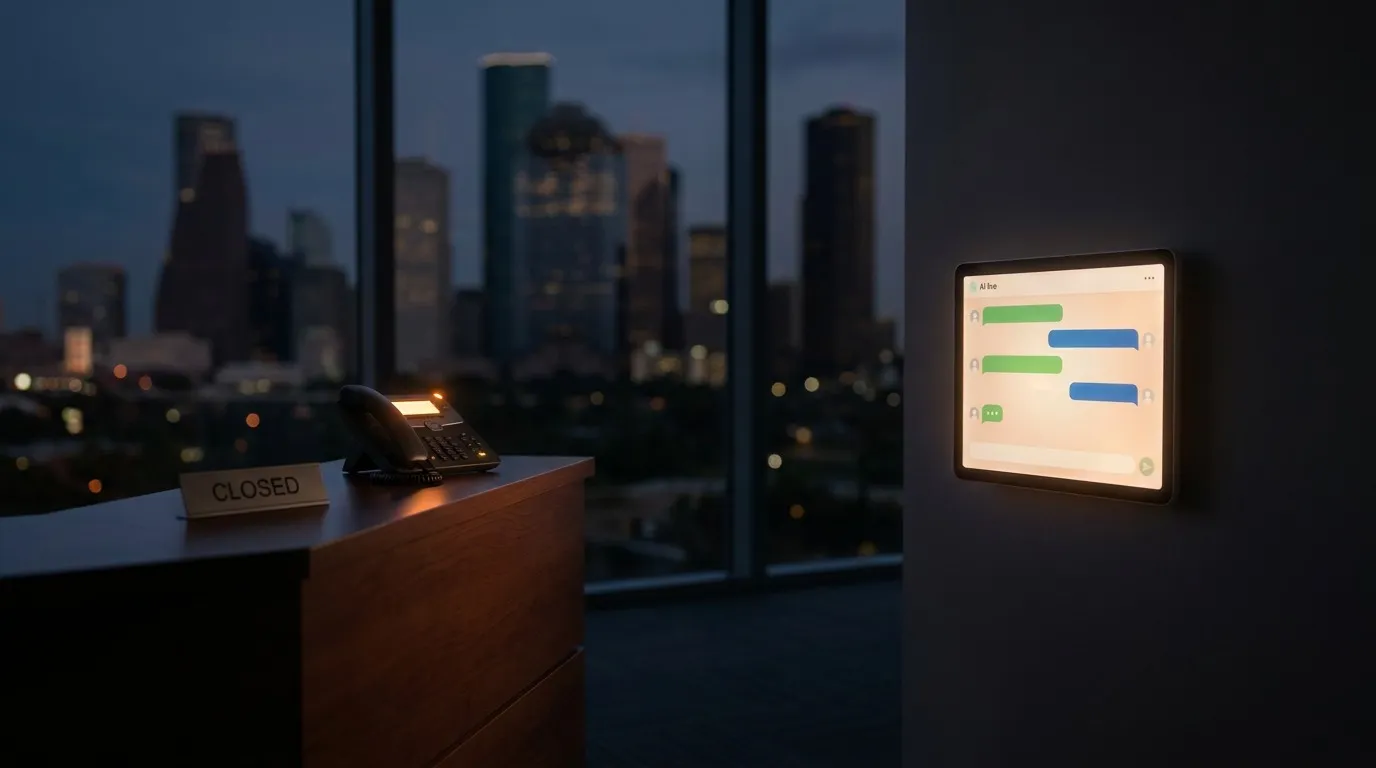
Every service business owner has heard the same story from their most successful competitors: an appointment showed up on the schedule at 4:47 a.m., booked by a customer whose water heater failed overnight, handled entirely by an AI voice agent, tech dispatched at 7 a.m., emergency service invoice paid by 10:30. The live receptionist would not clock in until 8 a.m. and would have found the water heater failure as a voicemail. By 8:15, the customer would already have called two competitors.
CallRail's inbound-call research and broader industry data document the shape of the problem consistently. The majority of missed-call revenue in service businesses and professional practices occurs outside business hours, with a smaller but material fraction happening during business hours when the live receptionist is handling another call or stepped away for a moment. The receptionist is not doing a bad job; the workload simply exceeds any single human's capacity to cover consistently. The question in 2026 is not whether to add AI; it is how to allocate the work between AI and human so each does what it does best.
This article walks through a head-to-head comparison across cost, quality, availability, and the specific call types each handles best, the automated attendant generation that changed the equation in 2026, the hybrid pattern that most businesses land on, and the Authority Solutions® AI Services path for standing up the right allocation in four to six weeks.
The 24-Hour Bake-Off That Ends the Debate
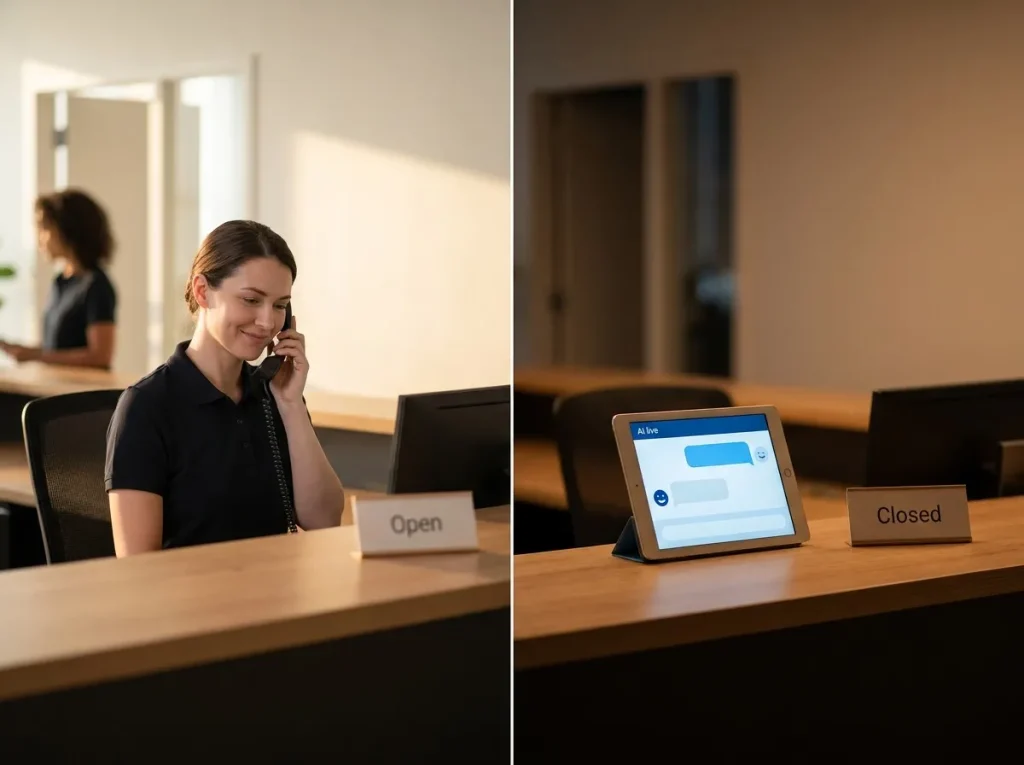
Every operator we have run this evaluation with has agreed to the same test structure: a 24-hour bake-off with parallel routing where all inbound calls hit both the live receptionist (during their scheduled hours) and the AI voice agent (across the full 24 hours), with a follow-up survey to the caller. The results are consistent enough that we now run the bake-off as standard discovery.
Bake-off structure:
- Parallel routing during business hours. The live receptionist and the AI voice agent both attempt to handle each inbound call. The customer sees whichever answers first; the other gets the transcript for comparison.
- AI-only after hours. After the receptionist's shift ends, all calls route to the AI. The morning after, the receptionist reviews the overnight log.
- Follow-up satisfaction survey. Every caller receives a two-question SMS survey the next day. Was the caller helped, and how would they rate the experience.
- Cost tracking on both sides. Fully-loaded cost of the receptionist (salary, benefits, training, no-show coverage) and fully-loaded cost of the AI (subscription, per-minute usage, engineering support).
- Missed-call tracking. Volume of calls that reached voicemail, that were abandoned before pickup, and that occurred when the receptionist was on another line.
The bake-off runs for 30 days. The report at the end is a data-grounded conversation about which motion serves the business better across the specific call mix the business receives.
What Live Receptionists Do Best
Being explicit about the strengths of the human receptionist is what makes the comparison fair. There are call types where humans clearly outperform AI, and the honest recommendation preserves those.
Live receptionist strengths:
- Emotional situations. A customer whose parent just went into hospice needs a human. A customer disputing a bill needs a human. AI can handle both, but the trust cost is high.
- Ambiguous requests. The caller who is not sure what they need and needs a conversation to figure it out. Human curiosity and follow-up questioning still exceed AI's inference on genuinely unclear intent.
- Regulatory or legal context. Some sectors (healthcare, legal, financial services) have specific requirements about who can take certain types of information. Humans in trained roles handle these more comfortably.
- Local relationship maintenance. The receptionist who knows the customer's dog by name adds a specific brand quality AI cannot replicate. This matters more in small local businesses than in national brands.
- Escalation catch. The receptionist who reads that the customer is angrier than they are saying and routes accordingly. AI is improving here but still trails.
The right AI deployment preserves these strengths by handling the routine call volume and routing the calls that warrant the human touch.
What AI Voice Agents Do Best
Being explicit about AI strengths ends the debate on the other side. AI outperforms humans decisively on specific call types.
AI voice agent strengths:
- Speed and consistency. The AI answers in 1 to 4 seconds every time. The receptionist answers in 8 to 45 seconds depending on their current load. Speed matters more than most operators recognize; the 30-second answer feels like an eternity to a caller with a broken pipe.
- 24/7/365 availability. No sick days, no vacation, no lunch breaks, no holidays. The AI handles the 6 p.m. Sunday call the human is never going to answer.
- Repeatable script quality. The AI never has a bad day, never rushes a call, never forgets to ask for the customer's ZIP code. The script quality is the same on call one as on call 800.
- Simultaneous volume. The AI handles ten calls at once during a rush without breaking. The receptionist handles one call at a time.
- Multilingual coverage. Bilingual AI is standard in 2026. Hiring a bilingual receptionist is possible; hiring one who speaks the right five languages for the business's customer base is much harder.
- Structured data capture. The AI writes structured, complete notes into the CRM after every call without effort. Human receptionists do this well when trained, but not always.
The math is stark on the call types that map to AI strengths. Most operators do not realize how much of their call volume falls in this bucket until they run the bake-off.
The Cost Comparison That Is Not Actually Close

The cost side is where the conversation usually ends. A fully-loaded receptionist runs one range; a fully-loaded AI voice agent runs another; the numbers are not close.
Cost dimensions:
- Live receptionist. Salary of 35,000 to 65,000 US dollars per year, benefits and payroll tax adding another 20 to 30 percent, training and turnover costs, and coverage costs for vacation and sick days. Fully-loaded cost typically 55,000 to 100,000 US dollars per year for a single full-time position.
- Live answering service. Per-call or per-minute pricing typically running 200 to 800 US dollars per month for typical small-business volume, with quality varying widely by provider.
- AI voice agent. Subscription typically 100 to 500 US dollars per month plus per-minute usage in the 15 to 40 cent range. Total cost for a typical small business runs 300 to 1,200 US dollars per month.
- Hybrid pattern. A part-time live receptionist (business hours only) paired with an AI voice agent (evenings, weekends, overflow) typically runs 30,000 to 45,000 US dollars per year fully loaded.
The AI is cheaper by a factor of five to fifteen depending on business size and volume. Coverage is broader. The math is stark, and the honest recommendation is a hybrid that captures the strengths of each without paying the full cost of either. Authority Solutions® Marketing Automation integrates the voice motion with the lead intake sequence so the savings compound across the funnel.
The Hybrid Pattern That Most Businesses Land On
Very few operators land on a pure AI or pure human answer. Most land on a hybrid, and the shape of the hybrid varies by business size and industry.
Common hybrid patterns:
- Small service business (0 to 3 employees). AI voice agent full-time as primary; owner or spouse handles escalations. No live receptionist headcount.
- Growing service business (4 to 15 employees). AI voice agent for after-hours and overflow; part-time live receptionist for business hours as primary. The AI handles about 60 to 75 percent of calls.
- Mid-size operation (15 to 50 employees). AI voice agent handles routine (appointments, hours, FAQ); live receptionist team handles complex, emotional, or regulated calls. The AI handles about 50 percent of calls with clean handoff.
- Enterprise or franchise. AI voice agent as the front door for every location; centralized live team handles escalations, complaints, and franchise-level issues. The AI handles about 65 to 80 percent of calls.
- Medical or legal practice. AI voice agent for scheduling, hours, and FAQ; live receptionist team handles patient or client conversations that require judgment. Regulatory compliance drives the split more than cost does.
Authority Solutions® Voice AI Development helps operators map their specific call mix to the right hybrid ratio before deploying.
The Handoff Design That Makes or Breaks It
The hybrid pattern is only as good as the handoff. Sloppy handoffs where the customer has to re-explain everything to the human after starting with the AI produce worse experience than either extreme. The handoff design is the discipline.
Handoff mechanics that work:
- Structured context transfer. When the AI escalates, the human sees the caller name, the reason for the call as understood by the AI, the summary of what has been discussed, and the specific reason for escalation.
- Warm transfer with cover. The AI stays on the line during the transfer, briefly summarizes the situation to the human ("I have Sarah on the line about a billing dispute; she was on hold for 45 seconds"), and only then hands off. The customer feels handed off, not dumped.
- Escalation triggers defined. Complexity above a threshold, emotional intensity, specific keywords, or explicit customer request all trigger escalation. The AI does not try to handle what it cannot.
- Fallback for unavailable humans. If the escalation reaches a human and the human is unavailable, the AI takes a structured message with priority level and callback commitment. The customer is not left in limbo.
- Post-call reconciliation. The human reviews the AI's part of the call before responding. The customer never asks a question that the AI already answered.
Authority Solutions® Chatbot Development applies the same handoff discipline to voice and text channels for a consistent customer experience across both.
The Quality Test That Actually Matters
The debate about "quality" often collapses under the weight of vendor claims and anti-vendor skepticism. The honest quality test is the customer's own answer after the call.
Quality test structure:
- Post-call SMS survey. Two questions: were you helped, and how would you rate the experience. Sent within 30 minutes of call completion.
- Segmented by AI vs. human. Report the results separately so you can see where each is winning and losing.
- Segmented by call type. Report the results by category so you can see which call types AI handles well and which need human touch.
- Watch the tail. Aggregate satisfaction hides the low-satisfaction long tail. The 1-star or 2-star reviews deserve individual analysis; that is where brand damage lives.
- Quarterly recalibration. The AI improves quarter over quarter; the receptionist's script training also improves. The allocation should adjust based on the current data, not the initial deployment decision.
Operators who run this quality test consistently make the right allocation calls. Operators who go on vendor promises alone almost always mis-allocate.
The Authority Solutions® Voice Motion Path
Our engagement to design and deploy the right voice motion runs roughly four to six weeks:
- Weeks 1 and 2. Discovery and call mix analysis. Review of 30 days of call logs, segmentation by call type, current receptionist utilization, missed-call cost analysis, hybrid ratio recommendation.
- Weeks 3 and 4. Deployment. AI voice agent configuration in the business's voice, handoff design with the live team, integration with the CRM and scheduling systems, structured context transfer.
- Weeks 5 and 6. Bake-off period. Parallel routing for the first two weeks, quality survey instrumentation, weekly performance review, ongoing tuning of the handoff triggers and the script.
By the end of the engagement the operator has a working hybrid voice motion, a clear picture of which calls each side handles best, cost savings the CFO can defend, and coverage the customer feels 24 hours a day. Authority Solutions® CRM Implementation wires the structured call data into the CRM so every call becomes a searchable, actionable record.
Key Takeaways
CallRail's inbound-call research documents that most missed-call revenue in service businesses occurs outside business hours or when the live receptionist is on another call. AI voice agents close both gaps at a fraction of the fully-loaded cost of a human receptionist.
The 24-hour bake-off with parallel routing, post-call surveys, and cost tracking is the honest evaluation structure. Most operators are surprised by the AI's win rate on the routine call mix once they run it.
Live receptionists retain clear strengths on emotional situations, genuinely ambiguous requests, regulatory or legal context, local relationship maintenance, and escalation catch. The right AI deployment preserves these strengths by routing to the human.
AI voice agents dominate on speed, 24/7/365 availability, repeatable script quality, simultaneous volume, multilingual coverage, and structured data capture. Most call volume in service businesses maps to AI strengths.
Cost is not close. AI is five to fifteen times cheaper depending on volume, with broader coverage. The honest recommendation is almost always a hybrid that captures the strengths of each without paying the full cost of either.
The handoff design makes or breaks the hybrid. Structured context transfer, warm transfer with cover, defined escalation triggers, fallback for unavailable humans, and post-call reconciliation prevent the customer from re-explaining to the human what they already told the AI.
FAQ
Can an AI voice agent replace a live receptionist?
For many small and mid-sized service businesses, yes, with the owner or a manager handling escalations. For larger operations and regulated industries, the honest answer is usually a hybrid where AI carries the volume and hours while humans cover the emotional, ambiguous, or regulated calls.
How does AI voice agent quality compare to a human receptionist?
The 2026 generation matches or exceeds human quality on scoped inquiries (appointments, hours, FAQs, structured intake) and trails on emotional or genuinely ambiguous conversations. Post-call satisfaction surveys segmented by call type and by channel give the honest per-business answer.
How much cheaper is an AI voice agent?
Typically five to fifteen times cheaper than a fully-loaded live receptionist depending on business size and call volume. Small businesses see AI voice agents at 300 to 1,200 US dollars per month; fully-loaded live receptionists run 55,000 to 100,000 US dollars per year.
What is the biggest weakness of AI voice agents?
Emotional situations, genuinely ambiguous requests, and moments where the caller needs curiosity and follow-up questioning that AI does not consistently produce. Regulatory situations in healthcare, legal, and financial services require additional design and often human backup.
How does the handoff between AI and human work?
Structured context transfer (the human sees name, reason, summary, escalation reason), warm transfer with the AI briefly summarizing to the human before disconnecting, defined escalation triggers, fallback for unavailable humans, and post-call reconciliation. Sloppy handoffs are worse than either extreme alone.
Can AI voice agents handle Spanish and other languages?
Yes. Bilingual English-Spanish is standard in 2026 and table-stakes for Texas operators. Additional languages (Vietnamese, Mandarin, Tagalog, Arabic) are available with additional configuration. The AI detects the language in the first few seconds and continues in that language.
What about HIPAA, GLBA, and other regulated data?
Vendors serving regulated industries offer BAAs and compliance certifications. The design pattern typically limits the AI to scheduling and non-PHI or non-account-specific interactions, with human handoff for anything requiring regulated data. This is a configuration decision, not a capability question.
How do I run a bake-off to compare?
Parallel routing during business hours (both the receptionist and the AI attempt each call), AI-only after hours, post-call SMS satisfaction survey, cost tracking on both sides, and missed-call tracking. Run for 30 days and let the data drive the allocation decision.
What about the customer's perception of "talking to a robot"?
The 2026 generation is well past the robotic-voice era, and satisfaction surveys typically do not show a penalty on the routine call mix. Customers do want disclosure that they are talking to AI, and offering a "reach a person" escape early in the call preserves the customer's agency.
How long does deployment take?
Authority Solutions® delivers the motion in roughly four to six weeks: two weeks of discovery and call mix analysis, two weeks of deployment with handoff design and CRM integration, and two weeks of bake-off with survey instrumentation and ongoing tuning.
Conclusion
The 4:47 a.m. call that booked itself is the opportunity every business without after-hours coverage has been missing at every off-hours moment. The AI voice agent captures those calls at a fraction of the cost of expanding human staffing, and the hybrid pattern preserves the human touch where the human touch actually matters. The right question is not whether to add AI; it is where to allocate each so the customer's experience improves and the operator's cost falls.
Authority Solutions® designs and deploys hybrid voice motions for service businesses, professional practices, franchises, and mid-market operations across Texas and beyond. We run the call mix analysis, configure the AI in the business's voice, design the handoff, integrate with the CRM and scheduling systems, and instrument the quality test. By week six the operator has a working motion producing measurable savings and coverage the customer feels at 4:47 a.m. as clearly as at 4:47 p.m.
Book your AI Voice Agent Assessment today. Cover every hour without hiring a night shift.