

AI training for business is structured education that builds employee competency in specific AI tools, applied to specific workflows, within a defined role context — producing the behavioral change required for organizations to extract measurable ROI from AI investments. It is architecturally distinct from vendor onboarding, product tutorials, and self-directed experimentation: those formats transfer information; professional AI training produces adoption at organizational scale.
The gap between deploying AI tools and realizing value from them is not a technology problem — it is a training problem. Most businesses discover this 60–90 days post-deployment when utilization metrics reveal that a meaningful percentage of their team has accessed AI tools fewer than five times since launch. That pattern isn't a workforce capability failure; it's a predictable consequence of deploying sophisticated tools without structured adoption architecture. This article explains what AI training for business actually addresses, why self-directed learning consistently underperforms at organizational scale, and which training components are non-negotiable for producing lasting behavioral change.
For a complete view of program architecture, formats, and ROI benchmarks, see the full AI training services for business guide.
Why Self-Directed AI Learning Fails Organizations at Scale
Self-directed AI learning — employees exploring tools independently through tutorials, YouTube content, and trial-and-error — produces individual capability outliers but fails to achieve organizational adoption at scale because it lacks the three structural components that drive consistent behavioral change: role-specific use case mapping, supervised practice with immediate feedback, and a reinforcement cadence that prevents skill atrophy. Without these components, 80% of a workforce settles at minimal viable usage rather than performance-optimized usage.
This failure pattern has a consistent profile. In the first two weeks post-deployment, curious employees experiment with AI tools and produce some promising outputs. Employees without immediate relevant use cases try the tool once or twice, get underwhelming results from poorly structured prompts, and deprioritize further exploration. Within 60 days, active usage concentrates in 10–20% of the team — typically the employees who would have adopted any new technology quickly regardless of training investment. The remaining 80% remain functionally unused.
The structural reasons self-directed learning fails at this stage are specific:
No role-specific use case mapping: Generic AI tutorials demonstrate impressive capabilities that don't map directly to the participant's actual job function. An operations manager watching a content creation demo doesn't automatically translate that to report automation. Without explicit role-context mapping — "here is exactly how this tool applies to your three highest-volume daily tasks" — the relevance connection that motivates adoption doesn't form.
No supervised practice with calibrated feedback: Employees forming opinions about AI capability based on their first few unguided prompt attempts are evaluating the tool's performance under the worst possible conditions — inexperienced prompting, no context loading, no output calibration. The resulting underwhelming outputs confirm low expectations and suppress further exploration. Supervised practice with facilitator feedback corrects prompting errors in real time, producing quality outputs that shift the employee's perception of the tool from "disappointing" to "genuinely useful."
No reinforcement cadence: Generative AI capabilities evolve materially every 3–6 months. Skills learned during a one-time orientation session degrade against an advancing technology baseline. Without quarterly refreshes and internal champion programs providing ongoing capability updates, even employees who achieved competency at launch fall behind the tool's expanding capability set over time.
According to IBM's research on enterprise AI adoption, organizations that invest in structured AI skills development are 1.4x more likely to achieve their target AI business outcomes than those relying on self-directed learning — a gap that widens as program rigor increases.
| Learning Approach | 30-Day Utilization | 90-Day Utilization | Adoption Ceiling |
| No formal training | 8–15% of workforce | 10–18% of workforce | Individual early adopters only |
| Vendor onboarding only | 20–30% | 18–25% (declines) | Feature-aware but shallow usage |
| Self-directed learning | 25–35% | 22–30% (declines) | Outlier adoption, not organizational |
| Structured role-based training | 55–70% | 65–80% (grows) | Organizational adoption at scale |
What Professional AI Training for Business Actually Covers
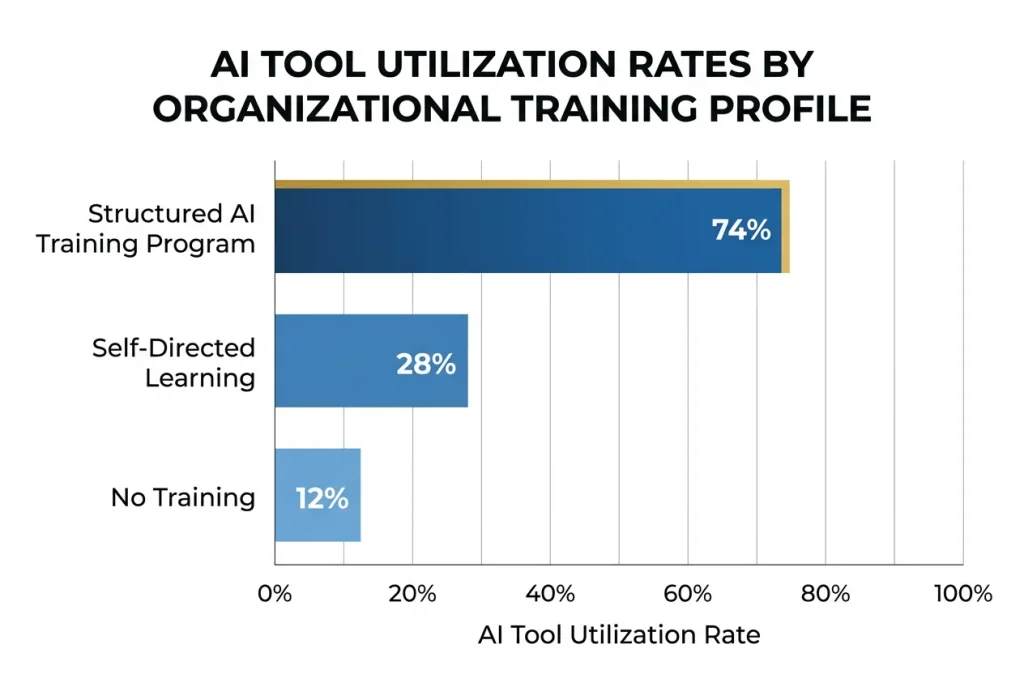
Professional AI training for business is structured around three foundational coverage areas: tool-specific competency (how to operate the specific AI systems deployed in the organization), workflow integration (how each tool applies to the participant's actual daily tasks), and output quality calibration (how to evaluate, refine, and validate AI outputs to the standard required for business use). Programs that omit any of these three areas produce partial adoption — employees who can access the tools but don't integrate them into production workflows.
Understanding these three coverage areas clarifies why professional AI training is materially different from product tutorials or vendor documentation:
Tool-Specific Competency
This layer covers the mechanics of the specific AI systems the organization has deployed — not AI in the abstract. For a business running ChatGPT, Microsoft Copilot, and HubSpot AI features, training covers these three tools specifically: interface navigation, prompt construction, output formats, capability boundaries, and feature configurations relevant to the participant's role. This specificity is what makes training immediately applicable rather than theoretically interesting.
Workflow Integration
Workflow integration training is the highest-leverage layer and the most consistently absent from generic AI programs. It requires pre-training analysis of each role's actual workflow to identify the specific tasks where AI assistance produces the highest time savings and quality improvement — then designs practice exercises built around those exact tasks. A marketing team member practicing AI-assisted email campaign drafting with their own brand voice guidelines and audience context produces adoption outcomes that a generic "write a blog post" exercise cannot replicate. The use case specificity is what converts training attendance into changed daily behavior.
Output Quality Calibration
AI tools produce outputs that range from immediately usable to subtly misleading, depending on prompt quality and model characteristics. Output quality calibration training covers three essential skills: recognizing when AI output quality is insufficient for business use without additional review, identifying the specific prompt adjustments that correct recurring quality failures, and understanding the categories of tasks where AI-generated outputs require mandatory human verification before deployment (financial data, legal content, client-facing communications with factual claims). Organizations that skip this layer accept reputational risk from unreviewed AI-generated errors deployed in production.
The Business Case: What AI Training Delivers in Measurable Terms

The business case for AI training investment is quantifiable across four metrics: utilization rate lift (training-driven adoption increase multiplied against software spend), productivity delta (time recovered per employee per week from AI-assisted workflows), error reduction (quality improvement from calibrated versus uncalibrated AI usage), and competitive durability (the compounding advantage of organization-wide AI proficiency relative to competitors running at minimal adoption rates).
The utilization rate calculation is the most direct. Consider a business spending $2,000 monthly on AI software subscriptions. At 15% team utilization — the typical unstructured deployment outcome — the organization is extracting $300 of effective value from a $2,000 spend. A structured training program that raises utilization to 70% extracts $1,400 of effective value from the same spend — a $1,100 monthly improvement for a one-time training investment that typically costs less than two months of the software subscription itself.
The productivity delta calculation adds additional ROI dimension. For a team of ten where AI-assisted workflows recover an average of 45 minutes per employee per day — a conservative estimate for roles with high writing, research, or data processing components — the weekly recovered capacity is 37.5 hours. At a fully loaded cost of $35/hour, that's $1,312 in recovered productive capacity per week. Per year, that figure is $68,000 in labor redeployment value from a one-time training investment.
These calculations assume nothing about revenue impact from faster output delivery, higher quality client-facing work, or competitive advantage from speed differentials — all of which add compounding value that the utilization and productivity calculations alone don't capture.
Key Takeaways
- Self-directed AI learning produces outlier adoption, not organizational adoption — 80% of a workforce without structured training settles at minimal viable usage rather than performance-optimized usage, regardless of tool quality.
- Three structural components are non-negotiable: role-specific use case mapping, supervised practice with calibrated feedback, and a reinforcement cadence. Programs missing any of these three produce partial adoption that degrades over time.
- IBM research confirms the adoption gap: organizations with structured AI skills development are 1.4x more likely to achieve target AI business outcomes than those relying on self-directed learning.
- The utilization rate calculation is the most direct ROI argument: at 15% adoption a $2,000/month AI spend delivers $300 of effective value; at 70% adoption the same spend delivers $1,400 — a differential that exceeds training investment cost within the first month.
- Output quality calibration is the most frequently skipped layer — and the one that creates reputational risk from unreviewed AI-generated errors deployed in client-facing or financial contexts.
- Competitive durability compounds over time: organizations achieving 70%+ AI adoption in 2026 build workflow advantages that competitors operating at 15% adoption cannot close quickly — the performance gap widens each quarter training investment is deferred.
Conclusion
AI training for business is the mechanism that converts AI software spend from a cost line into a productivity multiplier. The technology exists, the tools are deployed, and the capability is demonstrably available — but organizational value only materializes when a trained workforce operates those tools at performance-optimized utilization rather than minimal viable usage. The cost of that gap, measured in unrealized productivity and software ROI, exceeds the cost of the training required to close it in most businesses within the first quarter.
The starting point is an honest utilization audit: what percentage of your team is actively using AI tools weekly, at what depth, and against which workflows? Authority Solutions® conducts AI readiness assessments that quantify this baseline and design training programs calibrated to close the specific gaps your organization presents. Explore the full AI training services scope, or contact our team to schedule an assessment.
Frequently Asked Questions
What does AI training for business employees actually cover?
Professional AI training covers three areas: tool-specific competency (operating the specific AI systems your organization uses), workflow integration (applying those tools to participants' actual daily tasks), and output quality calibration (evaluating and refining AI outputs to business-use standards). Programs covering all three produce organizational adoption; programs covering only one or two produce partial adoption that typically degrades within 90 days.
How is AI training different from a product tutorial or vendor onboarding?
Vendor onboarding and product tutorials cover how a tool works in general. Professional AI training covers how a tool works for your specific role, applied to your specific workflows, with supervised practice producing your actual work outputs. The role-specificity and supervised practice components are what convert tool awareness into consistent daily usage behavior.
How long does it take to see results from AI training?
Organizations with structured programs typically see measurable utilization rate improvement within 30 days of program completion. Full adoption targets — 65–80% of workforce actively using AI tools in production workflows — are typically achieved within 90 days when the complete program including reinforcement cadence is deployed. Individual productivity improvements are typically visible to participants within the first week of applying trained skills.
What roles benefit most from AI training investment?
Roles with high writing, research, data processing, and communication components produce the highest per-employee ROI from AI training. This typically includes marketing, sales, operations, customer service, and administrative functions. Executive roles benefit most from strategic literacy training that supports AI investment decisions and organization-wide adoption modeling.
How do you measure AI training effectiveness?
The primary metrics are tool utilization rate before and after training (percentage of employees using AI tools actively weekly), productivity benchmarks (time-to-completion for AI-assisted versus manual workflows), and output quality indicators (revision cycles required, error rates in AI-assisted outputs). These metrics establish a baseline before training begins and are measured at 30, 60, and 90 days post-completion.