

AI training services for business provide structured, role-based education that bridges the gap between AI tool deployment and actual team adoption — the phase where most AI investments fail to deliver projected ROI. Without deliberate training architecture, even the most sophisticated AI systems underperform because the humans operating them default to minimal usage, avoid advanced features, or resist adoption entirely. Authority Solutions® delivers AI training programs built around your specific tools, workflows, and organizational roles.
The ROI failure pattern repeats across organizations with predictable consistency: a business invests in AI software, expects productivity gains within 30 days, and instead watches utilization rates stay below 20% while the tools sit largely idle. The technology isn't the problem. The AI training services gap is. Research from McKinsey indicates that technology adoption failure — not technology capability — accounts for the majority of unrealized AI ROI across enterprise deployments. The same pattern holds for small and mid-size businesses at proportionally similar cost.
This guide covers what AI training for business actually addresses, which training formats deliver the highest adoption rates, how to build a role-based curriculum that serves executives and frontline employees differently, and what separates AI training companies that produce lasting behavioral change from those delivering one-time information sessions teams forget within two weeks.
Why AI Training Determines Whether Your AI Investment Delivers ROI
The relationship between AI training quality and AI tool ROI is direct and quantifiable: organizations with structured AI training programs achieve adoption rates 3–5x higher than those relying on self-directed learning, and high-adoption teams extract measurably more value from identical software investments. AI training for employees isn't a soft benefit — it's the primary determinant of whether AI infrastructure investment converts into measurable business output.
This is the uncomfortable reality most technology vendors obscure: their tools are only as valuable as the behavioral change they produce in the people using them. A $50,000 annual AI software investment delivering 15% team utilization produces worse ROI than a $10,000 investment in AI training that drives 80% utilization of the same tools. The training multiplier effect is the most undervalued variable in AI investment analysis.
The resistance patterns that kill AI adoption are well-documented and consistent across industries. McKinsey's research on AI adoption found that technology adoption failure — not technology capability — accounts for the majority of unrealized AI ROI, with organizations citing employee resistance and lack of training as the top two barriers to value realization across surveyed deployments:
- Fear of job displacement: Employees who interpret AI as a threat to their role engage minimally and avoid demonstrating competency in tools they perceive as designed to replace them
- Interface unfamiliarity: Complex AI interfaces without contextual instruction produce immediate avoidance — employees revert to familiar manual processes rather than navigating uncertainty
- Output quality skepticism: Early AI outputs that don't meet expectations — often because of poor prompting, not poor AI — create lasting negative impressions that suppress further experimentation
- Lack of workflow integration: When AI tools exist as standalone applications rather than embedded into daily work processes, usage requires deliberate extra effort — and discretionary effort rarely happens at scale
- Absence of visible leadership adoption: Teams that see executives avoid AI tools draw accurate conclusions about organizational commitment to adoption — and follow suit
| Adoption Barrier | Frequency Across Organizations | Training Intervention That Addresses It |
| Fear of job displacement | 67% of employees report concern | Reframing workshops that position AI as capability amplifier, not replacement |
| Interface unfamiliarity | 71% cite as primary barrier | Hands-on workflow-specific practice with actual tools, not demos |
| Output quality skepticism | 58% after first poor experience | Prompt engineering fundamentals and output calibration techniques |
| Lack of workflow integration | 64% cite no clear use case for role | Role-specific use case mapping in pre-training curriculum design |
| No leadership modeling | 49% cite leadership non-adoption | Executive AI training program that produces visible senior user behavior |
The Compounding Cost of Delayed Training
Most organizations treat AI training as an implementation afterthought — something to schedule after the software is deployed and the problems become visible. This sequencing error is costly. Every week of unstructured AI usage post-deployment produces negative habit formation: employees develop workarounds, settle into minimal-feature usage patterns, and form opinions about AI capability based on unskilled outputs. Reversing those patterns requires significantly more training investment than establishing correct patterns from the start.
The optimal training sequence is: curriculum design → tool deployment → structured training → supervised practice → independent application → reinforcement cadence. Organizations that deploy first and train later consistently report lower final adoption rates and longer time-to-value than those that train before or concurrent with deployment.
Role-Based AI Training: Why One-Size-Fits-All Programs Fail
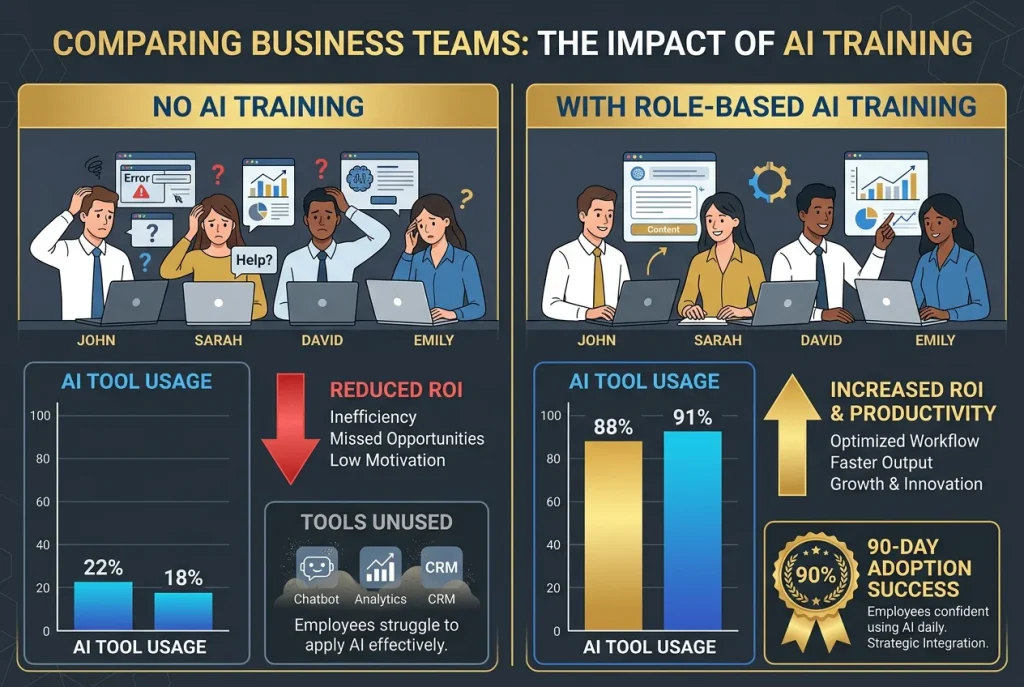
Role-based AI training delivers measurably higher adoption rates than generic programs because it addresses the specific use cases, workflow touchpoints, and output expectations of each organizational function. An executive's AI training requirements — strategic decision support, investment evaluation frameworks, governance literacy — are architecturally different from a marketing team's requirements (content generation, campaign optimization, audience analysis) or an operations team's requirements (process automation, data extraction, reporting). Generic programs satisfy none of these audiences adequately.
The failure mode of generic AI training is predictable: a two-hour overview session that covers what AI is, demonstrates a few general capabilities, and sends employees back to their desks without a clear answer to the question every employee is actually asking — "What do I use this for tomorrow morning?" Without a direct answer to that question, usage doesn't materialize.
Authority Solutions® designs AI training programs around four primary organizational role categories, each with distinct curriculum architecture:
Executive and Leadership Track
Executives don't need to understand how large language models work — they need to understand how AI decisions affect competitive positioning, what AI investments are worth making, how to evaluate AI vendor claims, and what governance frameworks prevent AI risk. Executive AI training focuses on strategic literacy, investment ROI frameworks, risk and compliance considerations, and the behavioral modeling that drives organization-wide adoption.
Core modules: AI investment evaluation methodology, competitive landscape analysis, AI governance and risk frameworks, leading AI-enabled teams, strategic use case prioritization.
Marketing and Sales Track
Marketing and sales teams have the highest density of immediately applicable AI use cases — content generation, audience research, campaign optimization, lead qualification, email personalization, and competitive analysis. This track prioritizes hands-on practice with generative AI tools applied to their actual campaigns and workflows, not hypothetical examples.
Core modules: Prompt engineering for content creation, AI-assisted campaign analysis, generative AI for email and ad copy, AI competitive research techniques, quality control for AI-generated outputs.
Operations and Administration Track
Operations teams benefit most from AI automation and data processing capabilities — extracting information from documents, generating structured reports, automating workflow communications, and using AI to analyze operational data. Training for this track emphasizes workflow integration and practical tool use within existing processes.
Core modules: AI document processing and data extraction, AI-assisted reporting, workflow automation fundamentals, AI tools for scheduling and coordination, output quality verification.
Customer Service and Support Track
Customer-facing teams need training in AI-assisted response generation, using AI to research answers quickly, maintaining brand voice while using AI drafting assistance, and understanding the boundaries of AI-appropriate responses versus human judgment requirements.
Core modules: AI-assisted response drafting, tone and brand voice consistency in AI outputs, escalation judgment frameworks, AI research tools for rapid answer generation, quality review workflows.
| Role Track | Primary AI Tools Covered | Key Outcome | Training Format | Duration |
| Executive / Leadership | Strategic AI platforms, analytics | Investment confidence, governance literacy | Workshop + 1:1 | 4–6 hrs |
| Marketing / Sales | ChatGPT, Claude, Gemini, HubSpot AI | Content velocity, campaign efficiency | Hands-on lab | 8–12 hrs |
| Operations / Admin | Make, Zapier, AI document tools | Process automation, reporting efficiency | Workflow workshops | 8–10 hrs |
| Customer Service | AI drafting tools, CRM AI features | Response speed, quality consistency | Live practice | 6–8 hrs |
| Technical / IT | API integration, AI development tools | Implementation, customization | Technical deep-dive | 12–16 hrs |
Generative AI Training: Building Team Competency in the Tools Reshaping Every Function

Generative AI training — specifically building team competency in LLM-based tools like ChatGPT, Claude, and Gemini — is the single highest-ROI training investment most businesses can make in 2026. These tools are already embedded in business software across every function; the performance gap between teams using them at 10% of capability versus 70%+ is directly attributable to training depth, not tool access. Prompt engineering proficiency alone can increase AI output quality by a measurable factor across content creation, research, analysis, and communication workflows.
The generative AI training gap is wider than most organizations recognize. The median business professional who has "used" AI tools has submitted a few prompts, received inconsistent outputs, formed an impression of limited capability, and settled into occasional use for simple tasks. Structured generative AI training reveals a competency ceiling that's dramatically higher than casual use suggests — and the gap between that ceiling and current usage represents unrealized productivity every month training is delayed.
Prompt Engineering: The Highest-Leverage Skill in Generative AI Training
Prompt engineering is the practice of structuring AI inputs to consistently produce high-quality, on-target outputs. It's the skill that determines whether an employee gets usable content from an AI tool in one attempt or fifteen — and whether that content requires significant editing or functions as a strong first draft.
The core principles that structured prompt engineering training covers:
Role specification: Instructing the AI to adopt a specific perspective ("You are a senior marketing strategist reviewing a campaign brief") produces outputs calibrated to that expertise level — dramatically improving quality for specialized tasks.
Context loading: Providing comprehensive context before the task instruction (brand guidelines, audience description, previous content examples) reduces iteration cycles and output editing time.
Output format specification: Explicitly defining the desired format (word count, structure, tone, what to include and exclude) eliminates the most common source of AI output frustration — receiving a response that's technically correct but wrong in format.
Chain-of-thought structuring: For complex analytical tasks, instructing the AI to work through reasoning before reaching conclusions improves accuracy and allows quality verification at each reasoning step.
Iteration frameworks: Teaching employees how to refine outputs through targeted follow-up prompts rather than starting over from scratch — a skill that reduces total prompt-to-final-output time by 40–60% for experienced practitioners.
Key Takeaways
- AI training determines ROI realization: Organizations with structured training programs achieve adoption rates 3–5x higher than those relying on self-directed learning — making training investment the highest-leverage variable in AI ROI analysis.
- Role-based curricula outperform generic programs because they answer the question every employee needs answered: "What do I use this for tomorrow morning?" Generic training sessions satisfy no role's specific needs adequately.
- Train before or concurrent with deployment, not after: Organizations that deploy first and train later consistently report lower final adoption rates and longer time-to-value due to negative habit formation in the unstructured period.
- Prompt engineering proficiency is the highest-ROI individual skill in generative AI adoption — it determines output quality consistency, reduces iteration time by 40–60%, and unlocks advanced AI capabilities inaccessible to casual users.
- Executive adoption modeling is a non-negotiable adoption driver: Teams that observe senior leadership avoiding AI tools draw accurate organizational commitment conclusions and mirror that behavior at scale.
- AI training is not a one-time event: Generative AI capabilities evolve on 3–6 month cycles, requiring a structured reinforcement cadence to maintain organizational competency as the underlying technology shifts.
How to Build an AI Training Program That Produces Lasting Behavioral Change
Effective AI training programs are architecturally distinct from information sessions: they produce lasting behavioral change through hands-on practice with actual tools, role-specific use case application, built-in reinforcement cadence, and internal champion systems that sustain adoption momentum after the formal training engagement ends. Programs that deliver information without behavioral practice produce awareness, not adoption — and awareness doesn't move productivity metrics.
The difference between AI training companies that deliver measurable adoption outcomes and those delivering forgettable sessions is program architecture. Specifically: whether the training is designed around behavioral change or information transfer. Most organizations default to information transfer — slide decks, demonstrations, Q&A sessions — because it's easier to design and deliver. Behavioral change requires significantly more sophisticated program architecture.
Authority Solutions® builds AI training programs on a five-component framework that has produced measurable adoption outcomes across business deployments in Houston and nationally:
Component 1: AI Readiness Assessment Before curriculum design begins, an organizational audit identifies current tool utilization rates by role and department, maps which AI capabilities exist in currently-deployed software but aren't being used, quantifies the productivity delta between current usage and full-capability usage, and surfaces the specific resistance patterns that need to be addressed in training design.
Component 2: Role-Based Curriculum Design Using readiness assessment data, a modular curriculum is designed with role-specific tracks that connect training content directly to participants' daily workflows. Each module includes a use case that participants apply to an actual work task during the session — not a hypothetical exercise — ensuring immediate relevance and beginning the habit formation process in training.
Component 3: Hands-On Practice Sessions Live training sessions use a practice-first methodology: participants apply AI tools to real work tasks, observe outputs, identify quality gaps, and learn refinement techniques in real time. Facilitators provide immediate feedback on prompting strategy, output evaluation, and workflow integration. Passive observation of demonstrations is minimized; active application is maximized.
Component 4: Internal AI Champion Program Post-training, two to three employees per department are identified and developed as internal AI champions — advanced users who receive additional training depth and serve as the first resource their colleagues consult for AI application questions. Champion programs create sustained peer-to-peer adoption momentum that extends organizational value far beyond the formal training period.
Component 5: Reinforcement Cadence Monthly micro-training sessions (30–60 minutes) covering new AI tool capabilities, advanced techniques, and real examples from the organization's own AI usage sustain adoption and prevent skill atrophy. Quarterly competency assessments measure adoption progress against baseline and identify where additional support is needed.
| Program Component | Primary Outcome | Timeline | Success Metric |
| AI Readiness Assessment | Baseline utilization data, resistance identification | Week 1 | Usage rate by role documented |
| Role-Based Curriculum Design | Relevant, immediately applicable training content | Weeks 1–2 | Relevance rating ≥ 4/5 from participants |
| Hands-On Practice Sessions | Behavioral habit formation, confidence | Weeks 2–4 | Post-training usage rate vs. baseline |
| AI Champion Program | Sustained peer-to-peer adoption momentum | Weeks 4–8 | Champion engagement rate, peer consultation frequency |
| Reinforcement Cadence | Sustained adoption, skill advancement | Ongoing monthly | 90-day and 180-day utilization benchmarks |
Most Authority Solutions® AI training engagements produce measurable utilization rate improvement within 30 days of program completion, with full adoption targets typically achieved within 90 days when the complete five-component program is deployed.
Conclusion
AI training services represent the highest-leverage investment in maximizing ROI from AI infrastructure already deployed — or planned for deployment. The tools exist. The capability is there. The gap between current organizational AI utilization and potential utilization is almost entirely a training problem, and it has a direct, quantifiable cost in unrealized productivity every month it goes unaddressed. Organizations that build structured AI training programs now establish compounding advantages over competitors whose teams use sophisticated tools at a fraction of their capability.
The right training program starts with understanding your organization's specific adoption barriers, role-specific use cases, and current utilization baseline. Authority Solutions® delivers AI training programs custom-built around your actual tools, workflows, and team structure — with measurable adoption benchmarks established before training begins. Contact our team to discuss an AI training assessment and program design tailored to your organization's specific requirements.
Frequently Asked Questions
What are AI training services for business?
AI training services for business provide structured education programs that build employee competency in AI tools relevant to their specific roles and workflows. Unlike generic technology orientation, professional AI training is designed around behavioral change — producing measurable increases in tool adoption rates and output quality that translate directly into productivity gains and ROI realization from AI investment.
Why do businesses need AI training if AI tools are intuitive to use?
Interface intuitiveness and performance-optimized usage are different things. Most business professionals who access AI tools without training use 10–20% of available capability — not because the tools are hard, but because advanced features, prompting techniques, and workflow integration aren't self-evident. Structured training increases utilization depth and output quality in ways that self-directed exploration rarely achieves at organizational scale.
What is the ROI of investing in AI training for employees?
AI training ROI is calculated against two baselines: current tool utilization rate (training multiplies effective output from existing software spend) and productivity hours recovered per role. Organizations with structured programs achieve 3–5x higher adoption rates than unstructured deployments — meaning a training investment that drives 60% utilization from 15% baseline produces 4x more value from the same AI software spend.
What does AI upskilling training typically cover?
AI upskilling training covers the specific tools, use cases, and techniques relevant to each participant's role. Common modules include generative AI fundamentals, prompt engineering for business applications, AI tool integration into daily workflows, output quality evaluation, and responsible AI use principles. Role-specific tracks address marketing, operations, customer service, and executive applications with distinct curriculum for each.
How long does an AI training program for business take?
Program duration varies by scope and depth. Initial role-based training sessions range from 4–16 hours depending on role complexity and tool coverage. Full organizational AI training programs — including readiness assessment, multi-track curriculum delivery, champion program development, and reinforcement cadence setup — typically complete initial deployment within 4–8 weeks.
What AI tools are covered in Authority Solutions® training programs?
Training programs are designed around your organization's deployed AI stack. Common platforms covered include ChatGPT and OpenAI tools, Anthropic Claude, Google Gemini, Microsoft Copilot, HubSpot AI features, marketing automation AI capabilities, and workflow automation platforms (Make, Zapier). Custom tool-specific training is developed for proprietary or industry-specific AI systems.
What's the difference between AI training and AI consulting?
AI consulting focuses on strategy, platform selection, and implementation architecture — the decisions made before AI tools are deployed. AI training focuses on behavioral adoption — ensuring the humans using deployed tools do so competently and consistently. Both services are components of a complete AI transformation; training without strategic consulting risks training teams on the wrong tools, while consulting without training risks deploying the right tools that nobody uses.
How do you measure whether AI training is working?
Key performance indicators for AI training effectiveness include: tool utilization rate before and after training (percentage of employees actively using AI tools weekly), output quality metrics (time from prompt to publishable output, editing revision cycles), productivity benchmarks (tasks completed per unit time for AI-assisted workflows), and adoption durability (90-day and 180-day utilization rates versus immediate post-training measurement).
Can AI training be delivered remotely for distributed teams?
Yes. Authority Solutions® delivers AI training programs in remote, in-person, and hybrid formats. Remote delivery uses collaborative virtual training environments that replicate hands-on practice sessions — screen sharing, live tool practice, breakout rooms for role-specific application exercises, and recorded session libraries for asynchronous reinforcement. Remote delivery maintains comparable adoption outcomes to in-person programs when the hands-on practice methodology is preserved.
How often should businesses update their AI training programs?
Generative AI capabilities evolve on approximately 3–6 month cycles, with major capability expansions occurring multiple times per year. AI training programs should include a quarterly refresh cadence that covers new tool capabilities, advanced techniques, and updated best practices. The internal AI champion program provides monthly peer-to-peer capability sharing between formal quarterly updates.