
AI CRM for small business gives teams of five to fifty people the same lead scoring, pipeline prediction, and automated follow-up capabilities that enterprise companies pay six figures to maintain. Modern AI-powered CRM platforms have eliminated the complexity and cost barriers that kept intelligent customer management out of reach for SMBs, meaning a three-person sales team can now prioritize leads, forecast revenue, and automate nurture sequences with the same precision as a Fortune 500 sales operation.
The gap between how enterprise companies manage customer relationships and how small businesses do it used to be enormous. Enterprise had dedicated CRM administrators, custom integrations, and predictive analytics dashboards. Small businesses had spreadsheets, sticky notes, and the hope that someone would remember to follow up. AI CRM solutions have compressed that gap dramatically, and the businesses catching on fastest are pulling ahead of competitors who still think CRM is just a fancy contact list.
Here's what changed. AI features that required custom development and enterprise licensing five years ago are now built into platforms that cost less than most businesses spend on coffee each month. The question isn't whether your small business can afford AI CRM. It's whether you can afford to compete without it.
Why Small Businesses Need AI CRM More Than Enterprise Companies Do
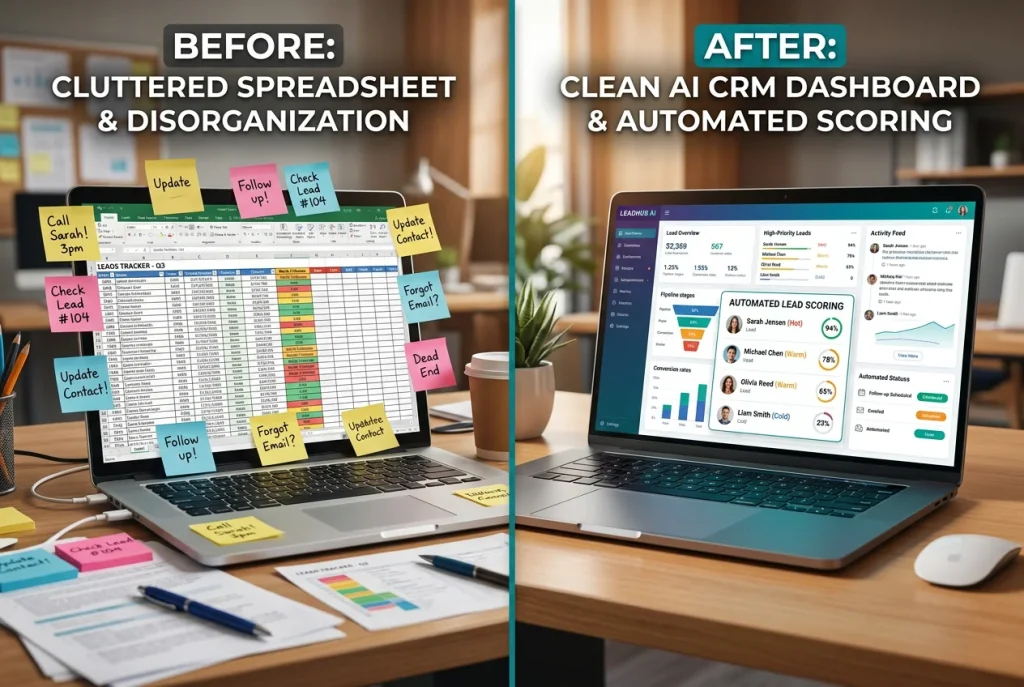
Enterprise companies have enough staff to compensate for CRM inefficiency. A Fortune 500 sales team can afford dedicated people to clean data, score leads manually, and chase follow-ups. Small businesses can't. Every lead that falls through the cracks, every follow-up that happens too late, and every hour spent on manual data entry hits harder when you have five salespeople instead of fifty. AI CRM doesn't just help small businesses. It levels a playing field that's been tilted against them.
The irony is that most AI CRM marketing targets enterprise buyers. But the businesses that benefit most from intelligent automation are the ones with the least capacity to waste. When your team wears multiple hats, AI handles the tasks that don't require human judgment so your people can focus on the tasks that do.
The Small Business CRM Pain Points AI Solves
Every small business owner recognizes at least three of these:
- Leads fall through cracks because nobody owns follow-up accountability and there's no system flagging when contacts go cold
- Data entry eats hours that sales staff should spend selling, with manual logging of calls, emails, and meeting notes consuming 20-30% of productive time
- No visibility into pipeline health because the "forecast" is whatever the sales manager thinks will close based on gut feel rather than data
- Follow-up is inconsistent depending on who's busy, who remembers, and whether the sticky note on someone's monitor is still relevant
- Can't prioritize leads because all incoming prospects look the same without scoring, meaning high-intent buyers wait in the same queue as tire-kickers
AI CRM addresses every one of these systematically. Not with more features your team won't use, but with intelligence that works silently in the background making your existing process smarter.
| Small Business Pain | Manual Workaround | AI CRM Solution |
| Leads falling through cracks | Daily spreadsheet reviews, maybe | Automated alerts when leads go cold |
| Manual data entry | Sales team logs everything by hand | Auto-capture from email, calls, forms |
| No pipeline visibility | Sales manager asks around each week | Real-time dashboard with AI forecasting |
| Inconsistent follow-up | Depends on individual discipline | Automated sequences triggered by behavior |
| Can't prioritize leads | Treat everyone the same | AI scoring ranks leads by conversion likelihood |
| Revenue forecasting | Best guess in a spreadsheet | Weighted pipeline with probability modeling |
What AI CRM Actually Looks Like for a 5-50 Person Company
For small businesses, AI CRM means three capabilities running automatically: lead scoring that tells you who's ready to buy so your limited sales team talks to the right people first, automated follow-up sequences that nurture leads without anyone manually sending emails, and pipeline intelligence that shows you which deals will actually close so you can forecast revenue accurately instead of guessing.
Let's get specific. "AI CRM" sounds impressive but vague. Here's what it actually does in a small business context, stripped of enterprise jargon.
Lead Scoring That Works Without a Data Scientist
Enterprise lead scoring requires custom models, dedicated analysts, and months of tuning. AI CRM for small business uses pre-built models that learn from your data automatically:
- Engagement scoring tracks which leads open emails, visit your website, download content, and interact with your chatbot, assigning points automatically
- Fit scoring evaluates whether a lead matches your ideal customer profile based on company size, industry, location, and other attributes you define once
- Intent signals detect when leads exhibit buying behavior like visiting your pricing page multiple times, comparing service options, or searching for competitor alternatives
- Combined scoring merges engagement and fit data into a single priority number your team can sort by every morning to know exactly who to call first
The practical result? Your best salesperson stops wasting time on leads that were never going to convert and starts every day with a ranked list of prospects most likely to say yes.
Automated Follow-Up That Feels Personal
The biggest revenue leak in small business sales is inconsistent follow-up. AI CRM solves this without requiring your team to become email marketing experts:
- Behavioral triggers send the right message at the right time based on what the lead actually does, not an arbitrary calendar schedule
- Dynamic content personalizes email and SMS sequences using CRM data so each message references the lead's specific situation, industry, or expressed interest
- Escalation rules automatically alert sales staff when a nurtured lead takes a high-intent action like requesting a quote, visiting the pricing page three times, or responding to a nurture email
- Multi-channel coordination ensures leads receive consistent messaging across email, SMS, and chatbot without getting the same message on every channel simultaneously
Pipeline Intelligence for Accurate Forecasting
Small business owners need to know what revenue is coming next month. AI CRM replaces gut-feel forecasting with data:
- Deal probability scoring assigns each opportunity a likelihood of closing based on stage progression speed, engagement patterns, and comparison to historically won and lost deals
- Stall detection flags deals that have stopped progressing before your sales manager notices, triggering intervention before the deal dies quietly
- Revenue projection calculates weighted pipeline value so you can see realistic forecasted revenue instead of best-case totals that never materialize
| AI CRM Feature | Enterprise Version | SMB Version | Same Outcome? |
| Lead scoring | Custom models, data science team | Pre-built models learning from your data | Yes, at 90% accuracy |
| Follow-up automation | Marketing ops team + enterprise platform | Built-in sequences with behavioral triggers | Yes, simpler to manage |
| Pipeline forecasting | BI team + custom dashboards | AI-generated forecasts in CRM dashboard | Yes, less customizable but equally accurate |
| Data enrichment | Third-party integrations, manual append | Built-in enrichment from public data sources | Close, less data depth |
| Reporting | Custom reports built by analysts | Pre-built templates with AI insights | Yes, less flexible but immediately useful |
Choosing the Right AI CRM Platform for Your Small Business

Evaluate AI CRM platforms across five criteria: ease of setup (can your team be productive in under two weeks?), AI feature depth (lead scoring, automation, and forecasting built-in, not add-on pricing), integration capability (connects to your email, phone, website forms, and existing tools), scalability (grows with you from 5 to 50 users without platform migration), and total cost (including training time and integration setup, not just monthly subscription).
The platform landscape changes fast, but the evaluation criteria don't. Use this framework regardless of which specific platforms you're comparing.
What to Prioritize
Setup speed matters more than feature count. A platform with 200 features your team will never configure is worse than one with 20 features that work out of the box. Small businesses need CRM value within the first two weeks, not the first two quarters.
Built-in AI beats bolt-on AI. Some platforms charge extra for AI features or require third-party integrations to get lead scoring and automation. Look for platforms where intelligence is native to the core product, not an upsell.
Mobile experience isn't optional. Your sales team lives on their phones. If the CRM mobile app is clunky or limited, adoption will die regardless of how powerful the desktop version is.
Integration with your communication tools is critical. Your CRM must connect to your email provider, phone system, website forms, and any chatbot or scheduling tool you use. Data that requires manual transfer between systems won't get transferred.
Common Mistakes Small Businesses Make
The biggest mistake isn't choosing the wrong platform. It's implementing the right platform wrong:
- Over-customizing from day one instead of using default workflows and adjusting based on real usage data
- Skipping data migration and starting with an empty CRM that lacks the historical context AI needs to generate useful insights
- Not assigning a CRM champion on the team who owns adoption, troubleshooting, and ongoing optimization
- Buying enterprise tier when the mid-market or startup tier has every AI feature you'll actually use in the first year
| Evaluation Criteria | Must Have | Nice to Have | Skip If Missing |
| Setup time | Under 2 weeks to basic productivity | Same-day quick start | Requires consultant for basic setup |
| AI lead scoring | Built-in, learns from your data | Custom scoring model options | Only available as paid add-on |
| Automation | Email + SMS sequences with triggers | Multi-channel with conditional logic | Requires separate automation platform |
| Mobile app | Full functionality, offline capable | Push notifications for hot leads | Limited or no mobile version |
| Integrations | Email, phone, forms, calendar | Accounting, chatbot, social | Requires custom development for basics |
Key Takeaways
- AI CRM levels the competitive playing field by giving small businesses the same lead scoring, pipeline forecasting, and automated follow-up capabilities that enterprise companies maintain with dedicated teams and six-figure budgets
- Small businesses benefit more from AI CRM than enterprise companies because every lost lead, missed follow-up, and hour of manual data entry hits harder when you have a five-person team instead of fifty
- Three AI capabilities matter most for SMBs including lead scoring that prioritizes your limited team's time, automated follow-up that nurtures without manual effort, and pipeline intelligence that replaces gut-feel forecasting with data
- Pre-built AI models eliminate the need for data scientists by learning from your business data automatically, delivering lead scoring accuracy comparable to custom enterprise models within weeks of initial setup
- Platform selection should prioritize setup speed over feature count because a CRM your team actually uses in two weeks delivers more value than a powerful system that takes months to configure and never reaches full adoption
- Implementation matters more than platform choice with the biggest mistakes being over-customization, skipping data migration, not assigning a CRM champion, and buying enterprise tiers with features you won't use in the first year
Getting Started: Your First 30 Days with AI CRM
Spend days one through five on data migration and basic setup, days six through fifteen on team training and workflow activation, and days sixteen through thirty on optimization based on real usage. The businesses that rush setup and skip training spend months fixing problems. The businesses that invest thirty focused days in proper onboarding extract AI CRM value for years.
The first month determines whether your AI CRM becomes a revenue-driving system or an expensive contact list your team resents. Here's the path that works.
Week 1: Foundation. Import your existing contacts, deals, and communication history. Don't start from zero. AI features need historical data to generate useful insights. Clean obvious duplicates and set up basic pipeline stages matching your actual sales process, not some theoretical ideal.
Week 2: Activation. Turn on lead scoring with default settings. Configure your first automated follow-up sequence for new leads. Connect your email and phone so activity logging happens automatically. This is where the time savings start.
Week 3: Team adoption. Focus entirely on making sure every team member uses the CRM daily. Address friction points immediately. The goal isn't perfection. It's habit formation. A partially adopted CRM is worse than no CRM because it creates data gaps.
Week 4: Optimization. Review which leads scored highest and whether those scores matched reality. Adjust scoring criteria based on your first closed deals. Refine automation sequences based on open rates and response patterns. This is where AI starts compounding because it's learning from your actual business patterns.
The gap between businesses that extract genuine competitive advantage from AI CRM solutions and those that don't almost always traces back to implementation quality, not platform choice. Contact Authority Solutions to build an AI CRM implementation plan sized for your team and budget.
Conclusion
Small businesses competing against companies with bigger sales teams and bigger budgets need every advantage available. AI CRM delivers the intelligence advantage by automating the work that doesn't require human judgment and surfacing the insights that make human judgment sharper. The technology that used to separate enterprise from SMB is now accessible to any business willing to invest thirty days in proper implementation.
Your competitors with five-person sales teams are already using AI to prioritize leads, automate follow-up, and forecast revenue. Every month without AI CRM is a month your team works harder instead of smarter. Contact Authority Solutions to implement AI CRM that gives your small business enterprise-level intelligence without enterprise-level complexity or cost.
Frequently Asked Questions
How much does AI CRM cost for a small business?
AI CRM platforms with built-in intelligence features typically range from affordable monthly subscriptions per user. Many platforms offer startup or SMB tiers with full AI capabilities at significantly lower rates than enterprise pricing.
Can AI CRM work with just two or three salespeople?
Absolutely. AI CRM actually delivers proportionally more value for smaller teams because each person handles more leads and wears more hats. Automation and scoring multiply the effectiveness of every team member.
How long until AI lead scoring becomes accurate for my business?
Most AI scoring models need 60-90 days of data to calibrate effectively. You'll see useful prioritization within the first month, with accuracy improving significantly as the system learns from your specific win and loss patterns.
Do I need to hire someone to manage AI CRM?
No dedicated CRM administrator is needed for small business implementations. Assign a CRM champion from your existing team who spends two to three hours weekly on optimization and troubleshooting.
Will my team actually use it or will it become shelfware?
Adoption depends on implementation quality. The two-week setup followed by focused training approach described above achieves significantly higher adoption than dump-and-pray implementations where teams receive login credentials without guidance.
Can AI CRM replace my current spreadsheet system?
Yes, and it should. Spreadsheets can't score leads, trigger automated follow-ups, predict deal outcomes, or alert you when leads go cold. The migration is worth the effort.
Does AI CRM integrate with my existing email and phone system?
Modern AI CRM platforms integrate with Gmail, Outlook, most VoIP phone systems, and popular business tools. Check integration availability for your specific tools before selecting a platform.
What data does AI CRM need to work effectively?
At minimum: contact information, deal stage history, email and call activity, and website form submissions. The more historical data you migrate, the faster AI features become useful.
Is AI CRM secure enough for customer data?
Reputable platforms provide enterprise-grade security including encryption, access controls, and compliance certifications. Evaluate security features during selection and ensure the platform meets your industry requirements.
Can I switch AI CRM platforms later if I outgrow the first one?
Yes, though migration involves effort. Choose a platform with data export capabilities and avoid proprietary formats that lock your data in. This makes future transitions manageable.