

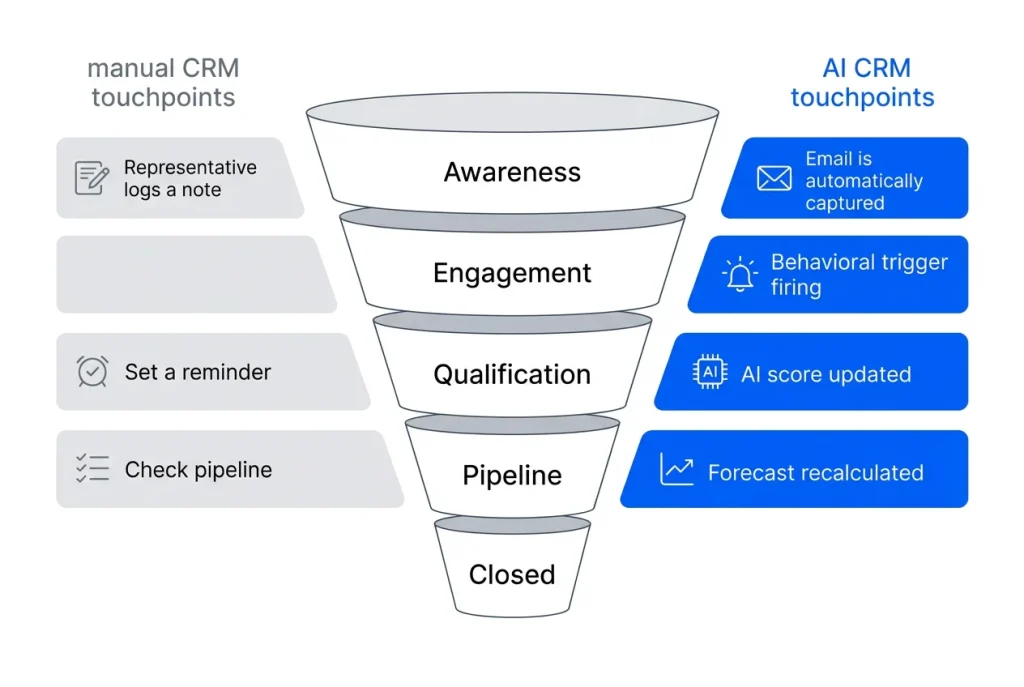
An AI-powered CRM is a customer relationship management system that uses machine learning, behavioral analysis, and workflow automation to manage the sales process proactively — capturing data automatically, scoring leads by conversion probability, and triggering follow-up actions based on prospect behavior rather than rep memory. The fundamental difference from traditional CRM is architectural: where conventional systems record what happened, AI CRM systems act on what's happening.
Sales teams running traditional CRM tools consistently describe the same failure pattern: incomplete records because data entry is burdensome, missed follow-ups because reminder discipline varies across reps, and inaccurate pipeline forecasts because stage weighting doesn't reflect actual deal health. These aren't rep performance failures — they're system design failures. Traditional CRM was built to store information; AI-powered CRM is built to drive revenue. This article explains the architectural distinction, which AI CRM capabilities produce the highest sales impact, and how the transition from traditional to intelligent customer management works in practice.
For a complete guide to platform options and implementation strategy, see the full AI CRM solutions for business overview.
The Core Architectural Difference: Reactive vs. Proactive CRM
Traditional CRM is a reactive system: it records what sales reps input and surfaces it back when reps request it. AI-powered CRM is a proactive system: it captures data automatically from connected sources, analyzes it continuously against conversion probability models, and initiates actions — alerts, sequences, score updates — without waiting for human input. This shift from reactive to proactive fundamentally changes what CRM delivers as a sales tool.
The reactive model's dependency on rep discipline is its fatal flaw at scale. A system that only knows what reps remember to enter will always have incomplete records, inconsistent follow-up, and forecast accuracy that reflects human behavior — which is to say, variable and error-prone. The proactive AI CRM model removes the discipline dependency entirely: data enters the system from source — emails, calendar events, call logs, web activity — automatically, without any rep action required.
The practical implications of this difference show up across five key sales functions:
Data completeness: Traditional CRM records average 40–60% completeness on contact activity fields because manual entry is systematically skipped under workload pressure. According to HubSpot's State of Sales research, sales reps report spending over 21% of their day on data entry — activity that AI CRM eliminates through automatic capture from source systems. AI CRM approaches 95%+ completeness by capturing from source systems without rep involvement.
Follow-up consistency: Traditional CRM depends on manually set reminders that are skipped, snoozed, or missed when rep workload peaks. AI CRM triggers follow-up sequences automatically based on behavioral conditions that fire regardless of rep attention.
Lead prioritization: Traditional CRM shows leads sorted by recency or rep assignment — not by conversion probability. AI CRM surfaces the highest-score, highest-intent leads at the top of every rep's daily view, directing effort to where it converts most reliably.
Forecast accuracy: Traditional stage-weighted forecasting applies a fixed close percentage to each pipeline stage regardless of individual deal signals. AI forecasting applies deal-specific probability scores based on engagement patterns, historical comparables, and stage velocity — producing materially more accurate predictions.
Personalization: Traditional CRM enables template-based outreach. AI CRM enables behavior-adapted outreach — messages that reference what a prospect specifically engaged with, timed to when behavioral signals indicate highest receptivity.
| Sales Function | Traditional CRM Performance | AI CRM Performance | Impact Differential |
| Data completeness | 40–60% of activity fields populated | 90–95% automatically captured | 1.5–2.4x more complete records |
| Follow-up consistency | Rep-dependent — variable | Trigger-based — consistent | Eliminates follow-up gaps entirely |
| Lead prioritization | Recency or assignment order | ML-scored by conversion probability | Higher-conversion leads worked first |
| Forecast accuracy | 40–60% accuracy (stage-weighted) | 75–92% accuracy (AI-analyzed) | Boardroom-credible revenue planning |
| Outreach personalization | Template-based | Behavior-adapted, signal-timed | Higher open and response rates |
How AI Lead Scoring Works Inside a CRM System
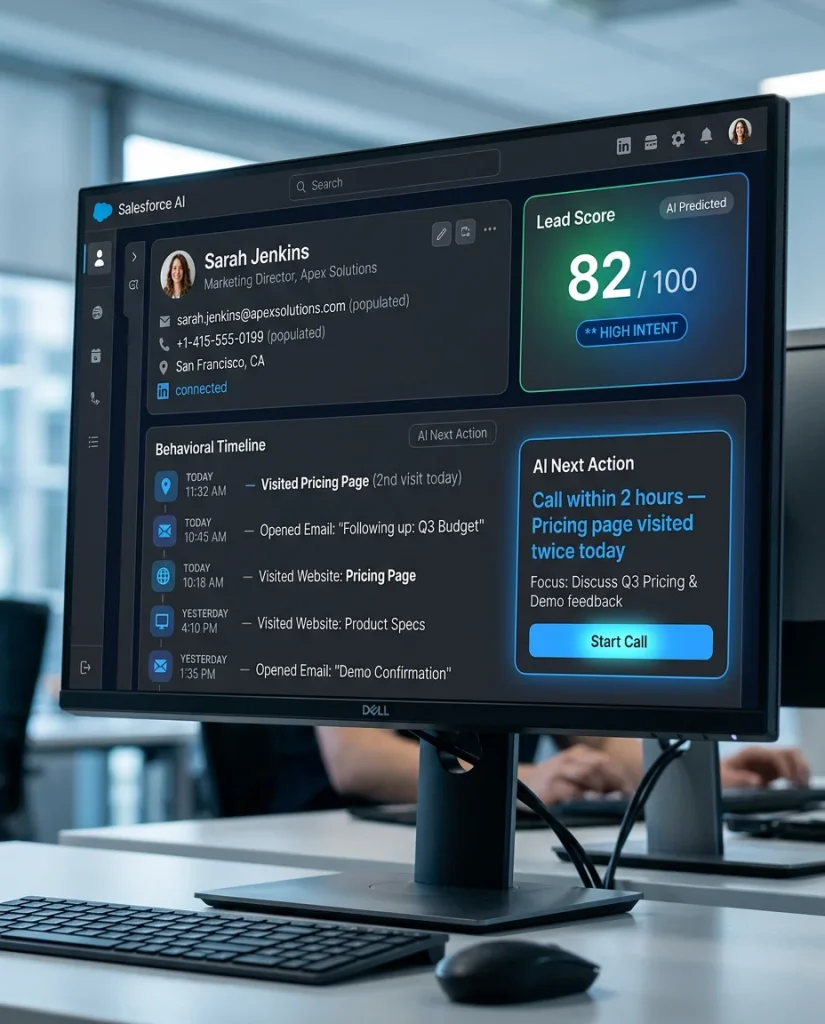
AI lead scoring inside a CRM assigns each contact a real-time conversion probability score by training machine learning models on your historical win-loss data and evaluating current prospects against the behavioral and demographic patterns associated with your actual closed deals. The model updates continuously as prospects engage — a score isn't a static assessment, it's a live reflection of current buying intent signals relative to your specific sales history.
This continuous updating characteristic is what makes AI scoring meaningfully different from static demographic scoring models that assign points based on job title and company size. A prospect who matched your ideal customer profile but went dark for 60 days should score differently than one who visited your pricing page twice this week. AI scoring reflects current behavioral reality; static scoring models do not.
The signal categories feeding a well-configured lead scoring model fall into three tiers:
Behavioral signals (highest predictive weight, ~60% of model):
- Email open frequency and click behavior over trailing 30 days
- Website pages visited — with pricing, case study, and service pages carrying significantly higher weight than blog or homepage visits
- Return visit frequency and recency — prospects who return unprompted are demonstrating sustained interest
- Content assets accessed — ROI calculators and comparison guides indicate decision-phase intent
- Response speed to previous outreach
Fit signals (moderate weight, ~25% of model):
- Industry vertical alignment with historical closed-won customer base
- Company size and revenue band matching your typical client profile
- Job title and decision-making authority
- Geographic proximity for locally-delivered services
Engagement velocity signals (momentum indicator, ~15% of model):
- Score trajectory over the past 7–14 days — accelerating scores indicate building intent
- Multi-channel simultaneous engagement — prospect active across email, web, and social simultaneously
- Re-engagement after dormancy — a previously cold contact resuming activity is a high-conversion signal
Scoring models become more accurate over time. The first 90 days of operation use industry-calibrated defaults; after 6–12 months of training against your actual conversion data, predictive accuracy typically improves to 85–90%, producing a forecast and prioritization tool that genuinely reflects your specific market and customer base.
What AI CRM Capabilities Produce the Highest Sales Impact
Four AI CRM capabilities consistently deliver the highest measurable sales impact across business deployments: automated data capture (directly addresses the data completeness failure of traditional CRM), behavioral trigger sequences (eliminates the follow-up gap where most sales are lost), predictive deal alerts (surfaces at-risk opportunities before deals go cold), and AI revenue forecasting (replaces guess-based stage weighting with data-calibrated probability). Deploying these four capabilities in the first 90 days of an AI CRM implementation captures the majority of available ROI.
Understanding which capabilities to activate first — and in what sequence — matters because AI CRM platforms typically offer more features than any sales team can effectively adopt simultaneously. The prioritization framework: start with capabilities that eliminate existing failure modes (data completeness, follow-up gaps), then layer in capabilities that add new intelligence (scoring, forecasting) as adoption of foundational features stabilizes.
Automated data capture eliminates the primary failure mode of traditional CRM. Connect email, calendar, and phone systems to the CRM so all interactions are logged without rep action. This single configuration change typically produces a 30–40% increase in pipeline visibility within 30 days — not because more sales activity is occurring, but because activity that was previously invisible is now recorded.
Behavioral trigger sequences replace calendar-based follow-up reminders with event-based automation. When a prospect opens a proposal email, the CRM triggers a same-day rep notification. When a prospect visits the pricing page, the next outreach references that specific engagement. These context-aware touchpoints consistently produce higher response rates than generic cadence-based follow-up.
Predictive deal alerts flag pipeline opportunities showing deterioration signals — declining engagement, extended stage duration, unresponsive contact — before they are formally lost. Early intervention on at-risk deals recovers revenue that traditional CRM processes never surface until the deal is already gone.
AI revenue forecasting replaces pipeline reviews built on rep optimism with data-calibrated probability assessments. Sales leadership can present board-level forecasts with documented accuracy benchmarks rather than defending estimates against skeptical questioning each quarter.
Key Takeaways
- Traditional CRM is reactive; AI CRM is proactive — the architectural shift from recording to acting is what transforms CRM from an administrative tool into a revenue driver.
- Data completeness is the first and most impactful improvement: automatically capturing from email, calendar, and call systems raises field completeness from 40–60% to 90–95%, giving every downstream capability better input data.
- AI lead scoring reflects live behavioral signals, not static demographics — continuous model updating against your actual conversion data produces prioritization accuracy that improves every quarter.
- Behavioral trigger sequences recover the follow-up gap where the majority of B2B sales are lost — context-aware, signal-timed outreach consistently outperforms fixed-cadence templates.
- Forecast accuracy improves from 40–60% to 75–92% when AI probability scoring replaces stage-weighted estimation — a shift that changes the credibility of revenue planning at every organizational level.
- Deploy foundational capabilities first: automated data capture and trigger sequences address existing failure modes before layering in scoring and forecasting intelligence for maximum adoption velocity.
Conclusion
The transition from traditional to AI-powered CRM isn't a platform upgrade — it's an architectural change in how your business manages sales pipeline. Traditional CRM records the past; AI CRM operates in the present, capturing data automatically, scoring prospects continuously, and taking action on behavioral signals without requiring rep intervention at every step. The sales teams that build on this infrastructure consistently outperform those managing equivalent opportunity volume on manual processes.
The right entry point is identifying where your current CRM fails most visibly — incomplete records, inconsistent follow-up, unreliable forecasts — and deploying AI capabilities that address those specific failure modes first. Authority Solutions® implements AI CRM solutions for business with a deployment sequence designed to deliver measurable pipeline improvement within 30 days. Contact our team to discuss which AI CRM capabilities address your highest-priority sales process gaps.
Frequently Asked Questions
What makes a CRM "AI-powered"?
An AI-powered CRM uses machine learning models to score leads by conversion probability, captures activity data automatically from email and calendar integrations, triggers follow-up sequences based on behavioral signals, and generates predictive revenue forecasts — all without requiring manual rep input for each action. The defining characteristic is proactive intelligence versus passive record-keeping.
Does an AI CRM replace my sales team?
No. AI CRM eliminates the administrative tasks that consume sales rep time — data entry, reminder management, report compilation — and redirects that capacity to selling activity. Reps using AI CRM work fewer hours on administration and more hours on conversations, proposals, and relationship management. AI CRM amplifies rep effectiveness; it doesn't replace human judgment in complex sales interactions.
What data does an AI CRM use to score leads?
AI lead scoring models draw from behavioral signals (email engagement, website activity, content downloads), demographic and firmographic fit (industry, company size, job title), and engagement velocity (score trajectory, multi-channel activity, re-engagement after dormancy). The model trains on your historical closed-won data, so scoring reflects your specific market and customer profile rather than generic industry benchmarks.
How accurate is AI CRM forecasting compared to traditional methods?
AI CRM revenue forecasting typically achieves 75–92% accuracy after 6–12 months of model calibration against your actual outcomes, compared to the 40–60% accuracy typical of stage-weighted manual forecasting. The improvement compounds over time as the model accumulates more conversion data specific to your sales process and customer base.
Is AI CRM only for large enterprise sales teams?
No. AI CRM platforms are available at price points and complexity levels appropriate for businesses with two-person sales teams through enterprise organizations. HubSpot and GoHighLevel deliver strong AI CRM capability for SMBs at accessible pricing. The ROI case is proportionally stronger for smaller teams where each rep's time is more constrained and every missed follow-up represents a larger percentage of total pipeline capacity.