

An AI-powered CRM system transforms customer relationship management from a passive database into an active sales engine — automatically capturing lead data, scoring prospects by conversion probability, triggering personalized follow-up sequences at optimal timing, and forecasting revenue with measurable accuracy. For businesses scaling sales operations, the right AI CRM eliminates the administrative burden that prevents sales teams from closing deals.
The gap between a traditional CRM and an AI CRM solution is the difference between a filing cabinet and a sales assistant that never sleeps. Traditional systems store data when humans remember to enter it. AI-powered CRM systems capture data automatically, analyze it continuously, and take action on it proactively — without waiting for a rep to update a field or set a reminder. This guide covers what AI CRM actually does, which capabilities drive the highest sales impact, how to evaluate platform options, and how to integrate AI into an existing CRM stack without disrupting your current sales team.
Understanding the mechanics — and the measurable differences — is what separates businesses that extract full value from AI CRM investment from those that pay for sophisticated software and use five percent of its capability.
What Is an AI-Powered CRM and Why It Outperforms Traditional Systems
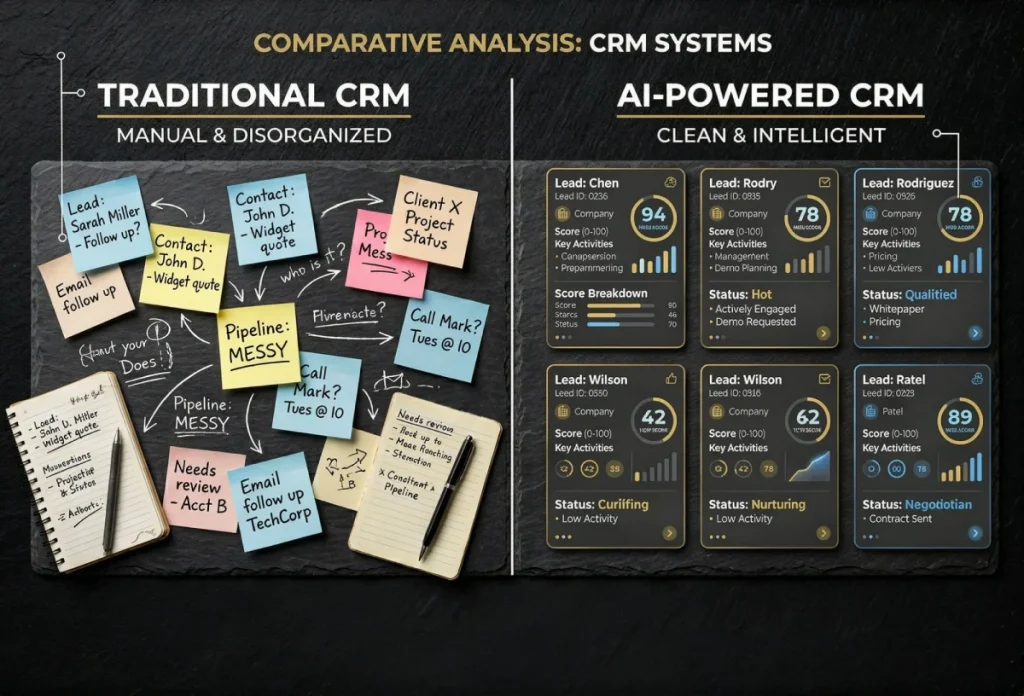
An AI-powered CRM combines traditional customer data management with machine learning, behavioral analysis, and automation to create a system that doesn't just store sales activity — it actively drives it. Unlike conventional CRM platforms that require manual data entry and rep discipline to function, AI CRM captures data automatically, scores leads objectively, and triggers the right action at the right time without human initiation.
The architectural difference between AI CRM and traditional CRM isn't cosmetic — it's functional. A traditional CRM is reactive: a rep closes a meeting, logs notes manually, sets a follow-up reminder, and moves on. If the reminder is missed or the rep is overloaded, the lead goes cold. An AI CRM is proactive: it captures the meeting automatically from calendar data, analyzes email and call patterns, adjusts the lead score based on engagement signals, and triggers the next follow-up sequence without rep intervention.
This shift — from tool that records to tool that acts — is what makes AI CRM a revenue driver rather than an administrative system.
Key capabilities that distinguish AI CRM from conventional customer management platforms:
- Predictive lead scoring: Machine learning models analyze demographic fit, engagement behavior, and historical conversion patterns to assign each lead a real-time probability score — eliminating gut-feel prioritization
- Automated data capture: Emails, calls, meetings, and web interactions are logged automatically, eliminating manual entry and maintaining complete contact records with zero rep effort
- Behavioral trigger automation: Follow-up sequences fire based on specific prospect actions — email opened, page visited, form submitted — not on calendar schedules
- Revenue forecasting: AI analyzes pipeline composition, historical win rates by deal stage, and current engagement signals to generate accurate revenue predictions
- Intelligent deal alerting: The system flags deals showing churn risk signals — declining engagement, stalled stages, extended response gaps — before they go cold
| CRM Capability | Traditional CRM | AI-Powered CRM |
| Data Entry | Manual — rep-dependent | Automatic from emails, calls, meetings |
| Lead Prioritization | Subjective — rep judgment | Objective — ML-scored by conversion probability |
| Follow-Up Triggers | Calendar reminders — miss-prone | Behavioral triggers — fire automatically |
| Revenue Forecasting | Stage-weighted guesswork | AI-analyzed prediction with historical calibration |
| Deal Risk Detection | Visible only when rep checks | Proactive alerts before deals go cold |
| Personalization | Template-based | Behavior-adapted per contact |
The Revenue Cost of Manual CRM Processes
Here's a number worth sitting with: studies across B2B sales organizations indicate that sales reps spend an average of 30–40% of their working hours on administrative tasks — data entry, CRM updates, scheduling, and reporting — rather than selling. For a five-person sales team, that's 1.5–2 full-time equivalents of capacity consumed by administration that AI CRM eliminates.
The more immediate cost is missed follow-up. Research consistently shows that the majority of B2B sales require five or more contact attempts before conversion — yet most manual follow-up processes break down after the second or third attempt when reps shift attention to active deals. AI CRM executes the full nurture sequence regardless of rep workload, capturing conversion opportunities that manual processes reliably lose.
AI Lead Scoring: How Predictive Intelligence Prioritizes Your Sales Pipeline
AI lead scoring uses machine learning models trained on your historical conversion data to assign each prospect a real-time probability score reflecting their likelihood of closing. This replaces subjective rep judgment with objective, data-driven prioritization — ensuring your sales team concentrates effort on the leads most likely to generate revenue, not the ones that arrived most recently or made the most noise.
The practical impact of AI lead scoring is immediate and measurable: sales teams that prioritize by AI score consistently report higher conversion rates, shorter sales cycles, and better forecast accuracy than teams using manual or demographic-only scoring models. The reason is straightforward — behavioral signals (pages visited, emails opened, content downloaded, time-on-site) predict intent more accurately than demographic fit alone.
How AI Lead Scoring Models Work
An effective AI lead scoring model integrates multiple signal categories:
Behavioral signals (highest predictive weight):
- Email open and click frequency over time
- Website pages visited and depth of engagement
- Content assets downloaded (high intent: case studies, pricing pages, ROI calculators)
- Response speed to previous outreach
- Return visit frequency and recency
Demographic and firmographic signals:
- Industry vertical alignment with your client base
- Company size relative to your target customer profile
- Job title and decision-making authority
- Geographic proximity (for local service businesses)
Engagement velocity signals:
- Rate of score increase over the past 7–14 days
- Recent activity after a period of dormancy (re-engagement signal)
- Multi-channel engagement (email + web + social simultaneously)
| Lead Score Range | Behavioral Profile | Recommended Action | Expected Conversion Rate |
| 85–100 | Highly active, pricing page viewed, multiple return visits | Immediate personal outreach — same day | 35–55% |
| 65–84 | Regular engagement, case study downloads, opened 3+ emails | Accelerate sequence, offer consultation | 20–35% |
| 45–64 | Moderate engagement, occasional opens, no pricing page | Continue automated nurture, monitor for spikes | 8–20% |
| 25–44 | Low engagement, single touch, no return visits | Long-cycle nurture, monthly content only | 2–8% |
| 0–24 | Minimal engagement, unsubscribe risk | Re-engagement campaign or suppression | Under 2% |
The behavioral scoring model isn't static. As your CRM accumulates more conversion data, the model recalibrates automatically — improving predictive accuracy over time as it learns which signal combinations in your specific market correlate with closed deals.
Integrating Lead Scoring with Sales Workflow
Lead scores are only valuable when sales teams actually use them to sequence their daily activity. The integration design matters: scores should surface in the rep's daily work view — not buried in a separate analytics module. Authority Solutions® implements lead score displays directly in the pipeline view, daily digest emails to reps ranked by highest-score contacts requiring attention, and automated Slack or CRM notifications when a previously cold lead spikes in score.
AI CRM Platforms: Evaluating the Right System for Your Business
AI CRM platform selection requires evaluating five dimensions against your specific sales process: data capture automation capability, lead scoring sophistication, native integration breadth, workflow automation flexibility, and total cost of ownership at your projected scale. Platforms that excel across all five dimensions for enterprise sales organizations often underperform for SMB use cases — and vice versa.
The AI CRM market has consolidated around a few dominant platforms, each with distinct architecture decisions that determine fit for specific business models. No platform wins across every dimension — the right selection depends on your sales process complexity, team size, existing tech stack, and growth trajectory.
Salesforce Einstein: Enterprise-Grade AI at Enterprise Cost
Salesforce Einstein delivers the most sophisticated AI capabilities in the market — predictive scoring, generative AI for email drafting, conversation intelligence, and deeply customizable workflow automation. The platform earns its position for organizations with complex, multi-stage enterprise sales processes and dedicated CRM administrators.
The practical ceiling for SMBs is cost and implementation complexity. Salesforce implementations require significant timeline and configuration investment — appropriate for organizations where the CRM is mission-critical infrastructure, not for businesses needing a deployable system in weeks.
HubSpot CRM with AI Features: Best Balance for Growing SMBs
HubSpot's AI-assisted CRM offers the most accessible entry into predictive lead management for small and mid-size businesses. Native email integration, behavioral tracking, deal pipeline automation, and AI-generated content suggestions ship in a single platform with a learning curve that non-technical sales teams can navigate without IT support. The platform scales effectively to mid-market without requiring full Salesforce-level complexity.
GoHighLevel: Purpose-Built for Marketing Agencies and Service Businesses
GoHighLevel combines CRM, marketing automation, pipeline management, and client communication in a single platform purpose-designed for agencies and local service businesses. Its AI automation capabilities — particularly for follow-up sequences, appointment booking, and reputation management — deliver high value for businesses that need integrated marketing-plus-sales workflow management without enterprise pricing.
| Platform | AI Scoring | Automation Depth | SMB Fit | Implementation Speed | Price Point |
| Salesforce Einstein | Excellent | Excellent | Low — complex | 8–16 weeks | Premium |
| HubSpot AI CRM | Good | Good | Excellent | 2–4 weeks | Mid-range |
| GoHighLevel | Good | Excellent | Excellent (agencies) | 1–3 weeks | Accessible |
| Zoho CRM Plus | Moderate | Good | Good | 2–4 weeks | Budget-friendly |
| Pipedrive AI | Moderate | Moderate | Good (sales-focused) | 1–2 weeks | Accessible |
Key Takeaways
- AI CRM captures data automatically from emails, calls, and meetings — eliminating the manual entry that consumes 30–40% of sales rep time in traditional CRM workflows.
- Predictive lead scoring replaces gut-feel prioritization with ML-calibrated probability scores that improve conversion rates and concentrate sales effort on highest-value prospects.
- Behavioral triggers outperform calendar reminders: follow-up sequences that fire based on prospect actions convert at higher rates than fixed-cadence outreach not tied to engagement signals.
- Platform selection determines ROI ceiling: HubSpot and GoHighLevel deliver the strongest SMB ROI; Salesforce Einstein is the right choice only when sales complexity and scale justify enterprise investment.
- AI revenue forecasting accuracy compounds over time: models recalibrate against your actual conversion data, making predictions more accurate every quarter as the training dataset grows.
- Integration design determines adoption rate: lead scores embedded in daily rep workflows drive usage; scores buried in analytics dashboards get ignored — implementation architecture matters as much as platform selection.
How to Integrate AI CRM Without Disrupting Your Existing Sales Team
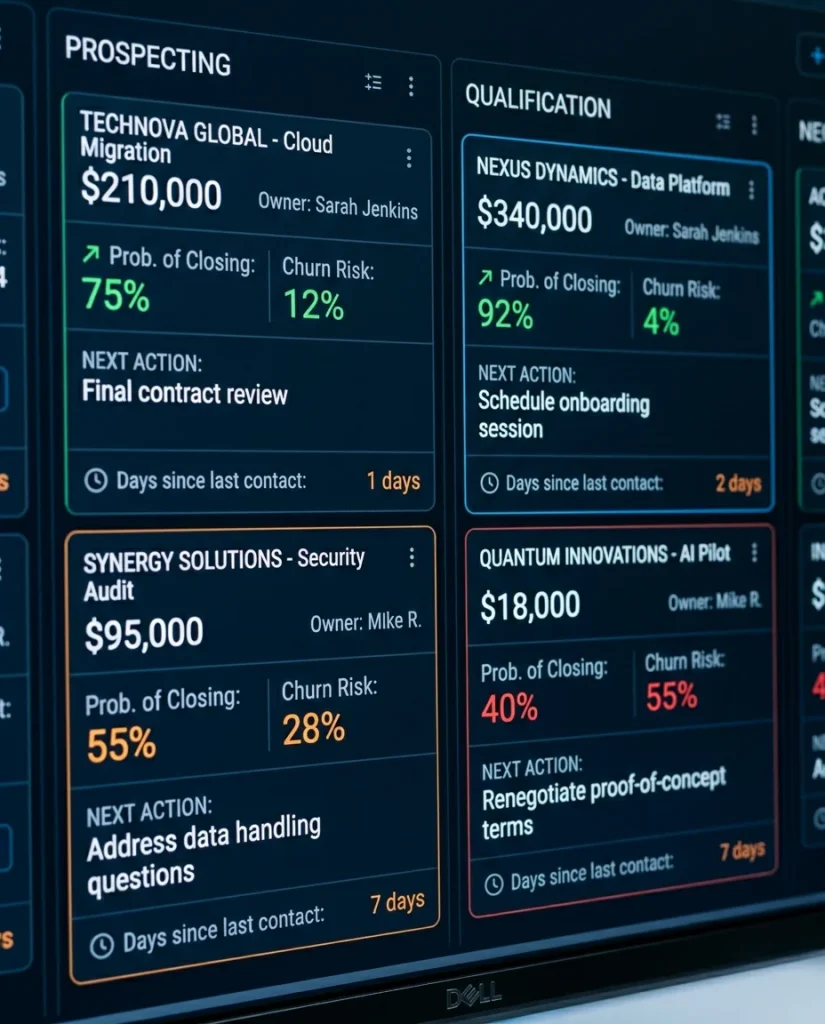
AI CRM integration succeeds or fails on change management as much as technical implementation. The most common failure mode is deploying a sophisticated new system that sales teams actively avoid because it wasn't integrated into their existing workflow — it was placed beside it. Effective integration uses a phased rollout that runs new and existing systems in parallel during a validation period, then migrates fully once rep confidence is established.
The technical integration is the easier half. Connecting your existing email platform, calendar system, website analytics, and communication tools to the AI CRM through native integrations or API connectors is an implementation problem with clear solutions. The harder problem is human: getting a sales team that has existing process habits to adopt new behavior consistently.
Authority Solutions® approaches AI CRM integration through four phases designed to protect sales continuity while systematically transferring workflow into the new system:
Phase 1: Audit and Architecture (Week 1–2) — Map current sales workflow in detail: how leads enter the system, how reps prioritize, what follow-up cadences exist, where data lives. Design the AI CRM architecture to replicate and enhance existing workflow rather than replace it entirely.
Phase 2: Parallel Operation (Week 2–4) — Deploy AI CRM alongside existing systems. Reps use both — the existing system as primary, the new system as parallel. This period validates data capture accuracy, integration connectivity, and automation logic without disrupting live sales activity.
Phase 3: Migration (Week 4–6) — With rep confidence established through parallel operation, migrate primary workflow into AI CRM. Existing system maintained as read-only backup for 2–4 weeks during the transition period.
Phase 4: Optimization (Ongoing) — Monitor adoption metrics, score model accuracy, automation performance, and rep feedback. Adjust workflows, scoring weights, and automation logic based on live performance data in the first 90 days.
Most Authority Solutions® clients complete full migration within six weeks of engagement start and report measurable improvement in follow-up consistency and pipeline visibility within the first 30 days of active use.
Conclusion
AI CRM systems deliver measurable sales impact across three dimensions simultaneously: they capture more data with zero additional rep effort, prioritize that data intelligently so sales teams work on the right leads, and execute follow-up sequences consistently regardless of rep workload or attention. The compound effect — better data, smarter prioritization, and reliable execution — is a pipeline conversion improvement that manual CRM workflows can't replicate at scale.
The right starting point is understanding exactly where your current sales process loses revenue — through missed follow-ups, poor lead prioritization, inaccurate forecasting, or administrative overhead consuming selling time. Authority Solutions® implements AI CRM solutions designed around your specific sales workflow, integrated with your existing tech stack, with measurable ROI benchmarks established before deployment begins. Contact our team to discuss how AI-powered customer management transforms your sales results.
Frequently Asked Questions
What is an AI CRM system?
An AI CRM system combines traditional customer relationship management with machine learning, behavioral analysis, and automation. It automatically captures lead data, scores prospects by conversion probability, triggers personalized follow-up sequences based on behavioral signals, and generates predictive revenue forecasts — replacing manual, rep-dependent processes with intelligent, proactive sales management.
How does AI lead scoring work in a CRM?
AI lead scoring trains machine learning models on your historical conversion data to assign real-time probability scores to each prospect. Behavioral signals — email engagement, website activity, content downloads, return visit frequency — carry the highest predictive weight. Scores update continuously as prospects interact with your brand, enabling reps to prioritize by actual conversion likelihood rather than gut feel.
What's the best AI-powered CRM for small business?
HubSpot CRM with AI features and GoHighLevel are the strongest options for small and mid-size businesses. HubSpot offers the best balance of AI capability, usability, and scalability for growing SMBs. GoHighLevel is the leading choice for marketing agencies and local service businesses that need integrated CRM plus marketing automation in a single platform at accessible pricing.
How does AI CRM reduce sales cycle length?
AI CRM reduces sales cycle length by ensuring no follow-up step is missed, delivering next-step outreach at optimal timing based on behavioral signals rather than arbitrary cadence, alerting reps to high-score leads requiring immediate attention, and eliminating administrative tasks that delay rep availability for active selling. These factors combine to accelerate deals through pipeline stages consistently.
Can AI CRM integrate with my existing email and calendar systems?
Yes. Leading AI CRM platforms connect natively with Gmail, Outlook, Google Calendar, and Microsoft Calendar — automatically capturing email threads, meeting notes, and calendar events as CRM activities without manual logging. Custom API integrations handle proprietary communication systems that lack pre-built connectors.
How accurate is AI revenue forecasting in CRM systems?
AI revenue forecasting accuracy improves over time as the model trains on more of your conversion data. Initial deployments typically achieve 70–80% forecast accuracy. After 6–12 months of calibration against actual outcomes, models routinely reach 85–92% accuracy — significantly outperforming the 40–60% accuracy typical of stage-weighted manual forecasting methods.
How long does AI CRM implementation take?
Implementation timelines depend on platform and complexity. HubSpot and GoHighLevel typically deploy in 2–4 weeks with parallel operation validation. Salesforce Einstein implementations range from 8–16 weeks. Authority Solutions® targets full migration within six weeks for most SMB clients, with measurable performance improvement visible within the first 30 days of active use.
What's the difference between AI CRM and marketing automation?
AI CRM manages the sales process — lead scoring, pipeline management, rep workflow, and revenue forecasting. Marketing automation manages the pre-sales process — email campaigns, lead nurturing, content distribution, and lead generation. The two systems complement each other; Authority Solutions® typically integrates both as components of a unified revenue operations architecture.
How does AI CRM handle data privacy and GDPR compliance?
Leading AI CRM platforms (Salesforce, HubSpot) provide built-in GDPR and CCPA compliance tools including consent tracking, data deletion workflows, and opt-out management. Implementation should include configuration of compliance workflows specific to your customer geography and industry before any data is migrated into the new system.
Does Authority Solutions® provide AI CRM training for sales teams?
Yes. Every Authority Solutions® AI CRM implementation includes sales team training customized to your specific workflow and platform. Training is conducted in phases aligned with the integration rollout — initial orientation during parallel operation and advanced workflow training during the migration phase — to build rep confidence progressively rather than overwhelming teams at launch.