Voice AI handles phone orders, reservations, and inquiries 24 hours a day with natural conversation that customers cannot distinguish from a person. The National Restaurant Association reports labor shortages as the top operator concern in 2026, and operators deploying voice AI are recovering the missed-call revenue that staffed phones cannot capture during the dinner rush.
The 7:42 p.m. Problem
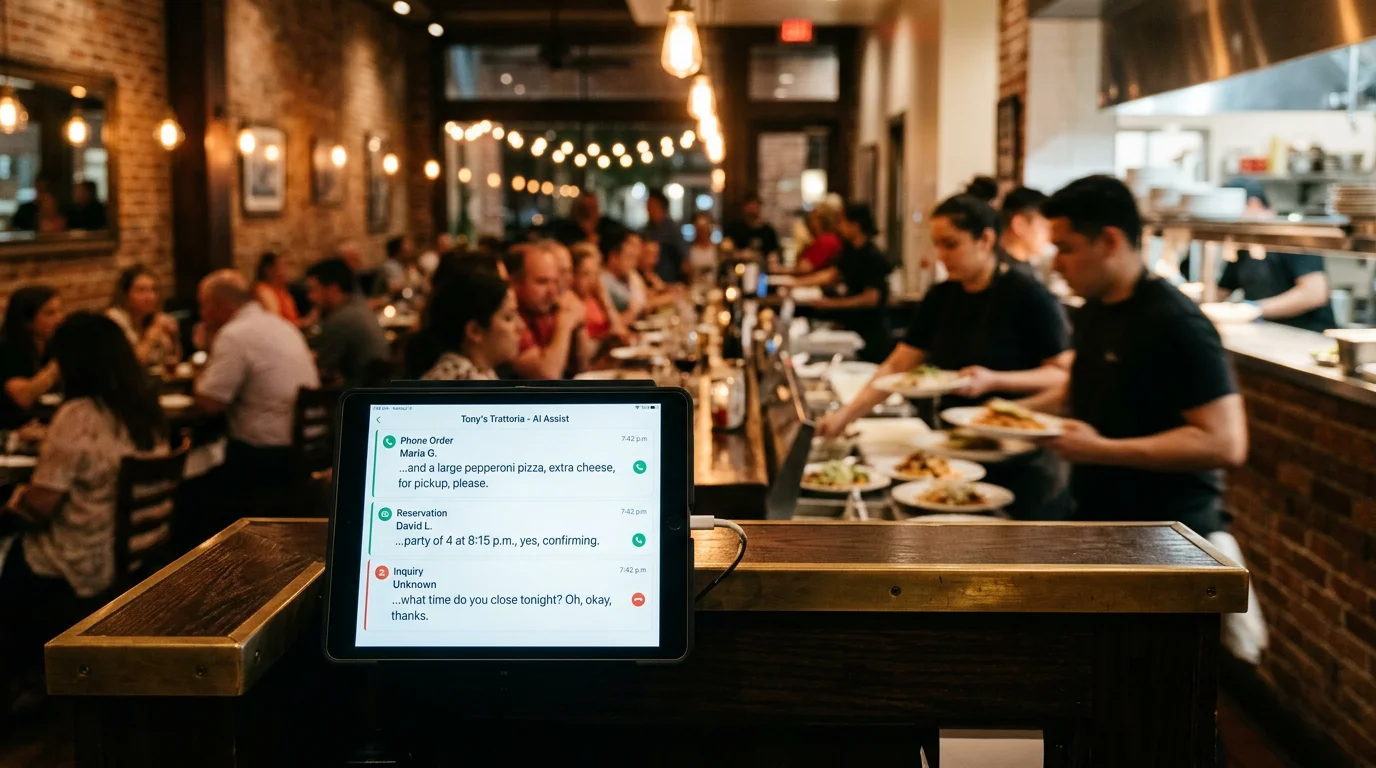
It is Friday night at 7:42 p.m. The dining room is packed, two servers called in, the host stand is fielding a wait list and the phone is ringing for the fourth time in eight minutes. The first call is a takeout order, the second is a reservation for Sunday, the third is an inquiry about gluten-free options. By the time the host answers the fourth, the first three have hung up. Each was a customer with intent and money. Each is now a competitor's customer.
The National Restaurant Association's industry tracking puts labor as the number one operator concern heading into 2026, with the operator-to-staff ratio still under pre-2020 norms and front-of-house turnover stubborn. The phone is the staffing position that lost the most ground. The restaurant that staffs the phones to volume on a Friday night does not exist in 2026; the restaurant that lets the phone ring and accepts the lost revenue does.
A voice user interface tuned for the restaurant phone is the operating change that closes the gap. Not a chatbot bolted onto the website, not an IVR menu that customers hang up on, but a conversational system that answers in the first ring, takes the order or books the table, and routes the genuinely complex calls to a human. This article walks the operator through what voice AI actually does on the call, what it gives back to the dining room, and how Authority Solutions® AI Services deploys it without breaking the way the restaurant already runs.
The Three Calls a Restaurant Phone Receives
A restaurant phone receives three categories of call, and a voice AI system has to handle all three or it is not worth deploying:
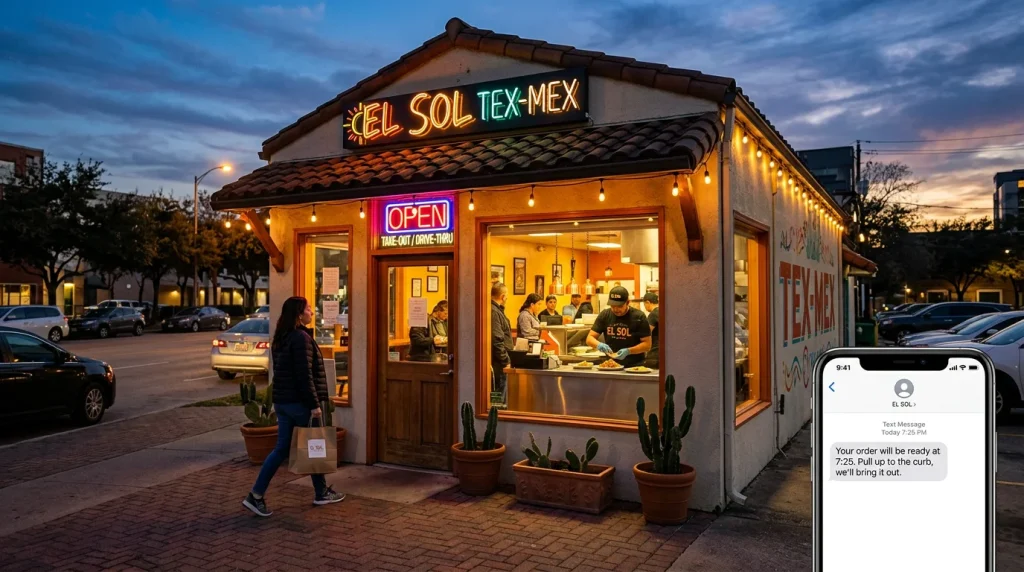
- Takeout and pickup orders. The single largest revenue category for most independents. The customer wants to read the menu, customize the order, and confirm timing. Voice AI quotes the menu, captures modifiers and dietary notes, processes payment, sends the order to the kitchen ticket printer or POS, and texts the customer the pickup window.
- Reservations and party bookings. The second largest by revenue impact, the largest by complexity. Voice AI reads the live availability from the reservation system, books the table, captures party-size and special-occasion notes, applies house policies on hold times and deposits, and sends confirmation by SMS.
- Inquiries and routing. Hours, location, menu questions, allergens, catering, gift cards, lost-and-found. Voice AI answers the factual questions instantly from a structured restaurant knowledge base, and warm-transfers the genuinely complex calls (a complaint about last night's order, a press inquiry) to the manager. Authority Solutions® Restaurant Marketing maps the inquiry taxonomy as part of every deployment.
A voice AI deployed for only one of the three is a partial fix; deployed across all three, it returns the host stand to the actual host job, which is greeting guests at the door.
What Happens on the Call
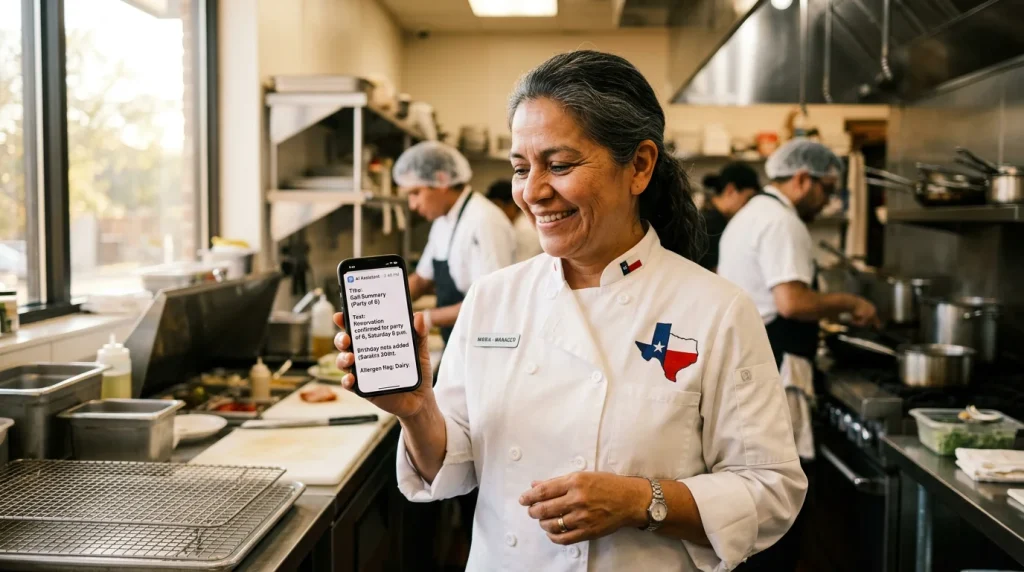
The customer dials the published restaurant number. The phone rings once. A natural voice answers, identifies the restaurant by name, asks how it can help. The customer talks the way they would talk to a person. The voice AI takes it from there.
The technical stack underneath is well understood in 2026:
- Speech to text. Real-time transcription with restaurant-trained vocabulary. The system understands "pollo asado" without prompting and does not mishear "no cilantro" as "no carrots."
- Conversational AI layer. A language model fine-tuned on restaurant dialogue handles the back-and-forth. It tolerates interruption, asks clarifying questions when the order is ambiguous, and stays on script for upsells the operator has authorized. Authority Solutions® Voice AI Development owns the language model fine-tuning step.
- Integration to POS and reservation system. Orders post directly to the kitchen ticket; reservations write directly to the table-management system. No human re-keys anything.
- Text to speech. A trained voice with the right cadence, regional inflection, and brand tone. The customer perceives a person; the staff perceives an extra teammate.
- Human handoff trigger. Anything outside the voice AI's scope, like a complaint, a press call, or a question the system does not recognize, routes to the manager's cell phone with full call context.
A complete call from dial to confirmation runs 90 to 180 seconds for a takeout order, 60 to 120 seconds for a reservation, and 20 to 45 seconds for a factual inquiry. None of those minutes were going to be available from a human host stand on a Friday night anyway.
Where the ROI Actually Lives
Operators evaluating voice AI tend to fixate on labor savings. Labor is real, but the bigger number is captured revenue that the phone was leaking before deployment. Three distinct streams:
- Missed-call recovery. The calls that previously hit voicemail or hung up after four rings now convert. A modest independent loses 40 to 80 calls a week to abandonment; recovering even half of them at average ticket size moves the monthly number meaningfully.
- Off-hour capture. Customers calling at 10 a.m. for a 7 p.m. reservation, at 11 p.m. for tomorrow's lunch order, or at 2 p.m. on a closed day to book the weekend. Voice AI books these calls; staffed phones miss them.
- Upsell discipline. The trained AI consistently offers the appetizer, the dessert, the bottle upgrade, with the same wording every time. Human staff vary; the AI does not. Three to seven percent ticket lift is the typical range.
The labor savings sit underneath all three: one front-of-house position that no longer needs to be staffed to phone volume, or that gets redeployed to the floor where guest experience actually lives.
The Reservation Math
Reservation handling is where independent restaurants give up the most ground to chains. The chain has a centralized reservation team or an automated system that books every call. The independent has the host stand, the host stand has the door, and the door wins every conflict with the phone.
Voice AI for reservations resolves the conflict by removing it. The system reads live availability from OpenTable, Resy, SevenRooms, Tock, or the operator's preferred system, books the table within the operator's defined buffer, captures the party size and special occasion, applies house policies on hold and deposits, and texts the guest the confirmation. It also handles the harder cases: the party-of-twelve birthday on a Saturday that requires manager approval, the dietary accommodation, the guest asking whether the patio is heated. Each of these gets routed or answered.
A practical outcome: a brunch-heavy restaurant reduces no-shows from twelve percent to seven percent in the first quarter because the AI calls every reservation the morning of, reconfirms, and rebooks the slot if the guest cancels. The host stand never had time for that, and the same operating pattern shows up in Authority Solutions® Chatbot Development work for hospitality clients.
The Operator Worries That Are Real
Three operator concerns are legitimate and must be designed against:
- Voice quality and the "robotic" perception. The early generation of voice bots was painful. The 2026 generation is not, but the customer perception still has to be earned. Use a trained voice with the right brand cadence, allow interruption mid-response, and never force the customer to repeat themselves twice.
- The complex call that needs a human. Some calls cannot be handled by AI. The deployment that survives is the one that detects complexity early and warm-transfers to a manager's phone with the call context attached. A bad voice AI lets the caller wrestle with the system; a good one bails out fast.
- Local accent, language, and menu pronunciation. The voice AI must speak Spanish if the customer does, must hear "pho" without correction, must recognize the regional name of the dish. Vendors without bilingual depth or a vocabulary-training capability should be off the shortlist for any restaurant with a diverse customer base.
The operator concerns that are not legitimate: AI replacing the host's relationship with regulars, AI mishandling a card payment that PCI-compliant systems already secure, AI talking back to a difficult guest. These are not real risks; the first two are myths, the third is a feature of good warm-transfer design.
What "Good" Looks Like in Production
A deployed voice AI is graded against five metrics from week one:
- Pickup rate. Percentage of calls answered within two rings. Target: 99 percent or higher.
- Order accuracy. Percentage of takeout orders that match what the customer said. Target: 98 percent or higher.
- Reservation conversion. Percentage of reservation calls that book a table. Target: 85 percent or higher.
- Containment rate. Percentage of calls handled without human transfer. Target: 75 to 90 percent depending on cuisine complexity.
- Customer satisfaction. Post-call SMS rating or follow-up. Target: 4.5 of 5 or higher.
The deployment that hits all five in the first 60 days is a win for the operator. The deployment that consistently misses one is a tuning problem, not a failure; weekly review of failed calls and quarterly menu-vocabulary updates keep the system improving.
The Authority Solutions® Restaurant Voice AI Path
Our deployment for independent restaurants and small groups runs roughly six weeks from kickoff to cutover:
- Weeks 1 to 2. Discovery and integration scoping. Menu digitization with modifiers and dietary tags, reservation system mapping, POS connection design, brand voice selection, accent and language scope, manager warm-transfer rules.
- Weeks 3 to 4. Build and tune. Voice persona, vocabulary training on the actual menu, conversational flow design for takeout, reservation, and inquiry. Test against a corpus of representative calls including the edge cases.
- Weeks 5 to 6. Soft launch and cutover. Run AI in parallel with human pickup for one week, measure against the five metrics, address tuning needs, full cutover in week six with weekly review for the next quarter.
By week six, the restaurant has answered every call for two weeks, the kitchen has not had to re-key a single order, the host stand is at the door, and the Friday night 7:42 p.m. moment is no longer a revenue leak. Authority Solutions® Marketing Automation extends the win into the post-visit reservation and loyalty workflow.
Key Takeaways
- The phone is the staffing position the post-pandemic labor market never gave back, and the calls that go unanswered are the most predictable revenue leak in independent restaurants in 2026.
- Voice AI handles takeout orders, reservations, and inquiries across the same number, with a trained voice the customer cannot distinguish from a person, and integrates directly to the POS and reservation system.
- Three revenue streams matter more than labor savings: missed-call recovery, off-hour capture, and disciplined upselling. The labor savings are real but are the floor, not the ceiling.
- Reservation handling is where independents lose ground to chains. Voice AI levels the field by booking every call, reconfirming the morning of, and rebooking cancellations into the open slot.
- Warm transfer to a manager's phone with full call context is what separates a tolerable voice AI from a great one. The best deployments bail out fast when they detect complexity.
- The five production metrics are pickup rate, order accuracy, reservation conversion, containment rate, and customer satisfaction. Hit all five in the first 60 days and the operator has a win.
FAQ
What is voice AI for restaurants?
Voice AI for restaurants is a conversational system that answers the restaurant's published phone number, handles takeout orders, reservations, and customer inquiries in natural language, and routes complex calls to a human manager. It integrates directly with the restaurant's POS and reservation system, so orders post to the kitchen and bookings post to the table-management software without human re-keying.
Does voice AI sound robotic to customers?
The 2026 generation does not. Trained voices with natural cadence, regional inflection, and brand tone are widely deployed, and most customers do not detect the difference within a normal call. The robotic perception is an artifact of earlier voice-bot generations and not characteristic of current systems when deployed properly.
What does voice AI cost for an independent restaurant?
Pricing varies by call volume and integration depth, but typical monthly subscriptions for independents run two hundred to seven hundred US dollars per month per location, with implementation costs in the three thousand to fifteen thousand range. ROI is typically demonstrable in the first 60 days from recovered missed-call revenue alone.
Can voice AI integrate with my POS and reservation system?
Yes. Mainstream voice AI vendors integrate with Toast, Square for Restaurants, Clover, Aloha, Lightspeed, OpenTable, Resy, SevenRooms, and Tock. Specialty or custom systems may require additional integration work; this is part of the scoping conversation before deployment.
How does voice AI handle Spanish-speaking or bilingual customers?
Bilingual voice AI is standard in 2026 and table-stakes for Texas operators. The system detects the language from the first few seconds of the call and continues in that language. Menu vocabulary, dietary terms, and conversational flow are trained in both English and Spanish.
What happens when the AI cannot handle a call?
The system warm-transfers the call to a designated manager's phone with the call context attached: the caller's name, the reason for the transfer, and a summary of what was discussed. The manager picks up already briefed; the customer does not have to repeat themselves.
Does voice AI replace the host staff?
No. It removes the phone burden from the host staff so they can do what hosts actually do: greet guests at the door, manage the wait list, and own the dining room experience. Restaurants typically redeploy the head-count, they do not eliminate it.
How long does deployment take?
A focused deployment for an independent restaurant runs roughly six weeks: two weeks of discovery and integration scoping, two weeks of build and tuning on the actual menu, and two weeks of soft launch and cutover with the five core metrics instrumented from day one.
Can voice AI handle complex reservation requests like large parties or events?
Routine large parties yes, with operator-defined policies on minimum spend, deposits, and approval thresholds. Complex events such as full buyouts, private dining, or media inquiries route to the manager's phone for live handling. The system knows when to bail out.
How is voice AI different from a phone tree or IVR?
A phone tree forces the customer through a menu of options ("Press 1 for hours, Press 2 for reservations") and frustrates the caller into hanging up. Voice AI listens to natural language ("I want a table for six on Saturday at 8") and handles the request in conversation. The customer experience is closer to a person than to a menu.
Conclusion
The Friday-night 7:42 p.m. moment is the operating reality of every independent restaurant in 2026. The phone rings, the host stand is full, and the calls go to voicemail. Voice AI closes that gap with a trained voice that books reservations, takes orders, and answers questions on the first ring, while the host stand returns to the door.
Authority Solutions® deploys restaurant voice AI for independent operators and small groups across Texas. We map the menu, integrate the POS and the reservation system, train the voice on the regional vocabulary, and instrument the five production metrics from week one. The restaurant gets back to running the floor; the phone stops being a leak.