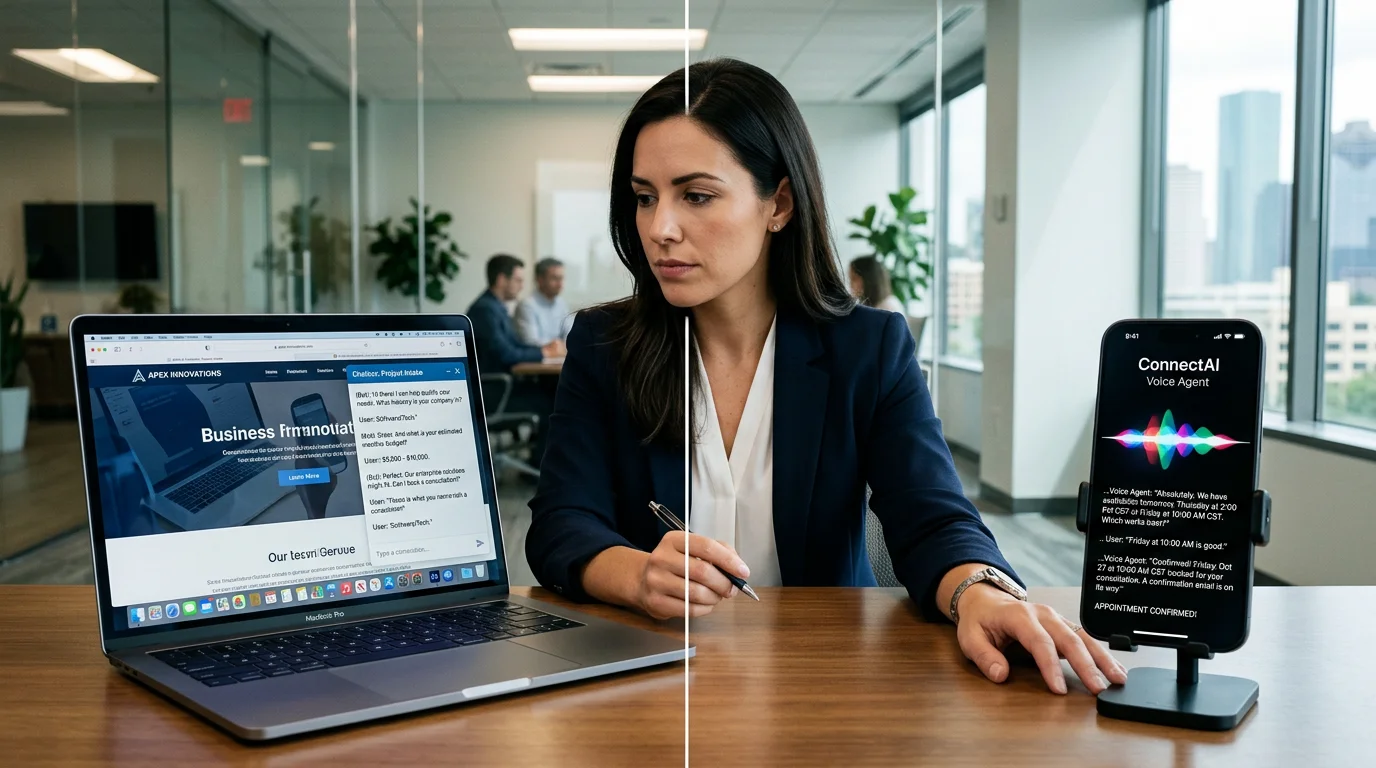
AI chatbots and AI voice agents are not interchangeable tools — they address structurally different customer engagement contexts, and deploying the wrong channel for a given use case produces measurably lower conversion rates than the right one. Chatbots outperform voice agents for text-native, multi-query, and research-phase interactions; voice agents outperform chatbots for appointment-setting flows, after-hours call capture, and hands-free engagement scenarios. The highest-performing deployments use both through a unified AI architecture rather than choosing between them.
The framing of "chatbot versus voice agent" as a binary choice is the first error most businesses make when evaluating conversational AI. The more useful question is: which channel does each of your customer engagement scenarios naturally occur through, and which AI format is architecturally matched to that channel's interaction pattern? The answer almost always involves both — with deliberate channel assignment rather than a default-to-one approach. Authority Solutions® builds AI chatbot and voice agent solutions on unified architecture precisely because forcing all customer engagement through a single channel consistently underperforms a deliberate multi-channel approach.
This article provides the decision framework for channel-to-scenario matching, with specific conversion rate benchmarks by scenario type, so the deployment decision is grounded in outcome data rather than vendor preference.
When AI Chatbots Deliver Superior Engagement Outcomes
AI chatbots produce higher engagement and resolution rates than voice agents in scenarios where customers need to read, review, reference, and respond at their own pace — lead qualification flows, multi-question research interactions, complex support with multiple steps, and any context where the customer is simultaneously consuming content and interacting. Text-based interaction reduces time pressure and allows customers to craft considered responses, which increases both engagement depth and qualification accuracy for intent assessment.
The psychological distinction driving chatbot's advantage in these scenarios is the absence of real-time response pressure. A prospect working through a qualification flow on a chatbot can pause, review their previous answers, consider their response, and proceed when ready. A voice agent interaction demands real-time response — an interaction pattern that suits straightforward bookings but creates friction for complex information-gathering. Qualification flows that take 4–6 minutes in text frequently feel rushed in 90-second voice exchanges where the customer hasn't had time to think.
The scenarios where chatbot architecture consistently produces the highest performance:
Lead Qualification and Initial Conversion
Chatbot lead qualification outperforms voice for inbound website visitors because website visitors are text-native by context — they arrived through a screen, they're reading content, and a chat interface is a natural extension of their current experience. Qualification flows that would feel like an interrogation in voice form — "What is your current challenge?", "What is your timeline?", "What is your budget range?" — feel conversational and low-pressure in text form. Research from Drift's conversational marketing benchmark data indicates chatbot qualification flows on B2B websites convert website visitors to qualified leads at rates 2–3x higher than form-based alternatives, with chat-to-meeting booking rates averaging 15–20% for well-designed qualification flows.
Multi-Query Support and Research Interactions
When customers have multiple sequential questions — or want to reference previous answers while formulating new ones — text chat enables a reading-and-responding behavior pattern that voice cannot replicate. Support interactions involving account details, technical specifications, pricing breakdowns, and multi-step processes perform significantly better in text because customers can scroll back, copy information, and process at their own pace.
Mobile Web and Asynchronous Contexts
Text chatbots are native to mobile web interfaces and require no additional permissions. A significant percentage of mobile users are in contexts where voice interaction is impractical — public environments, meetings, shared spaces — making text-only chatbot the default channel for a substantial slice of mobile traffic.
| Chatbot Scenario | Why Text Wins | Expected Completion Rate |
| Lead qualification (multi-question) | No real-time pressure; reviewable responses | 55–75% completion vs 30–45% voice |
| Multi-step support (account, billing) | Scrollable, referenceable; copy-friendly | 70–85% self-serve resolution |
| Research phase (pre-decision info) | Reading and responding simultaneously | 65–80% question resolution |
| Mobile web engagement | Native interface; no permission friction | 3–4x higher than voice opt-in rate |
When AI Voice Agents Deliver Superior Engagement Outcomes
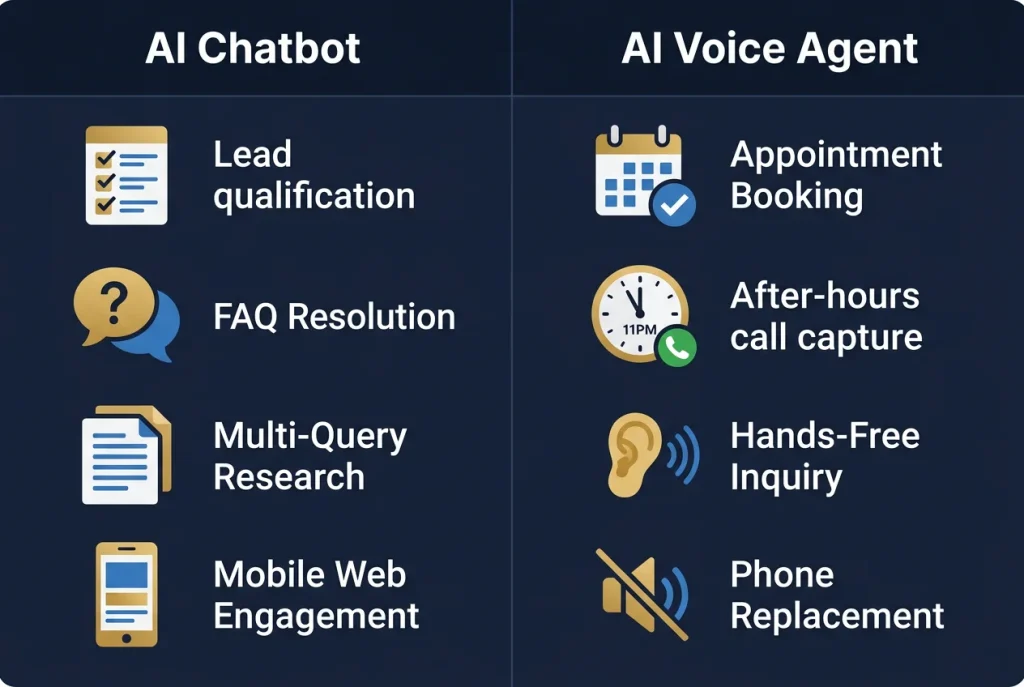
AI voice agents produce higher conversion rates than chatbots in scenarios where the interaction pattern mirrors familiar phone-based behavior — appointment booking, after-hours inquiry capture, callback flows, and hands-free engagement contexts. Voice reduces the cognitive load of communication for customers who are navigating a simple goal (book a time, get a quick answer, confirm a detail) and creates a higher-trust engagement environment for service businesses where phone has historically been the primary customer relationship channel.
The behavioral science behind voice's advantage in booking scenarios is well-established: the appointment scheduling interaction pattern — "Are you available Thursday at 2 PM?" / "Yes, confirmed" — is so familiar from decades of phone-based scheduling that voice AI replicates it with minimal adaptation friction. The same flow in text chatbot form is functionally equivalent but feels less natural because customers don't have a text-based mental model for the scheduling conversation pattern.
The scenarios where voice agent architecture consistently produces the highest performance:
Appointment Booking and Scheduling
Voice agents booking appointments outperform chatbot booking flows in service businesses with phone-primary customer demographics (medical, legal, home services, financial). The voice modality matches the customer's prior experience of booking by phone — the interaction feels familiar, the confirmation feels real, and the psychological commitment to the appointment is higher than text confirmation. Chatbot booking confirmation abandonment rates (customers who complete the flow but don't show up) run 15–25% higher than voice-confirmed bookings in comparable service business studies.
After-Hours Inquiry Capture
This is voice's clearest competitive advantage and most quantifiable ROI case. A customer calling a business after hours has explicitly chosen the phone channel — they dialed a number. Routing that call to a text chatbot creates channel friction; routing it to an AI voice agent that answers naturally and handles the inquiry meets the customer in their chosen channel. After-hours call capture rates for AI voice agents average 65–75% — meaning that percentage of after-hours callers who would previously reach voicemail are now resolved or scheduled. Chatbots don't access this traffic category at all.
Outbound Reactivation and Confirmation Calls
Voice agents conducting outbound calls for appointment confirmation, reactivation of dormant contacts, or follow-up on unfulfilled inquiries outperform SMS and email alternatives in response and engagement rates for service businesses. The voice channel signals higher-stakes investment in the customer relationship than automated text outreach.
The Case for Unified Architecture Over Single-Channel Deployment
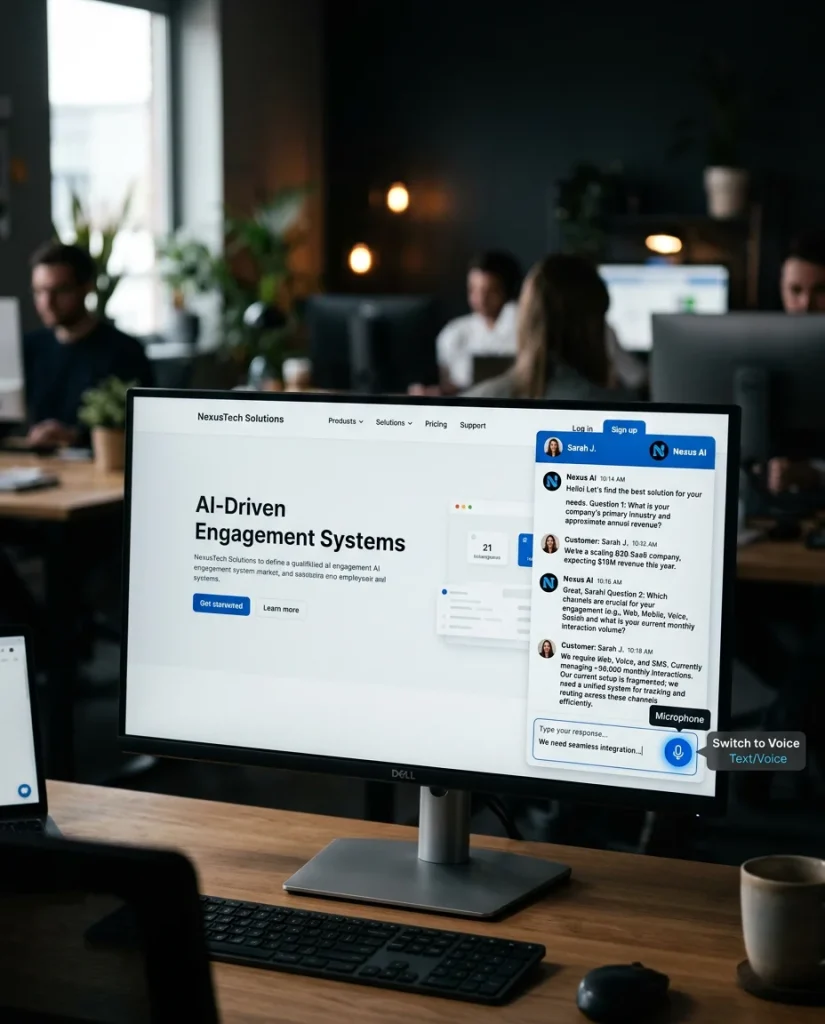
Businesses deploying chatbot-only or voice-only AI customer engagement architectures leave measurable revenue on the table by forcing customer interactions through a suboptimal channel. The highest-performing conversational AI deployments use a unified intelligence layer — one AI system handling both text and voice input — that routes customers to the appropriate channel based on their entry point, or offers channel choice where context is ambiguous. This architecture delivers the performance advantages of both formats without the maintenance overhead of two separate systems.
The unified architecture argument is practical, not theoretical. A customer visiting your website at 11 PM has two natural engagement options: text chat (if they're browsing on desktop or mobile) or calling your business number (which routes to an AI voice agent). Both channels should be available, both should be handled by the same underlying AI intelligence, and both should produce the same CRM record, follow-up trigger, and booking confirmation outcome — regardless of which channel the customer chose.
The maintenance argument for unified architecture is equally compelling. Two separate AI systems — a chatbot with its own knowledge base, conversation design, and CRM integration, and a voice agent with its own parallel infrastructure — require double the configuration, double the updates when business information changes, and double the monitoring overhead. A unified system where text and voice both draw from the same knowledge base and write to the same CRM record reduces that overhead by approximately half.
Channel routing logic in a unified architecture follows three principles: match channel to entry point (website visitor gets chatbot, phone caller gets voice agent), offer channel choice at high-ambiguity entry points (landing page with both chat and call options), and maintain conversation context across channel switches (customer who starts in text and requests a callback gets a voice agent that references the text conversation).
Key Takeaways
- Chatbots outperform voice in text-native, multi-query, and research-phase scenarios — lead qualification flows on websites convert 2–3x higher via chatbot than form alternatives; multi-step support resolves at 70–85% self-serve rates in text.
- Voice agents outperform chatbots in appointment booking, after-hours capture, and phone-primary demographics — after-hours voice capture averages 65–75% resolution versus 0% voicemail; booking no-show rates run 15–25% lower with voice-confirmed appointments.
- Channel selection should follow entry point, not default preference: website visitors are text-native; phone callers have explicitly chosen voice — deploying the wrong channel for each creates friction that reduces conversion rates measurably.
- Unified architecture delivers both channel advantages without double maintenance overhead — one AI intelligence layer handling text and voice, writing to the same CRM, with single-source knowledge base updates applying across both channels simultaneously.
- Conversation context continuity across channels is the highest-value unified architecture feature — customers who switch from text to voice (or vice versa) should never repeat previously provided information; that friction is eliminated by shared conversation state.
- The binary "chatbot or voice agent" framing is the wrong question — the right question is which scenarios in your specific customer journey are best served by which channel, then building the architecture that handles both optimally.
Conclusion
The chatbot versus voice agent decision resolves clearly when evaluated through customer engagement context rather than technology preference. Text chatbots are the right tool for website-native lead qualification, multi-query support, and research-phase interactions where reading and responding simultaneously is the natural behavior pattern. Voice agents are the right tool for appointment booking, after-hours inquiry capture, and phone-primary customer demographics where the spoken interaction pattern produces lower friction and higher commitment. Deploying both through a unified architecture captures the full conversion opportunity across your customer engagement surface.
Authority Solutions® designs and deploys conversational AI systems built on unified architecture — handling text, voice, and the handoffs between them through a single AI intelligence layer integrated with your CRM and booking systems. Contact our team to discuss which channel architecture fits your customer engagement patterns, or review the full AI chatbot and voice agent services scope to understand the complete implementation framework.
Frequently Asked Questions
What is the main difference between an AI chatbot and an AI voice agent?
An AI chatbot handles text-based customer interactions through website chat widgets, messaging apps, or SMS. An AI voice agent handles spoken conversations through phone calls or voice-enabled web interfaces. Both use the same underlying NLP and LLM intelligence — the difference is input and output modality. Text for chatbots, spoken audio for voice agents.
Which converts better for lead qualification — chatbot or voice agent?
Chatbots consistently outperform voice agents for website-based lead qualification. Text interaction allows prospects to respond at their own pace without real-time pressure, producing higher completion rates and more detailed qualification responses. Chatbot qualification flows on B2B websites convert visitors to qualified leads at rates 2–3x higher than form-based alternatives according to conversational marketing benchmark data.
Which AI channel is better for booking appointments?
AI voice agents outperform chatbots for appointment booking in service businesses with phone-primary customer demographics. The voice booking interaction mirrors familiar phone-scheduling behavior patterns, producing higher psychological commitment to the appointment — evidenced by 15–25% lower no-show rates for voice-confirmed bookings versus chatbot-confirmed bookings in comparable service industries.
Can I deploy both an AI chatbot and a voice agent for my business?
Yes — and deploying both through a unified architecture is the recommended approach for most businesses. A unified system uses one AI intelligence layer handling both text and voice channels, maintaining shared conversation context and writing to the same CRM record regardless of which channel the customer uses. This delivers both channels' performance advantages without double maintenance overhead.
Does an AI chatbot or voice agent work better for after-hours customer engagement?
AI voice agents are the only option for capturing after-hours phone callers — customers who dialed your number after hours have explicitly chosen the voice channel, and routing them to a text interface creates friction. Chatbots capture after-hours website visitors. Both should be deployed simultaneously to cover the full after-hours customer engagement surface.