

Employee resistance to AI adoption is not a technology problem — it's a change management problem with well-documented psychological mechanisms and proven organizational interventions. The three primary resistance drivers are fear of job displacement, unfamiliarity with AI interfaces producing early negative experiences, and absence of role-specific use cases that answer the practical question every resistant employee is actually asking: what does this replace in my specific daily work, and does replacing it help or threaten me?
Organizations that deploy AI tools and then wait for adoption to materialize organically are misunderstanding the mechanism. Adoption doesn't follow deployment automatically — it follows a deliberate change architecture that addresses resistance at its actual source rather than at its visible symptom. The symptom is low utilization rates; the source is unaddressed fear, inadequate onboarding, and structural absence of immediate relevant use cases for resistant roles.
Authority Solutions® has observed this pattern consistently across AI training services for business engagements: the organizations that achieve 70%+ adoption within 90 days are not the ones with the most sophisticated AI tools — they're the ones with the most deliberate change management architecture. This guide details what that architecture looks like at each stage.
Understanding the Five Stages of Employee AI Adoption
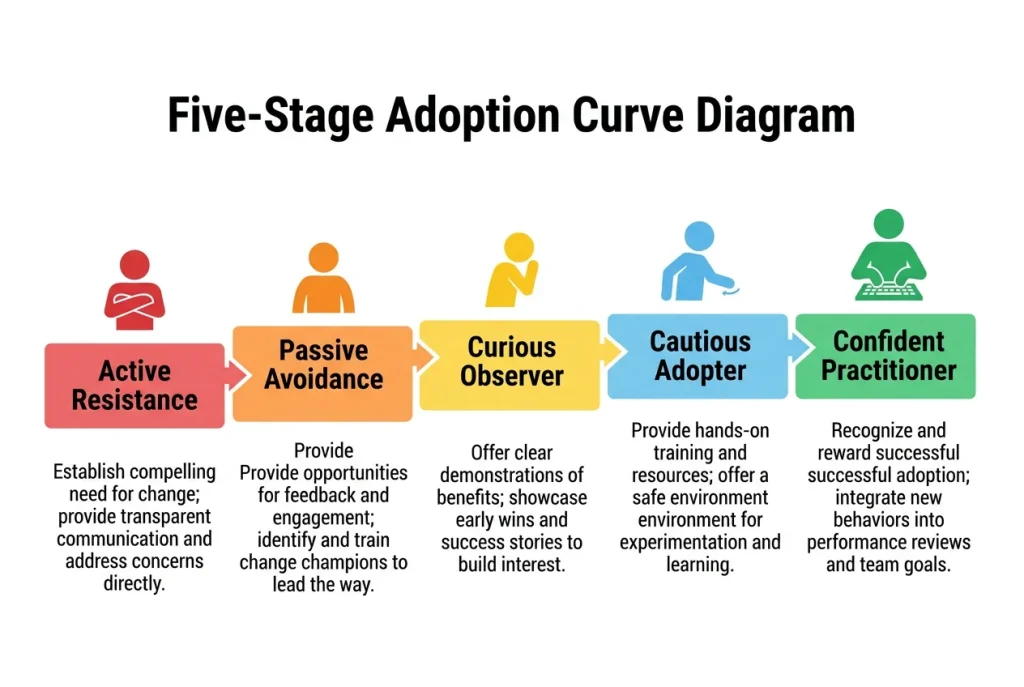
Employee AI adoption follows a predictable five-stage progression — active resistance, passive avoidance, curious observer, cautious adopter, and confident practitioner — with each stage requiring a distinct organizational intervention to accelerate movement to the next. Organizations that apply uniform adoption strategies regardless of where individual employees sit in this progression consistently underperform organizations that stage-match their interventions to actual employee readiness.
Most AI adoption programs treat the workforce as homogeneous — everyone receives the same training, the same messaging, the same timeline expectation. The reality is that any given workforce contains employees at all five stages simultaneously, and the intervention that moves a cautious adopter to confident practitioner actively alienates an actively resistant employee who first needs their fear addressed before any skill-building is productive.
Stage 1: Active Resistance
Profile: Employees who vocally oppose AI adoption, interpret it as a direct threat to their role, and may undermine adoption efforts in team discussions. Often your most experienced employees, whose identity is tied to the skills AI is perceived to replace.
Intervention: Direct, honest conversation about the organization's AI strategy and its specific implications for their role — not generic reassurance, but a concrete accounting of what their role looks like with AI assistance versus without it. Role mapping sessions that show specifically which tasks AI handles and which tasks require the human expertise they've developed over years. The goal is replacing vague threat with specific reality, which is almost always less threatening.
Stage 2: Passive Avoidance
Profile: Employees who comply with AI tool deployment requirements but use tools minimally and rarely voluntarily. Not vocal opponents, but not adopters. Their AI subscriptions show low login frequency and near-zero advanced feature usage.
Intervention: Personalized use case demonstration using their actual work — their specific tasks, their actual workflow — showing a concrete time savings or quality improvement achievable immediately. Abstract capability demonstrations don't move this group; specific, personal relevance does. "Here is 20 minutes you get back every day if you use this for report drafting" is more effective than any feature overview.
Stage 3: Curious Observer
Profile: Employees who are interested in AI but haven't committed to regular use. They watch colleagues use tools, ask questions, occasionally experiment, and are receptive to encouragement but haven't formed the daily habit.
Intervention: Structured practice sessions with low-stakes output requirements — writing a first draft, summarizing a document, generating options for a decision — where the goal is building experience with the tools in a context where a suboptimal output has no consequences. Success experiences at this stage convert curiosity into confidence.
Stage 4: Cautious Adopter
Profile: Employees who use AI tools regularly but conservatively — applying them to a narrow set of proven use cases and distrusting outputs in new application areas. Quality-anxious rather than capability-skeptical.
Intervention: Output quality calibration training that teaches systematic evaluation of AI outputs, specific prompt refinement techniques that address recurring quality failures in their use cases, and a structured framework for determining which output categories require mandatory human review. Removing quality anxiety expands the application surface they're willing to commit to.
Stage 5: Confident Practitioner
Profile: Employees who integrate AI tools into daily workflow naturally, apply them across a broad range of tasks, and seek out new application areas proactively.
Intervention: Development as internal AI champions — formalizing their peer influence role, providing additional advanced capability training, and creating structured opportunities to share their workflows with colleagues at earlier stages.
| Stage | Core Psychological State | Primary Barrier | Effective Intervention | Timeline to Next Stage |
| Active Resistance | Fear and threat perception | Role identity threat | Role mapping + honest strategy conversation | 2–4 weeks with direct engagement |
| Passive Avoidance | Skepticism + low motivation | No relevant personal use case | Personalized demonstration with their actual work | 1–2 weeks with targeted session |
| Curious Observer | Openness + low confidence | No practice opportunity | Low-stakes structured practice sessions | 1–2 weeks with practice access |
| Cautious Adopter | Anxiety about output quality | Quality uncertainty | Output calibration training + review framework | 2–3 weeks with calibration focus |
| Confident Practitioner | Competence + curiosity | Limited peer influence | Champion program + advanced training | Ongoing development |
According to McKinsey's research on organizational transformation, organizations that address employee mindset and behavior explicitly — rather than assuming technology deployment produces behavioral change organically — are 5x more likely to achieve successful transformation outcomes. AI adoption follows the same change management principles as any large-scale organizational behavior shift.
The AI Champion Program: Your Highest-Leverage Adoption Tool

Internal AI champion programs — identifying 2–3 employees per department as advanced AI users, providing them additional training depth, and formalizing their peer-influence role — consistently outperform top-down training mandates as adoption drivers because peer trust exceeds authority trust in most organizational cultures. An employee who watches a respected colleague demonstrate a specific AI workflow that saves 30 minutes on a shared task is more likely to adopt than an employee who watches an outside trainer demonstrate the same workflow on a hypothetical example.
The champion program mechanism works because it operates at the exact point where adoption decisions actually happen: informal desk conversations, team meetings, Slack channels, and spontaneous "can you show me how you did that?" moments. These are the influence contexts that top-down training programs structurally can't access, and they're the most persuasive adoption environments because they involve demonstrated peer outcomes rather than theoretical capability arguments.
Designing an effective AI champion program requires deliberate attention to four elements:
Selection Criteria for AI Champions
Champions should be selected based on peer trust and communication effectiveness, not exclusively on existing AI proficiency. A highly technical early adopter who isn't respected by colleagues is a less effective champion than a moderately advanced user who colleagues regularly consult. Selection criteria: demonstrably respected by peers, communicates clearly without condescension, genuinely enthusiastic (not compliant), and willing to spend informal time helping colleagues.
Champion Training Depth
Champions receive additional training beyond the standard role-based curriculum — advanced prompt engineering techniques, emerging capability updates, cross-tool workflow architecture, and specific training on how to teach and demonstrate rather than just use. The teaching skill is distinct from the tool skill; investing in both produces champions who can actually accelerate peer adoption rather than just use the tools well themselves.
Formalized Peer Influence Channels
Create structured channels for champion-to-team knowledge sharing: monthly "AI workflow spotlight" segments in team meetings (15 minutes maximum — respect meeting time), a shared internal document where champions post useful prompts and workflow templates, and an explicit invitation for colleagues to bring AI challenges to champions before escalating to formal training. The formalization legitimizes the champion role without making it feel bureaucratic.
Champion Recognition
Champions are performing a function with organizational value beyond their standard role description. Recognition — visibility in leadership communications, priority access to new AI tool evaluations, inclusion in AI strategy discussions — acknowledges that value and sustains champion motivation through what can be a repetitive peer support commitment.
Communication Strategy: Addressing the Job Displacement Fear Directly
The most common change management error in AI adoption programs is avoiding direct discussion of the job displacement concern in an attempt to prevent panic. This avoidance strategy consistently backfires: employees fill the information vacuum with worst-case assumptions, informal discussion networks amplify anxiety without factual grounding, and trust in organizational communication erodes when employees perceive leadership is not being honest about implications. Direct, factual communication about AI's role and its specific implications for each function produces better adoption outcomes than reassuring generalities.
The communication framework that Authority Solutions® has found most effective in AI adoption engagements addresses three questions every employee is actually asking:
"Will this replace my job?" Answer specifically and by role — not generically. "AI is replacing the report formatting step in your workflow, which currently takes 90 minutes of your Monday. That 90 minutes will shift to [specific higher-value activity]." Concrete specificity about what changes and what doesn't is more reassuring than abstract promises that "AI complements human work."
"What happens if I'm not good at it?" Define the adoption expectation clearly: what proficiency level is expected, by when, with what support available for employees who struggle. Undefined expectations produce anxiety; defined, achievable expectations with support pathways produce manageable challenges.
"What's in it for me specifically?" Translate organizational benefit into individual benefit by role. Marketing team: "You'll produce first-draft content in 20% of current time, shifting the recovered capacity toward strategy and client relationships." Operations team: "Report compilation that currently takes 2 hours will take 20 minutes, freeing the difference for work that moves projects forward." Individual benefit framing converts compliance motivation into genuine adoption motivation.
Key Takeaways
- Employee AI resistance is a change management problem, not a technology problem — the psychological mechanisms (fear, unfamiliarity, lack of personal use cases) are well-documented and addressable through deliberate organizational intervention.
- Adoption stages require stage-matched interventions: active resistance requires fear-addressing role mapping conversations; passive avoidance requires personalized relevance demonstrations; uniform programs applied to heterogeneous readiness levels underperform stage-targeted approaches by wide margins.
- McKinsey transformation research confirms the 5x advantage for organizations that explicitly address employee mindset and behavior versus those assuming technology deployment produces adoption organically.
- AI champion programs outperform top-down training mandates because peer trust exceeds authority trust in most cultures — informal desk demonstrations of real colleague workflows are the highest-conversion adoption influence context available.
- Avoiding the job displacement conversation produces worse outcomes than addressing it directly — information vacuums fill with worst-case assumptions; specific, honest role-level communication about what changes and what doesn't produces lower anxiety than reassuring generalities.
- Individual benefit framing converts compliance motivation into adoption motivation — "this frees 90 minutes of your Monday" produces sustained behavioral change; "AI will make your department more efficient" does not.
Conclusion
Overcoming employee resistance to AI adoption requires treating the resistance as a legitimate organizational challenge with specific psychological mechanisms — not as an obstacle to push through or ignore until it fades. The employees resisting AI adoption aren't wrong to have concerns; they're wrong in their assumptions about what those concerns mean. The change management architecture that addresses those assumptions directly, provides role-specific use cases that make personal relevance concrete, builds peer-influence channels that sustain momentum after formal training ends, and communicates organizational AI strategy honestly at the individual-impact level consistently achieves 70%+ adoption within 90 days.
Authority Solutions® designs AI adoption change management programs as part of comprehensive AI training services — including readiness assessment, role-based curriculum design, champion program development, and communication strategy architecture. Contact our team to discuss the specific resistance patterns in your organization and the intervention architecture that addresses them.
Frequently Asked Questions
Why do employees resist AI adoption even when the tools are clearly beneficial?
Resistance typically stems from three sources: fear that AI competency requirements will disadvantage experienced employees whose expertise was built on skills AI now handles, unfamiliarity with AI interfaces producing early negative output experiences that confirm low expectations, and absence of clear role-specific use cases that answer the personal relevance question. Benefits that are clear at the organizational level often aren't clear at the individual role level without explicit translation.
What's the most effective first step for addressing AI adoption resistance?
Conduct individual or small-group role mapping sessions that specifically identify which tasks in each role AI handles, which tasks remain human, and what the time recovered from automated tasks can be redirected toward. This session replaces vague displacement fears with specific workflow realities — which are almost always less threatening than the assumption employees carry without factual grounding.
How long does it typically take to move a resistant employee to active AI adoption?
Timeline varies by stage: actively resistant employees typically require 2–4 weeks of direct engagement including role mapping and honest strategy communication before resistance converts to openness. Passively avoidant employees move to regular use within 1–2 weeks of a targeted personal-use-case demonstration. Curious observers with access to structured practice sessions typically reach consistent use within 1–2 weeks. Full organizational adoption to 65–75% workforce utilization typically takes 60–90 days from structured program launch.
Should AI adoption be mandatory or voluntary?
A hybrid approach produces the best outcomes: define a minimum expected proficiency level and timeline (mandatory baseline), while allowing self-directed variation in how employees reach that baseline (voluntary method). Fully mandatory with rigid method compliance produces surface compliance without genuine adoption. Fully voluntary produces concentrated adoption among early adopters and persistent avoidance among resistant employees who never have a structural reason to engage.
What role should leadership play in AI adoption programs?
Leadership adoption modeling is the highest-leverage organizational signal for workforce adoption. Teams that observe senior leaders actively using AI tools, referencing AI-generated work in meetings, and publicly discussing their own AI learning curve interpret organizational AI commitment as genuine rather than performative — producing adoption rates measurably higher than teams whose leadership maintains visible distance from the tools. Executive AI training that produces visible senior user behavior is therefore a workforce adoption investment, not just an individual leadership development investment.