
Department-specific AI training tailors the curriculum to each function's actual workflow. BCG's research on generative AI at work shows the productivity lift varies dramatically by task type, so a one-size training course leaves measurable value on the table. Marketing, sales, and operations each need a distinct curriculum, drill set, and prompt library to land the lift their work allows.
The One-Size Training Trap
The most common AI training rollout looks like this. Leadership commissions a "ChatGPT for Business" workshop, every department sends representatives, the same 90-minute session runs three times, and the team walks out with a certificate and a faint sense that nothing about Monday will actually change. Six weeks later the adoption telemetry confirms it: spikes during the workshop, a slow decline, baseline by month two.
The BCG research on generative artificial intelligence at work is the clearest explanation of why this happens. In their controlled study on consultant tasks, generative AI produced sharply different productivity effects depending on whether the task fell inside or outside the technology's current capability frontier. Inside the frontier, the lift was substantial and consistent. Outside it, the AI sometimes hurt performance because workers over-trusted the output. The same model, same workers, very different outcomes by task type.
The implication for any leader designing AI training is unavoidable. Marketing, sales, and operations do different kinds of work, those work types fall in different relationships to the AI capability frontier, and the training has to reflect that. This article walks through the three department-specific curricula Authority Solutions® AI Services delivers, what each team's prompt library looks like, and why the consolidated workshop almost always underperforms the targeted ones.
What Marketing Actually Needs
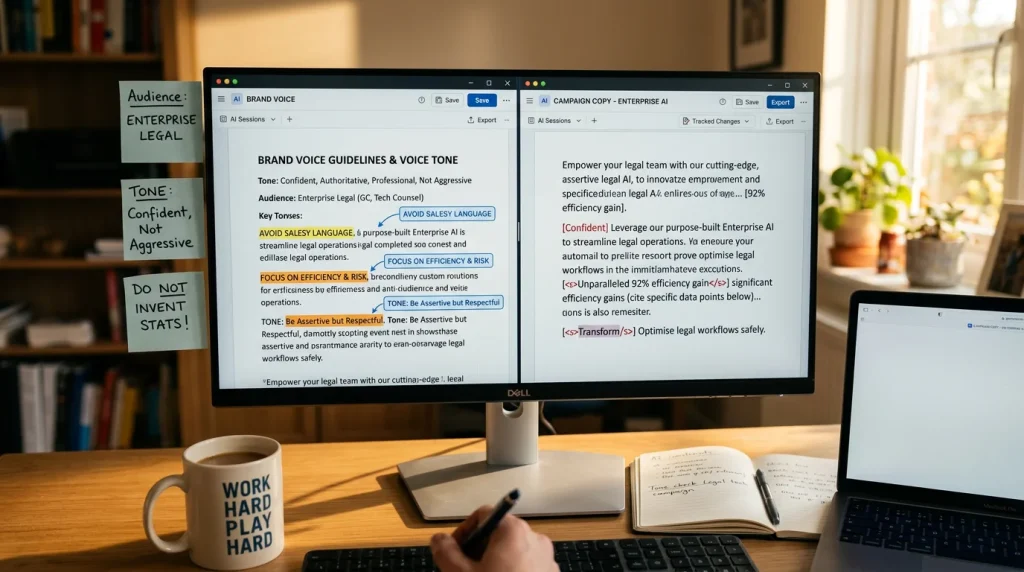
Marketing's relationship with AI is the most mature of the three departments and the most prone to false confidence. The work is mostly creative production, brand-voice work, and audience-specific copy. AI is genuinely transformative for the first draft of all of it and dangerous for finished work without grounding.
The marketing-specific training covers:
- Brand voice grounding. The team learns to paste the brand voice document into every creative prompt, instruct the model to match it, and use cited examples from prior work as the calibration signal.
- Audience-specific persona prompts. Templates for each major audience the brand serves, with explicit dos and don'ts that prevent the AI from defaulting to generic B2B copy.
- The first-draft discipline. AI produces the structural draft; the marketer owns the angle, the proof points, and the close. The training teaches the team to never publish without an editorial pass and instruments the edit ratio so improvement is measurable.
- Visual and multimodal prompts. Marketing increasingly works in image, video, and ad-creative AI tools. Each has its own prompt grammar; the workshop covers Midjourney, Nano Banana Pro, and the major video tools.
- Performance feedback loop. Marketing has more direct outcome telemetry than any other function. CTR, conversion, engagement. The training shows the team how to feed performance back into the prompt library so the next version of each template is informed by what worked.
A marketing team that completes the curriculum produces creative output that is on-brand, audience-tuned, and grounded, with an edit ratio that converges on what the team would accept from a junior copywriter. The output is not the AI's; it is the marketer's, with the AI doing the volume work, and Authority Solutions® Marketing Automation extends the same brand-voice discipline into the lifecycle workflow.
What Sales Actually Needs
Sales operates under different constraints than marketing. The work is mostly research, customization, and conversation, not volume content. AI is most valuable on research and recap, less valuable on cold outbound copy than vendors claim, and disastrous on un-grounded prospect outreach.
The sales-specific training covers:
- Account research workflows. Templates that pull together a prospect's 10-K language, recent news, leadership changes, and product-page positioning into a structured account brief the rep reads before the discovery call.
- Discovery call recap. The rep records the call (with consent), the AI transcribes and summarizes, and produces a structured recap matching the team's qualification framework. Manager review time drops sharply because every recap follows the same shape.
- Proposal first drafts. Templates that take the discovery notes and produce a structured proposal outline, with the rep writing the high-leverage paragraphs and the AI handling the connective tissue.
- Forecast hygiene. Reps learn to use AI to audit their pipeline, identify deals where the next step is missing or stale, and produce a clean weekly commit.
- The non-uses. Cold outbound copy without research, generic email templates, and any customer-facing output that has not been grounded against real account context. The workshop draws these lines explicitly so the team does not embarrass itself or the brand.
A sales team that completes the curriculum walks in to discovery calls better prepared, leaves the call with a sharper recap, and produces proposals that read like they were written for the specific prospect. The lift is in the parts of the job the rep already valued but never had time to do well, and Authority Solutions® CRM Implementation wires the sales prompt library directly into the rep's daily flow.
What Operations Actually Needs

Operations is the least obvious and often the highest-leverage AI training audience. The work is mostly variance detection, process documentation, and exception handling, all of which AI accelerates dramatically when the team learns to use it for the right tasks.
The operations-specific training covers:
- Process documentation at scale. AI captures and structures the institutional knowledge that lives in long-tenured employees' heads, producing SOPs that are searchable and actually current.
- Anomaly investigation. When a metric departs from baseline, the AI assembles the relevant context (recent process changes, supplier issues, system events) into an investigation brief the ops leader uses to direct the team.
- Vendor and contract analysis. AI reads through master service agreements, change orders, and amendments to surface the clauses the operations team needs to understand, with citations.
- Compliance and audit preparation. AI assembles the documentation the auditor will request, organized by control, with the gaps flagged before the auditor arrives.
- Data hygiene work. Ops teams own the master data in most organizations; AI accelerates duplicate detection, normalization, and entity resolution at scale.
An operations team that completes the curriculum produces documentation that did not exist before, catches variance earlier than the legacy reporting cadence allows, and walks into audits with the binder already assembled. The lift is in the work the team had been planning to do for years but never had the bandwidth for, and Authority Solutions® Workflow Automation industrializes the highest-frequency ops prompts.
Why a Unified Workshop Underperforms
A single workshop that tries to teach all three departments at once fails for predictable reasons:
- The drills do not match anyone's work. A generic prompt drill on "write a customer email" is not the marketing email, not the sales email, not the operations email. Everyone learns a watered-down version of their own discipline.
- The prompt library has no owner. Universal training produces universal prompts that no one champions. Department-specific training produces department-specific prompts that the function lead owns and improves.
- The performance metrics are blurred. Marketing wants engagement, sales wants pipeline, operations wants variance reduction. A unified curriculum cannot instrument them all; the team finishes without a way to prove the workshop worked.
- The peer reinforcement is missing. Department-specific training creates a cohort that shares a vocabulary and a library. Universal training disperses participants who never reinforce one another.
The unified workshop is cheaper per head and visibly worse in outcome. The cost of a department-specific rollout is the marginal training time; the return is multiples of what the unified version produces.
The Sequence That Works
The order in which departments train matters more than most rollouts recognize. The pattern Authority Solutions® has found durable:
- Start with marketing. Marketing has the fastest adoption curve and the most visible output. Early wins create organizational momentum.
- Sales second. Sales builds on the marketing-trained content patterns, and the sales prompts often reuse marketing's brand voice grounding work.
- Operations third. Operations needs the longest curriculum, the deepest custom prompt library, and the most patience. Running it third means the methodology is already proven inside the organization.
Each department's training stands alone and could be run in isolation, but the sequence above produces the strongest organization-wide adoption curve.
What the Investment Looks Like
A department-specific training engagement covers three departments over roughly twelve weeks:
- Weeks 1 to 4: Marketing. Two-day workshop, four weeks of office hours, prompt library at thirty prompts by close.
- Weeks 5 to 8: Sales. Two-day workshop, four weeks of office hours, sales prompt library at twenty-five prompts plus integration with the CRM.
- Weeks 9 to 12: Operations. Two-day workshop, four weeks of office hours, operations prompt library at twenty prompts plus SOP templates.
The investment is roughly two-and-a-half times a unified workshop and produces five to ten times the durable lift, measured at the ninety-day mark and again at the six-month mark, and Authority Solutions® AI Training Programs instruments both checkpoints as part of the engagement.
Key Takeaways
- The BCG research on AI at work shows productivity effects vary sharply by task type. A unified training course flattens that variance and leaves most of the available lift on the table.
- Marketing needs brand-voice grounding, audience-specific personas, first-draft discipline, multimodal prompts, and a performance feedback loop. The output is the marketer's; the AI does the volume work.
- Sales needs account research, discovery recap, proposal first drafts, forecast hygiene, and an explicit list of non-uses. The lift is in the parts of the job the rep valued but never had time to do well.
- Operations needs process documentation, anomaly investigation, vendor analysis, audit preparation, and data hygiene. The lift is in the long-deferred work the team finally has the bandwidth to ship.
- The unified workshop is cheaper per head and reliably worse in outcome. Department-specific training produces a cohort, a library owner, and instrumented metrics that the unified version cannot.
- The marketing, sales, operations sequence produces the strongest adoption curve. Marketing wins create momentum; sales reuses the brand voice work; operations gets the most patient onboarding once methodology is proven.
FAQ
What is department-specific AI training?
Department-specific AI training is a curriculum tailored to each function's actual workflow, prompt patterns, and performance metrics. Instead of a single universal workshop, marketing, sales, and operations each receive a curriculum, drill set, and prompt library matched to the work the function actually does.
Why not run a single AI workshop for everyone?
Research from BCG and others shows productivity lift from AI varies sharply by task type. A unified workshop teaches a watered-down version of each discipline, produces a generic prompt library no one owns, and instruments blurred metrics. The unified workshop is cheaper per head and reliably worse in outcome.
What does the marketing AI curriculum cover?
Brand voice grounding, audience-specific persona prompts, first-draft discipline with edit-ratio instrumentation, multimodal prompts for image and video AI, and a performance feedback loop that ties campaign outcomes back into the prompt library. The output is on-brand, audience-tuned, and grounded.
What does the sales AI curriculum cover?
Account research workflows, discovery call recap templates, proposal first drafts, forecast hygiene, and an explicit list of non-uses (cold outbound without research, generic templates, ungrounded customer-facing output). The lift concentrates in the high-value preparation work reps rarely have time for.
What does the operations AI curriculum cover?
Process documentation at scale, anomaly investigation, vendor and contract analysis, compliance and audit preparation, and data hygiene work. Operations is often the least obvious and highest-leverage AI training audience.
In what order should departments be trained?
Marketing first for fast wins and organizational momentum. Sales second to build on the marketing-trained content patterns and brand voice work. Operations third because it needs the deepest custom library and the most patient onboarding, which goes faster once methodology is proven inside the organization.
How long does department-specific training take?
A three-department engagement runs roughly twelve weeks: four weeks per department with a two-day intensive followed by four weeks of office hours and library build. Each department's training also stands alone and can be run in isolation if the organization is starting with one function.
How is success measured?
Marketing measures edit ratio and downstream campaign performance. Sales measures forecast hygiene, proposal quality, and pipeline progression. Operations measures documentation coverage, anomaly response time, and audit readiness. Each function instruments the metrics that match its work.
Does department-specific training cost more than a unified workshop?
Roughly two-and-a-half times more per head for three departments. The lift, measured at the ninety-day and six-month marks, is five to ten times larger than the unified workshop produces, making the per-dollar return substantially higher.
Who owns the prompt library after training?
A department lead owns each library. The marketing director owns the marketing prompts, the head of sales operations owns the sales prompts, the operations director owns the operations prompts. Ownership is the single biggest predictor of whether the library compounds or stagnates.
Conclusion
The unified AI workshop is the most common training rollout and the most predictable underperformer. BCG's research makes the cause explicit: AI's productivity effect varies sharply by task type, so a curriculum that ignores function-specific work will land function-specific results well below what each team can capture.
Authority Solutions® delivers department-specific AI training for marketing, sales, and operations across Texas and beyond. We map the workflow, build the function-specific prompt library, instrument the right metrics, and run the sequence that produces the strongest organization-wide adoption curve. The team finishes with the lift their work allows, not the lift a generic course offers.