
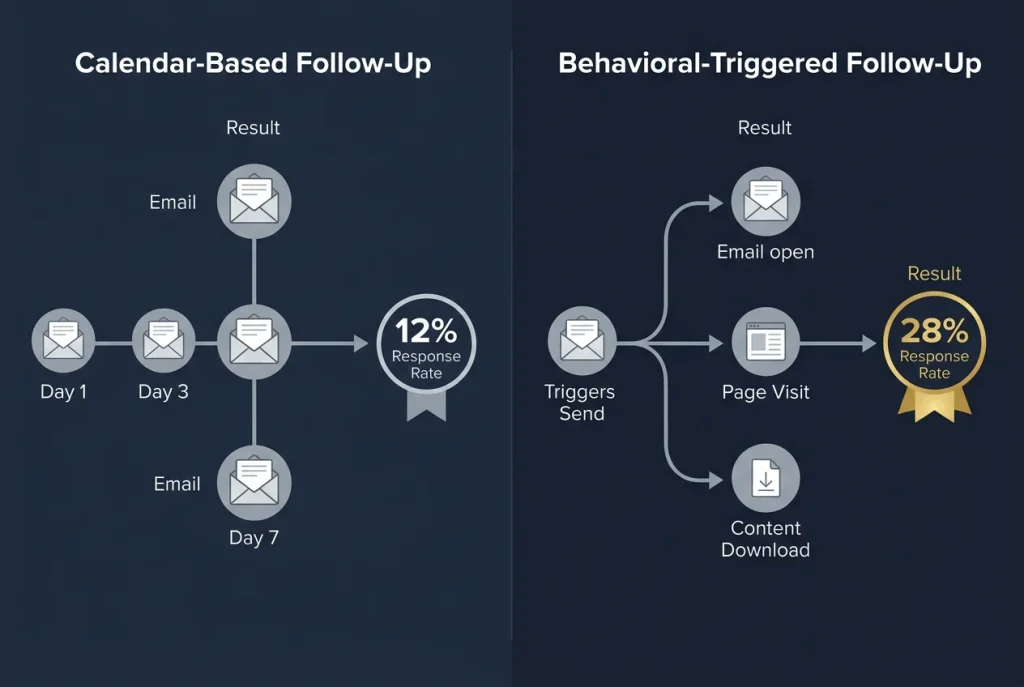
AI-powered CRM follow-up automation executes personalized lead nurture sequences triggered by specific prospect behaviors — email opens, page visits, content downloads, score thresholds — rather than fixed calendar schedules disconnected from actual buying signals. This behavioral trigger architecture produces response rates 2–3x higher than fixed-cadence sequences because outreach arrives when a prospect is demonstrably active and engaged, not when a timer fires regardless of context.
The most expensive sales failure mode isn't losing deals to competitors — it's losing deals to inaction. Research across B2B sales cycles consistently demonstrates that the majority of conversions require five or more contact attempts, yet most manual follow-up processes functionally collapse after the second or third touch when rep attention shifts to active negotiations. AI CRM automation solves this structurally: follow-up sequences execute completely regardless of rep workload, adapt based on prospect behavior at each step, and escalate to human intervention only when behavioral signals indicate the conversation is ready for it.
The "human touch" concern that most often surfaces in follow-up automation discussions is legitimate but misdirected. The question isn't whether automation preserves human feeling — it's whether automation is designed well enough that recipients can't tell the difference between a thoughtfully designed automated sequence and a manually written individual email. That design standard is achievable, and this article details exactly how to reach it.
Why Calendar-Based Follow-Up Sequences Underperform Behavioral Triggers
Calendar-based follow-up sequences — Day 1, Day 3, Day 7, Day 14 — underperform behavioral triggers because they apply identical timing and messaging to prospects regardless of their actual engagement state. A prospect who opened your last email, visited your pricing page twice, and downloaded a case study yesterday is in a fundamentally different buying context than one who hasn't opened anything in three weeks — yet a calendar-based sequence treats them identically. Behavioral trigger architecture applies the right message at the moment of demonstrated intent, not at an arbitrarily scheduled interval.
The timing dimension of this distinction is the most direct conversion driver. Contact with a prospect within minutes of a high-intent signal — a pricing page visit, a proposal download, a demo video completion — produces dramatically higher response rates than contact at a fixed interval that may or may not coincide with any active evaluation activity. The prospect who just finished reading your case study is in a different mental state than the one who will receive the same automated email on Day 7 regardless of what they've done in the intervening week.
The core behavioral triggers that drive highest-performing CRM follow-up architecture:
Tier 1: Immediate-Response Triggers (Fire Within 5–15 Minutes)
- Pricing page visit — the single highest-intent behavioral signal in most B2B models; rep notification should fire immediately alongside a relevant automated value-proof email
- Demo request or consultation form submission — immediate confirmation plus rep assignment
- Proposal document opened — rep notification with full context; this is the highest-priority sales trigger in an active opportunity
- High-value content download — case study or ROI calculator access indicates late-stage evaluation
Tier 2: Same-Day Response Triggers (Fire Within 2–4 Hours)
- Email clicked through to service or solution page — intent above average; personalized follow-up referencing the specific page viewed
- Second or third website visit within one week — repeat self-directed research signals sustained evaluation
- Lead score crosses defined threshold — score milestone triggering rep assignment or sequence acceleration
Tier 3: Cadence Triggers (Fire on Defined Delays After Previous Action)
- No email open after 3 days — subject line variation test or channel switch to SMS
- No response after 2 follow-ups — move to a value-delivery email (insight, resource) rather than another ask
- Dormancy after 30 days — re-engagement sequence with pattern interrupt subject line
| Trigger Type | Timing | Expected Response Rate Lift vs. Calendar | Use Case |
| Pricing page visit | Within 5 min | +180–240% | Active evaluation signal |
| Content download | Within 15 min | +120–160% | Late-stage research signal |
| Email click to service page | Within 2–4 hrs | +80–110% | Interest above baseline |
| Score threshold crossed | Within 1 hr | +90–130% | Pipeline acceleration signal |
| No open after 3 days | Day 3 | Maintains baseline | Cadence recovery |
| 30-day dormancy | Day 30 | Pattern interrupt required | Re-engagement |
According to HubSpot's Email Marketing Benchmarks, behavior-triggered emails generate 3x higher open rates and 2x higher click-through rates compared to batch-and-blast campaigns — a performance differential that directly translates to pipeline velocity improvement when applied to CRM nurture sequences.
Building Follow-Up Sequences That Feel Human, Not Automated
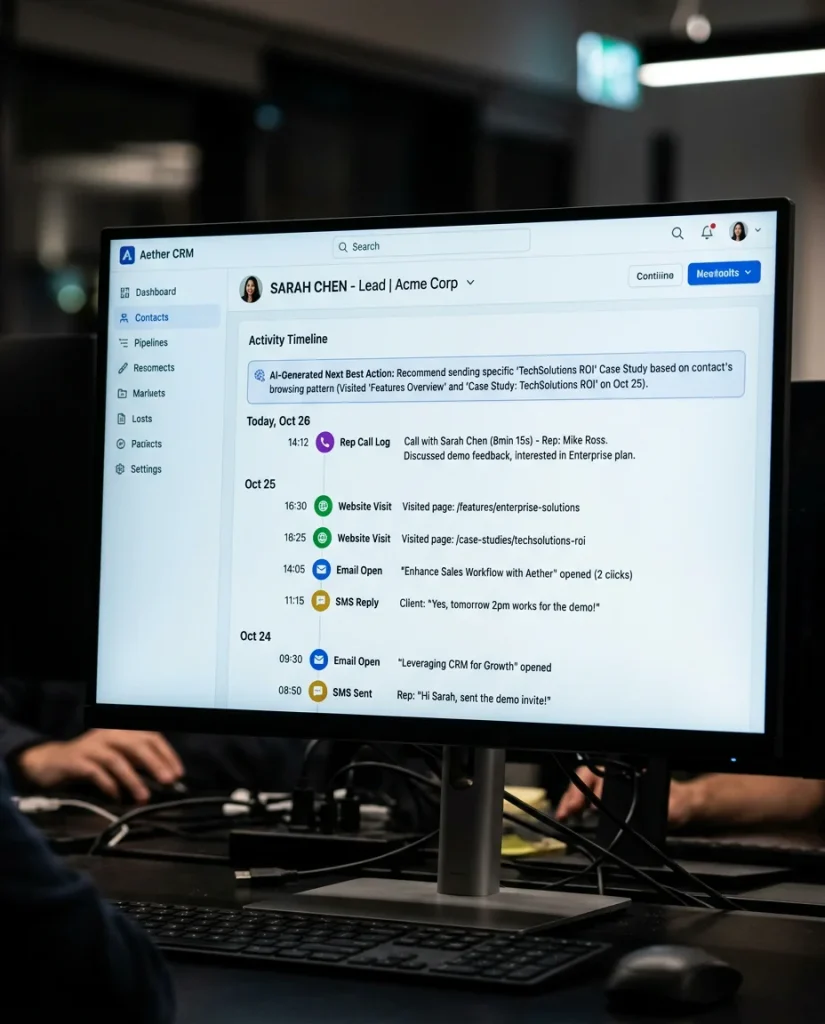
The perceived "humanness" of an automated follow-up sequence is determined by four design variables: message specificity (does the email reference what the prospect actually did or viewed), timing plausibility (does the send time feel like a person wrote it on a normal workday rather than a bot firing at 3 AM), reply detection (does the sequence pause immediately when a prospect responds), and escalation intelligence (does it hand off to a human at the right moment rather than continuing to fire automation after a conversation has begun). Sequences that optimize all four variables are indistinguishable from individually written outreach in recipient experience.
This is the design standard that separates Authority Solutions® automated sequence architecture from the generic templates most automation platforms ship with. Template sequences are detectable — recipients recognize their structural patterns because they've seen them before. Custom sequences built around your specific prospect behavior data, your brand voice, and real personalization tokens referenced to actual engagement history produce a categorically different recipient experience.
Message Specificity: Reference What the Prospect Actually Did
Generic: "I wanted to follow up on my previous email and see if you had any questions."
Behavioral: "I noticed you took a look at our case study on workflow automation for legal firms — given the volume challenges firms like yours typically run into, I thought this 3-minute breakdown of how we reduced processing time for a Houston practice might be worth your time."
The second version references a real behavior (case study view), connects it to a relevant pain point (volume challenges), and offers specific value (a concrete example with a measurable outcome). It took the same amount of time to send — because it was automated — but it reads as individually crafted because it was individually relevant.
Timing Plausibility: Send During Business Hours
Automated sequences firing at 11:47 PM or 6:12 AM are identifiable as automation regardless of how well-crafted the message is. Configure follow-up sequences to deliver within business hours windows (8 AM – 5 PM recipient time zone) and introduce slight send-time variation (not all emails sending at the top of the hour). These configuration choices cost nothing and preserve the perception of individual sender behavior.
Reply Detection: The Non-Negotiable Sequence Rule
Every follow-up automation sequence must incorporate reply detection — the logic that immediately pauses all automated outreach when a prospect responds to any message in the sequence. Continuing to send automated follow-ups after a conversation has begun is the most reliable way to damage trust and signal that the entire sequence was robotic. Reply detection is a standard feature in platforms like ActiveCampaign, HubSpot, and GoHighLevel; it must be explicitly configured, not assumed.
Escalation Intelligence: Know When to Hand Off
The sequence's job is to create the conditions for a sales conversation, not to replace it. Define specific behavioral thresholds — score reaching 80+, pricing page visit, proposal opened — at which the sequence pauses and a rep notification fires. The automation has done its job; human judgment takes over for the conversation it warrants.
Sequence Architecture by Funnel Stage
Effective CRM follow-up automation requires distinct sequence architectures for different funnel positions — a new cold lead requires a different nurture approach than a warm prospect who engaged with a proposal last week. Applying a single universal sequence to all contacts regardless of their pipeline position produces messaging mismatch that depresses conversion rates across every stage simultaneously.
The three core sequence types and their structural requirements:
New Lead Nurture (Top of Funnel): 5–7 touch sequence over 14–21 days. Objective is value delivery and trust establishment, not immediate conversion request. Touch mix: educational content delivery (2 touches), social proof via case study or client outcome (1 touch), direct value offer like a free audit or consultation (1 touch), breakup email if no engagement after final attempt (1 touch). Personalization tokens: first name, company name, industry-specific pain point reference.
Warm Lead Acceleration (Mid Funnel): 3–5 touch sequence over 7–10 days. Triggered by lead score crossing a defined threshold or high-intent behavioral signal. Objective is moving an engaged prospect toward a scheduled conversation. Touch mix: behavior-referenced follow-up (1 touch), specific social proof matched to their industry or challenge (1 touch), direct calendar link offer (1 touch), SMS follow-up if no email response after 48 hours (1 touch). Personalization tokens: specific page or content visited, rep first name for personal send appearance.
Re-Engagement (Dormant Contacts): 2–3 touch sequence with 14-day gaps. Triggered by 30–60 days of no engagement. Objective is pattern interruption to reactivate. Touch mix: pattern-interrupt subject line with unexpected value offer (1 touch), direct soft ask ("Still exploring options? Happy to answer questions with no pressure") (1 touch), final breakup email with clear unsubscribe path (1 touch). Aggressive unsubscribe inclusion in re-engagement sequences actually improves deliverability by cleaning non-engaged contacts from the active list.
Key Takeaways
- Behavioral triggers produce 2–3x higher response rates than calendar sequences because outreach arrives at moments of demonstrated intent — pricing page visits, content downloads, score spikes — not at arbitrary fixed intervals.
- HubSpot benchmark data confirms the performance gap: behavior-triggered emails achieve 3x higher open rates and 2x higher click-through rates compared to non-triggered outreach, translating directly to pipeline velocity improvement.
- Four design variables determine sequence perceived humanness: message specificity, timing plausibility, reply detection, and escalation intelligence. Sequences optimized across all four are experientially indistinguishable from individually written outreach.
- Reply detection is non-negotiable: continuing to send automation after a prospect responds is the single most reliable way to identify the entire sequence as robotic and damage relationship trust.
- Distinct sequence architectures are required by funnel stage — applying a universal sequence to all contacts regardless of pipeline position produces messaging mismatch that depresses conversion across every stage simultaneously.
- Escalation intelligence is where automation creates human value: the sequence's job is to build the conditions for a sales conversation, not replace it — behavioral thresholds that pause automation and trigger rep notification are where the system earns its ROI.
Conclusion
AI-powered CRM follow-up automation delivers its highest value when it's designed to feel like a thoughtful human wrote each message at exactly the right moment — because that's precisely what behavioral trigger architecture produces at scale. The combination of behavioral signal detection, personalization token depth, reply detection, and intelligent escalation creates a follow-up system that consistently outperforms manual processes on every measurable dimension: response rates, pipeline velocity, and conversion rates — while freeing rep capacity for the conversations the system creates.
Authority Solutions® builds CRM follow-up automation architecture as part of integrated AI CRM services — calibrated to your specific lead behavior patterns, your brand voice, and your sales process logic. Contact our team to discuss how behavioral trigger sequences apply to your current pipeline volume and follow-up challenges.
Frequently Asked Questions
What is CRM follow-up automation?
CRM follow-up automation uses your CRM platform's workflow and sequencing tools to execute personalized outreach across email, SMS, and internal notifications based on predefined triggers — prospect behaviors, time delays, or score thresholds. The automation handles execution; you design the strategy, messaging, and escalation logic that determines what fires, when, and why.
How is behavioral-triggered follow-up different from a standard drip campaign?
A drip campaign sends messages on a fixed schedule regardless of recipient behavior — Day 1, Day 3, Day 7 regardless of engagement. Behavioral-triggered follow-up fires based on what a prospect actually does: opens an email, visits a specific page, downloads content, or crosses a score threshold. The behavioral version reaches prospects at moments of active intent rather than arbitrary intervals, producing measurably higher response rates.
What happens if a prospect replies to an automated follow-up sequence?
In a properly configured sequence, a prospect reply immediately triggers a pause on all subsequent automated messages — called reply detection. The rep receives a notification with full conversation context and the lead's behavioral history, enabling a seamless transition from automated nurture to human conversation. Sequences that don't include reply detection continue firing automation after a conversation begins, which damages trust and relationship credibility.
How many touches should a lead nurture sequence include?
Optimal sequence length varies by funnel stage and lead temperature. New top-of-funnel leads typically warrant 5–7 touches over 14–21 days before a final breakup email. Warm mid-funnel leads with behavioral signals warrant 3–5 accelerated touches over 7–10 days. Re-engagement sequences for dormant contacts use 2–3 touches with 14-day gaps and clear unsubscribe paths. Sequences longer than these ranges without engagement signals produce diminishing returns and deliverability risk.
Which CRM platforms support behavioral trigger automation?
HubSpot, GoHighLevel, ActiveCampaign, and Salesforce all support behavioral trigger automation natively — including email open detection, page visit triggers via tracking code, form submission triggers, and lead score change triggers. The configuration complexity varies by platform; HubSpot and GoHighLevel offer the most accessible workflow builders for SMB-level implementations without dedicated technical staff.