
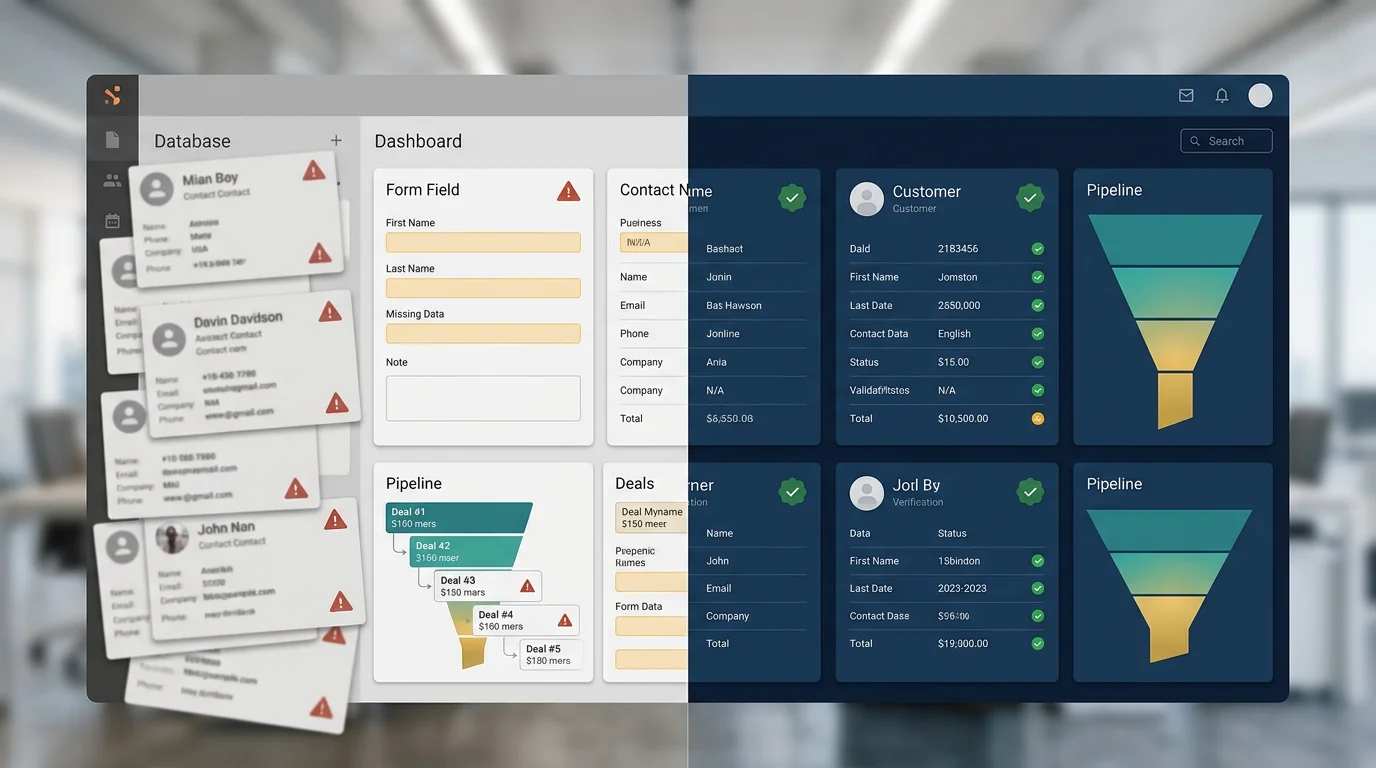
CRM data hygiene is the continuous, AI-driven process of keeping customer data accurate, complete, consistent, and current. It prevents errors at entry, deduplicates continuously, enriches records in real time, and governs data quality as an ongoing discipline rather than a quarterly cleanup project. The shift from periodic to continuous is what makes every downstream AI and revenue capability possible.
Your sales team opens the pipeline dashboard Monday morning, and three reps are chasing the same prospect under slightly different company spellings. Twenty percent of the contacts on the outbound list bounced last quarter. The forecast call is in an hour, and nobody quite trusts the number. This is what dirty CRM data costs in real revenue, wasted rep cycles, and leadership trust eroding one forecast at a time.
The good news is that the same tools that introduce bad data (form fills, imports, integrations, manual entry) are now the same tools that can clean it continuously. Below, you will learn what separates hygiene from cleansing, why data quality is now the #1 blocker to AI adoption, the five pillars of a modern hygiene stack, the metrics to track, the platform-specific deployment patterns that actually work, and the 90-day framework to turn a dirty CRM into a reliable decision-making system. The work draws on patterns observed across AI CRM solutions deployments where dirty data was the variable holding back every AI initiative downstream.
What Is CRM Data Hygiene (and Why "Hygiene", Not "Cleansing", Matters)
CRM data cleansing is reactive. It finds errors that already exist and fixes them. CRM data hygiene is proactive. It sets guardrails so errors never enter the system in the first place. The distinction matters because the cheapest fix is the one that happens before a bad record lands in your database. Real-time validation at the point of entry, email verification APIs, format masks, address standardization, and duplicate detection act as a filter at the door. The manual dedupe project your ops team runs every quarter is cleanup from the records that slipped through.
Most organizations still treat CRM data as something to clean periodically. The leaders treat it as something to protect continuously. That shift, from periodic to continuous, is the single biggest operational change required, and it is what makes every downstream AI and revenue capability possible. A quarterly cleanup project also fails on a structural level because by the time the project ends, new bad records have accumulated, the data is already stale, and the analyst hours that produced the cleanup were diverted from strategic work.
The economic framing matters when explaining the shift to leadership. Quarterly cleanup is a cost center with diminishing returns. Continuous hygiene is a compounding capability that improves every AI outcome the company invests in next.
Table 1: Cleansing vs Hygiene at a Glance
| Discipline | Cadence | Approach | Cost Profile | Result |
| Cleansing | Periodic (quarterly or annual) | Reactive: find and fix existing errors | Cost center, diminishing returns | Clean data temporarily |
| Hygiene | Continuous (real-time) | Proactive: prevent errors at entry | Compounding capability | Clean data permanently |
Why CRM Data Hygiene Is the #1 Blocker to AI Adoption
AI amplifies both clean and dirty data. Feed a lead scoring model stale contact information and it will confidently rank the wrong accounts. Feed a forecasting model duplicate opportunities and it will double-count your pipeline. Feed a segmentation engine misspelled job titles and it will miss your ideal customers entirely. The model is not the problem in any of these cases. The data is. And the worst part of bad-data-driven AI is that the outputs look authoritative. The forecast comes with a confidence interval. The lead score comes with a numeric rank. The presentation hides the underlying problem until decisions have already been made on top of it.
Per a 2026 Gartner survey on AI readiness, 63% of organizations either do not have, or are unsure whether they have, the right data management practices for AI. The same research predicts organizations will abandon 60% of AI projects through 2026 because the data cannot support them. Data hygiene is not a prerequisite for some AI use cases. It is the prerequisite. The companies that recognize this in their planning sequence (data first, then AI) are the ones whose AI investments produce returns.
The economic framing that moves leadership: every dollar invested in AI projects without underlying data quality is a dollar with a negative expected return. Cleaning the data is not a cost center, it is the yield curve for every downstream AI investment the company is already planning to make.
Table 2: How Bad Data Breaks Common AI Use Cases
| AI Use Case | Bad Data Symptom | Result |
| Lead scoring | Stale contact info, missing fields | Confidently ranks wrong accounts |
| Forecasting | Duplicate opportunities | Double-counts pipeline |
| Segmentation | Misspelled job titles | Misses ideal customer profile |
| Personalization | Outdated company size, role | Wrong message to wrong segment |
| Churn prediction | Missing engagement events | Predicts churn for healthy accounts |
The 5 Pillars of AI-Powered CRM Data Hygiene

Modern AI CRM hygiene stacks address five continuous functions that work together. Miss any one of them and the others lose value, because data quality is a systems problem rather than a feature problem. The five pillars are:
- Validation at point of entry. Required fields, dropdowns replacing free-text, format validation on emails and phone numbers, and real-time address standardization catch errors before they enter the system. AI adds fuzzy matching, recognizing that "Acme Corp." and "ACME Corporation" are the same account even when the entry does not match exactly.
- Continuous deduplication. AI identifies duplicates across records that share no exact-match field (same person, different email; same company, different spelling). Traditional rules-based deduplication catches 40 to 60% of duplicates. AI-powered probabilistic matching catches 90%+.
- Enrichment and completion. When a rep fills out 3 of 15 required fields, AI pulls the remaining 12 from connected sources (company size, industry code, tech stack, revenue band, LinkedIn profile) so the record is complete the first time. The rep captures the lead faster, and the record is immediately useful for downstream automation.
- Decay detection. Email addresses become invalid at roughly 22% per year. Job titles change. Companies merge. AI monitors record freshness and routes aging records to automated re-verification or targeted outreach before the decay contaminates campaigns.
- Governance and audit. AI generates hygiene scorecards at the record, user, team, and organization level so leaders see exactly where quality wins and losses happen, including which reps create the cleanest records, which integrations introduce errors, and which campaigns drive data quality up or down.
The structural shift across all five pillars is the same: AI lets every pillar operate continuously rather than on a calendar. The traditional approach ran on a project schedule, with cleanup running quarterly, enrichment running on imports, and deduplication running when someone noticed a problem. The AI-powered approach runs in real time, which both prevents errors from accumulating and changes the cost profile from a recurring expense to a fixed-capability investment.
Table 3: Traditional vs AI-Powered Approach Across the 5 Pillars
| Pillar | Traditional Approach | AI-Powered Approach | Typical Lift |
| Validation | Required fields plus regex | Fuzzy matching plus real-time normalization | 10x fewer bad entries |
| Deduplication | Rules-based exact match | Probabilistic multi-field scoring | 40-60% to 90%+ catch rate |
| Enrichment | Manual lookups, periodic imports | Real-time enrichment at entry | 12+ fields auto-populated |
| Decay Detection | Quarterly bounce-list review | Continuous freshness monitoring | Bounce rate cut 40-60% |
| Governance | Ad-hoc admin reports | Dashboards at record/user/team level | Leading vs lagging indicators |
How to Measure CRM Data Hygiene Performance

Track three headline metrics monthly. Teams that measure these cut quarterly cleanup time by more than half because the metrics surface problems early enough to fix them before they compound. The headline three are deliberately small in number, because dashboards with dozens of quality measurements produce decision paralysis rather than action:
- Percentage of contacts missing a valid email (target: under 5%)
- Percentage of contacts missing a phone number (target: under 10%)
- Percentage of open opportunities missing a close date (target: under 3%)
Below the headline numbers, track record-level completeness (the percentage of required fields populated), duplicate rate (duplicates as a percentage of total records), enrichment coverage (the percentage of records enriched in the last 90 days), and email deliverability (the bounce rate from the last outbound send). These secondary metrics support the headline three but should not replace them at the leadership reporting layer, because anything more than three numbers makes it harder to keep the team focused.
The reason the three headline metrics matter more than the dozens of other quality measurements teams try to track: they are directly observable, directly fixable, and directly tied to sales and marketing outcomes. A rep cannot reach a prospect without an email or phone. A forecast cannot mean anything without a close date. Fix the three, and the dozens of downstream numbers follow because the underlying hygiene discipline that improves the headline three improves everything else as a byproduct.
Platform-Specific Deployment
The deployment path depends heavily on the underlying CRM, and the four most common scenarios map to distinct starting points. The principle is the same regardless of platform: exhaust native capabilities first, layer specialized tooling where native coverage falls short, and architect the governance layer before scaling. Skipping the governance step is the most common mistake because the platform features and the third-party tools both seem to handle quality on their own, but neither produces the cross-record visibility leadership needs.
Platform-specific deployment patterns:
- Salesforce. Einstein Data Detect, Duplicate Management, and Lightning Data are native features worth switching on before any third-party tooling. Validity DemandTools, Plauti, and Cloudingo deepen the native stack for enterprise-scale dedupe. Most mid-market Salesforce deployments cover 70 to 80% of hygiene needs with native features alone.
- HubSpot. Native AI features (Breeze, duplicate management, enrichment) have matured fast in 2025 and 2026. Clearbit and ZoomInfo integrations add enrichment depth for B2B segments. Smaller implementations often need nothing beyond native HubSpot once properly configured.
- Microsoft Dynamics. Copilot for Sales, Data Management capabilities, and Dynamics-native duplicate detection cover most mid-market use cases. LinkedIn Sales Navigator integration adds first-party signal richness, and Purview governance layers support enterprise data quality audits.
- Smaller or custom CRMs. Pipedrive, Zoho, and custom-built systems need dedicated hygiene platforms layered on top. Tools such as DemandTools, Melissa, Experian Aperture, and Datanyze do the work that native features handle on larger platforms. The lighter the native feature set, the heavier the layered tooling.
The work to upgrade these stacks frequently overlaps with AI workflow automation projects because the data quality layer feeds every automation downstream. Architecting identity resolution and governance from the start prevents retrofit work that becomes expensive once data volume grows.
The 90-Day Hygiene Framework
When Authority Solutions® as a digital marketing agency deploys CRM data hygiene with clients, the work is sequenced across a 90-day window so the business sees results fast without overwhelming the team. The framework has three phases of 30 days each, and each phase produces visible outputs that build confidence before the next phase begins.
The three phases:
- Days 1 to 30: Assessment and Baseline. Audit current data quality, instrument the three headline metrics, map integration points that introduce the most errors, and identify the top 10% of records that drive 80% of pipeline value. The output is a concrete list of quality gaps ranked by business impact, not a generic "your data is dirty" report. Skipping this diagnostic and going straight to deployment is the most common reason hygiene programs run over budget.
- Days 31 to 60: Validation Layer Deployment. Install entry-point validation on forms, integrations, and manual entry paths. Deploy AI deduplication across existing records with human review on ambiguous merges. Start automated enrichment on high-value segments first (the top 10% of pipeline accounts, not the full database). Priority sequencing produces visible wins within two weeks and funds the rest of the deployment politically.
- Days 61 to 90: Governance and Iteration. Stand up hygiene scorecards at team and user level, tune rules based on the 60-day data quality trend, and transition the client team to ongoing governance while monitoring continues. The test of whether the deployment stuck is whether the three headline metrics keep improving after the consulting engagement steps back.
By day 90, clients typically see bounce rates drop 40 to 60%, duplicate records reduced by 80%+, and forecast accuracy improve to within a meaningful margin of what leadership can act on. The ongoing governance layer is what keeps those gains from regressing and turns the 90-day project into a permanent capability rather than a one-time cleanup.
Key Takeaways
- CRM data hygiene is proactive while data cleansing is reactive. Hygiene prevents errors at entry through validation, dedupe, and enrichment. The shift from periodic cleansing to continuous hygiene is the single biggest operational change required.
- AI amplifies both clean and dirty data. Gartner projects 60% of AI projects will be abandoned through 2026 because the underlying data cannot support them, which makes data hygiene the prerequisite for any AI investment.
- The 5 pillars of modern AI hygiene are validation at entry, continuous deduplication, enrichment, decay detection, and governance. Each pillar must operate continuously rather than on a calendar.
- Three headline metrics drive hygiene performance: percentage of contacts missing valid emails, percentage missing phone numbers, and percentage of open opportunities missing close dates. Teams that measure these monthly cut quarterly cleanup time by more than half.
- Platform deployment follows a consistent principle: exhaust native capabilities first, layer specialized tooling where native coverage falls short, and architect the governance layer before scaling. Salesforce, HubSpot, and Microsoft Dynamics ship strong native AI hygiene features.
- The 90-day framework sequences assessment, validation deployment, and governance so the business sees measurable wins within the first 30 days. Skipping the assessment phase is the most common reason hygiene programs run over budget.
Getting Started With AI CRM Data Hygiene
If you are evaluating AI data hygiene for your CRM, start with the assessment. Pull your three headline metrics today: missing emails, missing phones, missing close dates. Those numbers will tell you whether your CRM is a reliable decision-making surface or a liability your team works around. If the three numbers come back significantly off the targets above, the next investment should be hygiene rather than another AI tool, because the AI tool will not perform on dirty data regardless of how good the model is.
From there, the path depends on your current stack. Teams on Salesforce, HubSpot, and Microsoft Dynamics have native AI data features that can be switched on before any third-party tooling is added. Teams on smaller or custom CRMs benefit from dedicated hygiene platforms layered on top. To baseline your three headline metrics and map the 90-day path to a reliable, AI-ready CRM, schedule a consultation for a CRM Data Hygiene Assessment.
Conclusion
Prevention beats cleanup. Build the guardrails once (validation at entry, continuous deduplication, real-time enrichment, decay detection, and governance scorecards) and the CRM becomes what it was always supposed to be: a source of truth your team trusts and your AI can build on. Teams that move from quarterly cleanup projects to continuous AI hygiene see the math show up within 90 days with cleaner data, faster forecasts, and AI outcomes that finally match the pitch.
Frequently Asked Questions
What is CRM data hygiene?
CRM data hygiene is the continuous process of keeping customer data accurate, complete, consistent, and current inside a CRM system. It includes validation at entry, deduplication, enrichment, decay detection, and governance, run proactively rather than as periodic cleanup. Unlike data cleansing, hygiene prevents errors at entry.
What is the difference between CRM data cleansing and CRM data hygiene?
Data cleansing is reactive: finding and fixing errors that already exist. Data hygiene is proactive: setting guardrails so errors never enter the system. Cleansing is a project with a start and end date. Hygiene is a continuous system that runs every day. Most mature programs use AI hygiene continuously.
Why does CRM data hygiene matter for AI?
AI amplifies both clean and dirty data. Gartner research indicates 60% of AI projects will be abandoned through 2026 because the data cannot support them. Hygiene is the prerequisite for AI lead scoring, forecasting, segmentation, and personalization. Investing in AI models before the data is hygienic produces confidently wrong recommendations.
How often should a CRM be cleaned?
With AI-powered hygiene, cleanup is continuous rather than periodic. Traditional cadences include daily entry-point validation, weekly pipeline reviews, monthly deduplication audits, and quarterly deep cleans. AI collapses most of that into real-time operation, with errors caught at entry, duplicates detected as they accumulate, and enrichment running on every record.
What are the most important CRM data hygiene metrics?
Three headline metrics: percentage of contacts missing a valid email, percentage missing a phone number, and percentage of open opportunities missing a close date. Below those, track record completeness, duplicate rate, enrichment coverage, and email deliverability. Monthly reporting on the headline three usually surfaces regressions before they damage pipeline.
What tools work best for AI CRM data hygiene?
The right toolset depends on the underlying CRM. Salesforce environments use Einstein Data Detect, Lightning Data, and specialists like DemandTools or Cloudingo. HubSpot exhausts native Breeze AI before layering Clearbit or ZoomInfo. Microsoft Dynamics shops use Copilot for Sales and Purview governance.
How long does it take to see results from AI CRM data hygiene?
Most deployments show measurable improvement in the three headline metrics within 30 to 45 days. By day 90, typical results include 40 to 60% reduction in bounce rates, 80%+ reduction in duplicate records, and noticeably tighter forecast confidence intervals. Full cultural adoption usually takes 6 to 9 months.
Does AI CRM data hygiene work with Salesforce, HubSpot, and Microsoft Dynamics?
Yes, and better than it works with smaller CRMs. Salesforce, HubSpot, and Microsoft Dynamics all ship native AI data quality features that cover 70 to 80% of use cases before any third-party tooling is required. Third-party platforms fill remaining gaps for enterprise-scale deduplication, complex identity resolution, or vertical-specific enrichment needs.
How does AI-powered deduplication differ from traditional deduplication?
Traditional deduplication relies on exact-match rules across specific fields. It typically catches 40 to 60% of duplicates and misses any record that varies even slightly in spelling. AI-powered deduplication uses probabilistic matching across many fields simultaneously, treating near-matches as likely duplicates. Catch rates commonly reach 90%+ with fewer false positives.
What does AI data enrichment actually add to a CRM record?
Enrichment adds context the rep did not capture at entry: company size, industry code, tech stack, revenue band, headquarters location, LinkedIn profile, job function, and intent signals. A record arriving with three fields can leave the enrichment layer with fifteen or twenty populated fields ready for segmentation.