

AI lead scoring uses machine learning models trained on your historical conversion data to assign each prospect a real-time probability score reflecting their current likelihood of closing — replacing subjective rep prioritization with objective, continuously updated intelligence. Sales teams operating on AI lead scores consistently close at higher rates because they concentrate effort on the contacts most actively signaling intent, not the contacts that arrived most recently or followed up most persistently.
The lead prioritization problem is one of the most expensive inefficiencies in sales operations, and it's almost entirely invisible until quantified. A sales rep working a pipeline of 80 leads without scoring-based prioritization distributes attention through some combination of recency bias, personal rapport, and deal size intuition. Some of that judgment is sound; much of it is systematically wrong. The prospect who downloaded a case study, visited the pricing page twice, and opened every email in the last 14 days — but hasn't responded to an outreach yet — scores far higher on actual conversion probability than a prospect who replies promptly but hasn't engaged with any high-intent content. Without AI CRM scoring surfacing that distinction, the first prospect sits at the bottom of the follow-up queue while the second gets disproportionate attention.
This article covers how AI lead scoring models work, which signal categories carry the highest predictive weight, and how to integrate scoring into daily sales workflow so the intelligence actually changes rep behavior — not just dashboard numbers.
How AI Lead Scoring Models Are Built and Why They Outperform Static Scoring
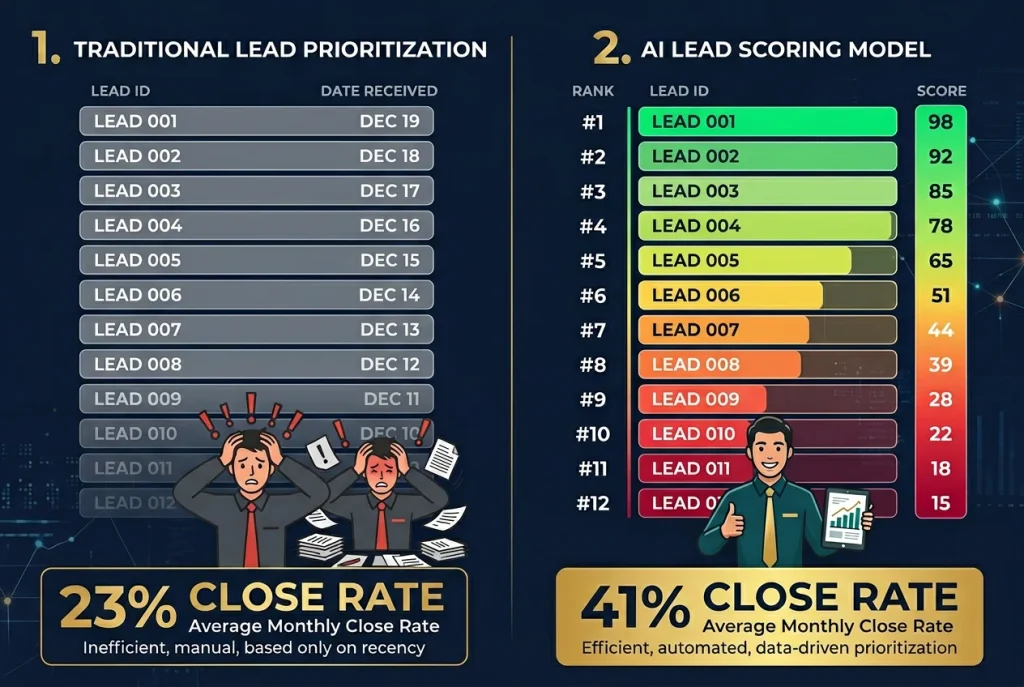
AI lead scoring models outperform static demographic and firmographic scoring systems because they train on your actual historical conversion data — learning which specific signal combinations in your market correlate with closed deals — rather than applying generic industry weights that may bear no relationship to your customer profile. The model's accuracy compounds over time as it accumulates more outcome data, producing a prioritization tool that becomes a genuine competitive advantage as it calibrates to your specific sales patterns.
Static scoring models — the kind where a job title earns 20 points, a company size match earns 15 points, and an email open earns 5 points — have two structural failure modes. First, the weights are assigned by intuition rather than calibrated against outcome data, meaning they often score the wrong signals highest. Second, they're static: a contact with the ideal demographic profile who last engaged eight months ago scores identically to one who visited your pricing page yesterday. Static models measure fit; AI models measure intent.
The ML model construction process for AI lead scoring follows a defined sequence:
Step 1 — Historical data ingestion: The model ingests your closed-won and closed-lost deal records — typically 12–24 months of history — extracting the behavioral and demographic signals present at each stage of deals that converted versus those that didn't. Minimum viable training dataset is approximately 200–300 closed deals; models with 1,000+ records produce materially higher initial accuracy.
Step 2 — Signal weight calibration: The model identifies which signals correlate most strongly with conversion in your specific data. Pricing page visits might carry 3x the predictive weight of blog post views in your dataset — or 10x, depending on your customer behavior patterns. These weights emerge from the data rather than being manually assigned, which is why ML scoring outperforms rule-based scoring in longitudinal studies.
Step 3 — Threshold scoring: The trained model assigns probability scores to current prospects by evaluating their signal profiles against the patterns learned from historical data. Scores update automatically as new behavioral signals are recorded.
Step 4 — Continuous recalibration: As new deals close (won or lost), those outcomes feed back into the model, continuously improving its accuracy. This recalibration loop is the mechanism through which AI scoring becomes more accurate over time rather than degrading.
| Scoring Approach | Data Foundation | Weight Assignment | Recalibration | 12-Month Accuracy |
| Static demographic scoring | Industry benchmarks | Manual / intuition | None | 45–55% |
| Rule-based behavioral scoring | Internal assumptions | Manual / rule-based | Manual only | 55–65% |
| AI / ML predictive scoring | Your historical closed deals | Algorithm-derived | Continuous, automatic | 75–90% |
According to Forrester's research on sales intelligence, B2B organizations using AI-driven lead scoring report 10–20% higher conversion rates and 15–25% shorter sales cycles compared to those using manual or rule-based prioritization — outcomes that compound directly into revenue per rep per quarter.
The Signal Categories That Predict Conversion Most Reliably
Behavioral signals carry the highest predictive weight in AI lead scoring models — consistently outperforming demographic and firmographic fit signals as conversion predictors — because they reflect current buying intent rather than static profile characteristics. A contact who matches your ideal customer profile but hasn't engaged in 90 days is a weaker conversion candidate than one who slightly mismatches your typical profile but has visited your pricing page three times this week.
This behavioral primacy insight is the most counterintuitive finding in sales intelligence research, and it's the one that most static scoring models get wrong by weighting demographic fit above behavioral signals. The architectural implication for AI lead scoring: behavioral signals must be continuously captured and refreshed in real time, not batch-updated weekly, to reflect the current state of a prospect's buying process.
High-Predictive-Weight Behavioral Signals
Pricing and conversion-intent page visits: Visits to pricing, ROI calculator, comparison, and "get started" pages carry the highest behavioral predictive weight in most B2B models — typically 3–5x the weight of blog or resource page visits. A contact visiting the pricing page twice in one week is displaying purchasing research behavior, not general interest.
Case study and evidence content access: Downloads of case studies, client results pages, and proof-of-concept documentation indicate a prospect in late-stage evaluation — comparing evidence of outcomes rather than exploring whether a solution category applies to their problem.
Email engagement frequency and recency: Not whether a contact opened a single email, but the pattern — open rate over trailing 30 days, click behavior on specific content types, response to direct outreach. Declining engagement after a period of high engagement is a deal-risk signal; improving engagement after dormancy is a re-engagement signal requiring immediate prioritization.
Return visit frequency: Multiple return visits to the same site without direct outreach — particularly to service or solution pages — indicates a prospect conducting self-directed research. Frequency and session depth (pages per visit) both feed the scoring model.
Score velocity: The rate of score change over 7–14 days. A contact whose score increased 25 points in one week is displaying accelerating intent — time-sensitive prioritization is warranted regardless of absolute score level.
Fit Signals as Scoring Multipliers
Demographic and firmographic signals function best as scoring multipliers rather than primary predictors — amplifying a high behavioral signal profile for contacts who also match your ideal customer profile, and moderating scores for contacts with strong behavioral signals but poor fit:
- Industry vertical alignment with historical closed-won concentration
- Company size and revenue band relative to your typical client profile
- Decision-maker title versus individual contributor (authority multiplier)
- Geographic match for locally-delivered or region-specific services
Integrating Lead Scores Into Daily Sales Workflow
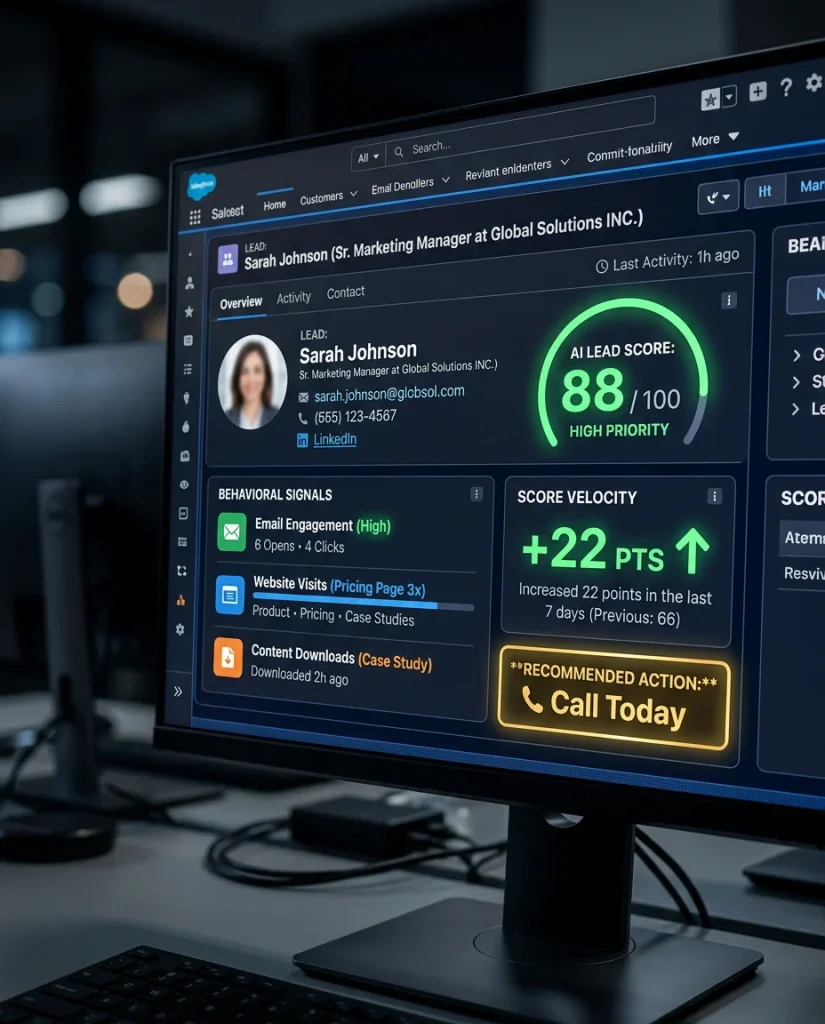
AI lead scores deliver revenue impact only when they're integrated into the workflow surfaces sales reps actually use daily — pipeline views, daily digest emails, rep activity dashboards, and CRM notification systems. Scores embedded in a separate analytics module that reps must navigate to separately are effectively invisible; adoption research consistently shows that data influencing behavior must appear in the context where the behavioral decision occurs, not in a parallel reporting interface.
This integration design principle is where many AI lead scoring deployments underperform despite accurate models. The model produces correct scores; reps don't change their prioritization behavior because the scores don't appear where prioritization decisions happen. The implementation architecture matters as much as the model accuracy.
Effective workflow integration surfaces scores across four touchpoints:
Pipeline view scoring: Lead scores displayed as badges directly on pipeline cards in the rep's primary work view — not in a subpanel, not in a separate module. The score should be visible without any additional click or navigation. This is the single highest-impact integration for changing daily prioritization behavior.
Daily digest email: An automated morning email ranking each rep's assigned leads by current score, flagging score increases above a defined threshold since yesterday, and surfacing the top three recommended actions for the day. This digest should be opinionated — "These three contacts require outreach today based on score acceleration" — not a passive data report.
Score spike notifications: Real-time Slack or CRM notifications when a lead's score crosses a defined threshold (e.g., jumps above 75) or when score velocity exceeds a defined weekly change rate. These notifications create urgency that flat priority queues don't generate.
Score decline alerts: Notifications when a previously high-scoring lead shows declining engagement — a deal risk signal that should trigger an intervention workflow before the deal goes fully cold.
Key Takeaways
- AI lead scoring outperforms static models because it trains on your historical conversion data rather than industry benchmarks — producing weights that reflect your actual customer purchase behavior, not generic assumptions.
- Behavioral signals carry the highest predictive weight, consistently outperforming demographic fit as conversion predictors — pricing page visits, case study downloads, and score velocity are the most reliable intent signals in most B2B models.
- Model accuracy compounds over time: initial deployments achieve 75–80% accuracy; 12-month models calibrated against your actual outcomes routinely reach 85–90%, producing a scoring asset that becomes more valuable every quarter.
- Forrester research confirms the revenue impact: AI-driven lead scoring organizations report 10–20% higher conversion rates and 15–25% shorter sales cycles — compounding into measurable revenue per rep per quarter.
- Integration design determines adoption: scores embedded in pipeline views and daily digest emails change rep behavior; scores buried in analytics modules get ignored. The workflow surface where scoring data appears determines whether it influences decisions.
- Score velocity is the most time-sensitive signal: a contact whose score increased 25 points in one week warrants immediate prioritization regardless of absolute score level — accelerating intent has a short window before competitive outreach closes it.
Conclusion
AI lead scoring transforms sales prioritization from a function of rep judgment and recency bias into a data-calibrated process that concentrates effort where conversion probability is highest. The revenue impact is direct — higher conversion rates, shorter cycles, and better forecast accuracy — and it compounds as the scoring model trains against more of your actual outcome data each quarter. The implementation requirement is equally direct: accurate scores integrated into the workflow surfaces where reps make daily prioritization decisions, not parked in dashboards they don't visit.
Authority Solutions® implements AI lead scoring as part of integrated AI CRM solutions — calibrated to your specific historical data, embedded in your primary workflow surfaces, and monitored for adoption and accuracy in the first 90 days. Contact our team to discuss how predictive scoring applies to your current pipeline volume and sales process.
Frequently Asked Questions
What is AI lead scoring in a CRM?
AI lead scoring in a CRM assigns each prospect a real-time conversion probability score using machine learning models trained on your historical closed-won and closed-lost data. The score updates continuously as behavioral signals are recorded — email engagement, website activity, content downloads — reflecting the prospect's current buying intent rather than a static profile assessment.
How is AI lead scoring different from traditional lead scoring?
Traditional lead scoring assigns points manually based on demographic criteria and single behavioral events, using weights determined by intuition rather than outcome data. AI lead scoring derives weights algorithmically from your actual historical conversion data and recalibrates continuously as new outcomes are recorded — producing accuracy that improves over time versus the static ceiling of manual models.
Which signals carry the most weight in AI lead scoring?
Behavioral signals consistently carry the highest predictive weight: pricing page visits, case study downloads, email engagement frequency over trailing 30 days, return visit patterns, and score velocity (rate of change over 7–14 days). Demographic fit signals function best as score multipliers that amplify strong behavioral profiles for contacts who also match your ideal customer profile.
How much historical data is needed to build an accurate AI lead scoring model?
A minimum viable training dataset is approximately 200–300 closed deals (both won and lost). Models trained on 1,000+ records produce materially higher initial accuracy. In markets with lower deal volume, Authority Solutions® supplements historical data with industry-calibrated defaults that are progressively replaced as your own outcome data accumulates.
How do I get my sales team to actually use lead scores?
Adoption depends on integration placement: scores must appear in the workflow surfaces where prioritization decisions occur — pipeline views, daily digest emails, real-time notifications — not in separate analytics modules. Behavioral change research consistently shows that data influences decisions when it appears in the decision context, not when it requires additional navigation to access.