
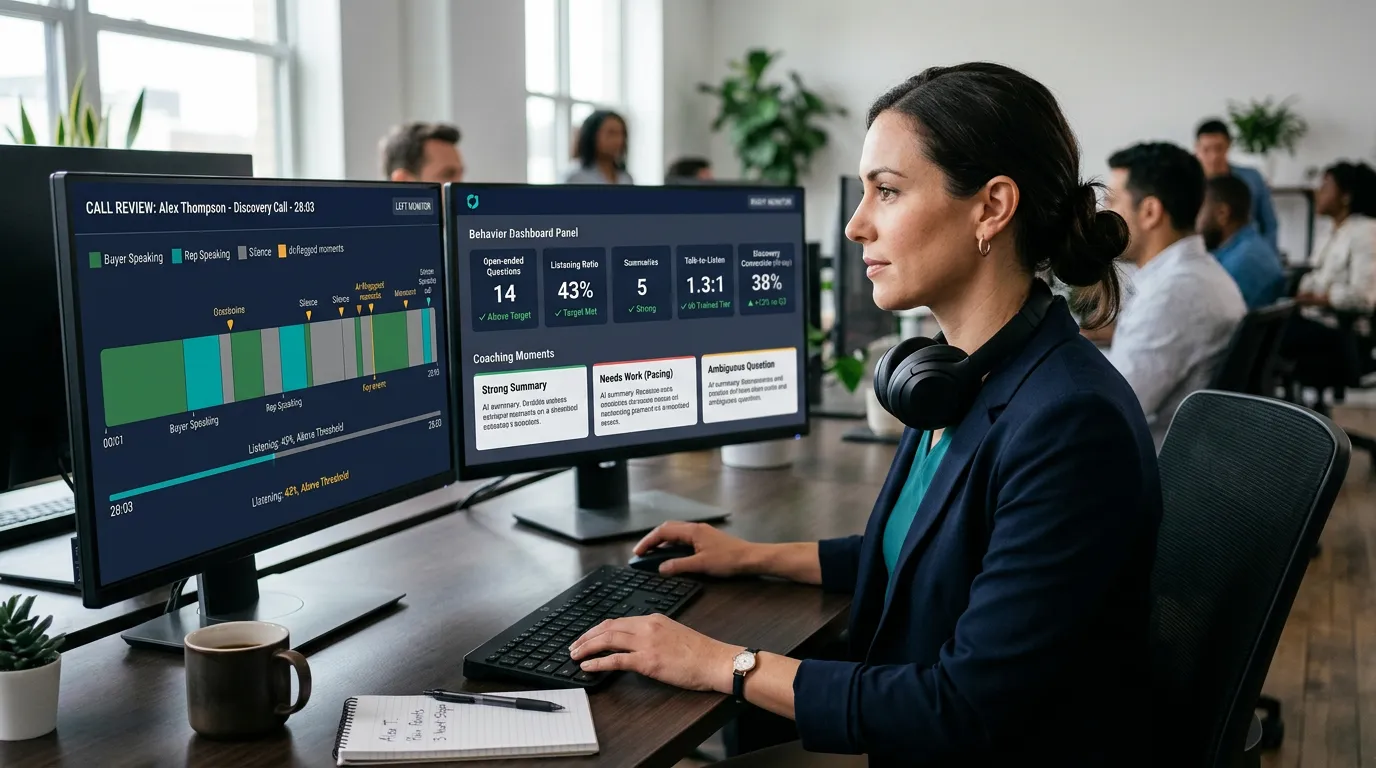
Sales teams that effectively use AI generate 77 percent more revenue per rep than teams that do not, per Gong research. The gap is not tool access; it is behavioral. AI-trained reps spend 45 percent of calls listening, ask 12 open-ended questions per discovery, and convert AI suggestions into deals. AI training in 2026 closes that gap.
Two SDRs start Monday with the same Salesforce login, the same Outreach license, the same Gong access, the same ChatGPT subscription, and the same quota. By Friday, one has booked 14 qualified meetings; the other has booked 5. They are working in the same office. They have the same tools. The difference is what each one does between the moment a lead lands in their queue and the moment that lead either books a meeting or goes cold. AI training is the discipline that builds the first rep's pattern into the second rep's habit.
Below: what the conversation data reveals about top-performer behavior, why the 77 percent revenue gap between AI-effective and AI-ignoring sales teams is the single most important number in B2B selling right now, how the listening-to-talking ratio separates winners from losers, why 12 open-ended questions per discovery call is the threshold that matters, how simulation training drops ramp-time from 8 months to 4.2, and what an AI training program built on revenue intelligence actually looks like in practice.
The Monday Morning Test
Watch two reps work the same lead. The lead came in over the weekend asking about a specific use case.
- Rep A (AI-ignoring) opens the email at 9:14 a.m. Monday. Reads the form fields, opens LinkedIn, spends 18 minutes researching the prospect and the company. Composes a reply from scratch. Sends it at 10:02 a.m. Logs the activity in Salesforce. Total elapsed: 48 minutes.
- Rep B (AI-trained) opens the same lead at 9:14 a.m. The CRM already shows an AI-generated brief: the prospect's role, the company's recent funding round, three relevant case studies, a draft outreach email tuned to the use case mentioned in the form, and a suggested follow-up cadence. The rep reads the brief, edits the email for personalization (changes the opening and adds a specific point about the prospect's LinkedIn post from last week), and sends it at 9:21 a.m. Total elapsed: 7 minutes.
Both reps did the same work. Rep B did it in 15 percent of the time and personalized the message more effectively because the AI handled the research compression. Multiply across 40 leads per week, and Rep B has hours of additional capacity to spend on live conversations while Rep A is still drafting Monday emails on Wednesday afternoon.
What the Conversation Data Tells Us
The single largest body of evidence on what separates top-performing reps from underperforming ones comes from conversation intelligence platforms that record and analyze sales calls at scale. Per Gong's revenue intelligence research, the patterns are consistent across industries, deal sizes, and buyer profiles.
Top-performing reps spend 45 percent of their calls listening. Underperformers spend only 25 percent listening. The 20-point gap shows up in every segment Gong has studied. The reps who win deals are running discovery, not running pitches.
Successful discovery calls include at least 12 open-ended questions. Calls with 8 or fewer open-ended questions convert at materially lower rates regardless of how confident the rep sounds or how technically accurate their explanations were. The skill is not knowing the product; the skill is asking the right questions about the buyer's situation.
Teams that adopt AI effectively generate 77 percent more revenue per rep than teams that do not. Gong characterizes this as a six-figure difference per salesperson annually for enterprise B2B teams. The gap is the largest performance differentiator currently available in sales operations, larger than tenure differences, larger than territory differences, larger than comp plan differences.
These numbers exist because conversation AI now records every call. The data is not anecdotal. It is the operational signal that defines what training should target.
The 12-Question Threshold
The 12-question threshold for discovery calls is the most actionable insight in modern sales training because it is teachable, measurable, and tied directly to conversion. A rep who asks 5 questions in a 30-minute call is pitching disguised as discovery. A rep who asks 18 questions in the same call is doing the work of finding fit.
AI training around this threshold has three components.
- Question library. A curated set of open-ended questions organized by sales stage and buyer profile. The rep learns the question architecture, not a script. Example structure: 3 questions about current state, 3 about pain or opportunity, 3 about desired future state, 3 about decision process and timeline.
- Simulation practice. Reps practice asking the question architecture against AI buyer personas before they speak to real prospects. The simulator scores the call on question count, open-ended ratio, listening time, and discovery coverage. Reps run 15 to 20 practice calls before the first real one. SaaS B2B companies that deploy simulation programs cut average ramp-time from 8 months to 4.2 months.
- Real-time coaching. Gong, Chorus, or similar tools surface a discreet on-screen prompt during live calls when the rep is below threshold on question count or above threshold on talk-time. The rep adjusts mid-call rather than learning the lesson after the call is lost.
The 12-question target sounds artificial until reps see their own call data. Then it becomes a behavior they can train toward, measure against, and improve weekly.
Why Listening Matters More Than Talking
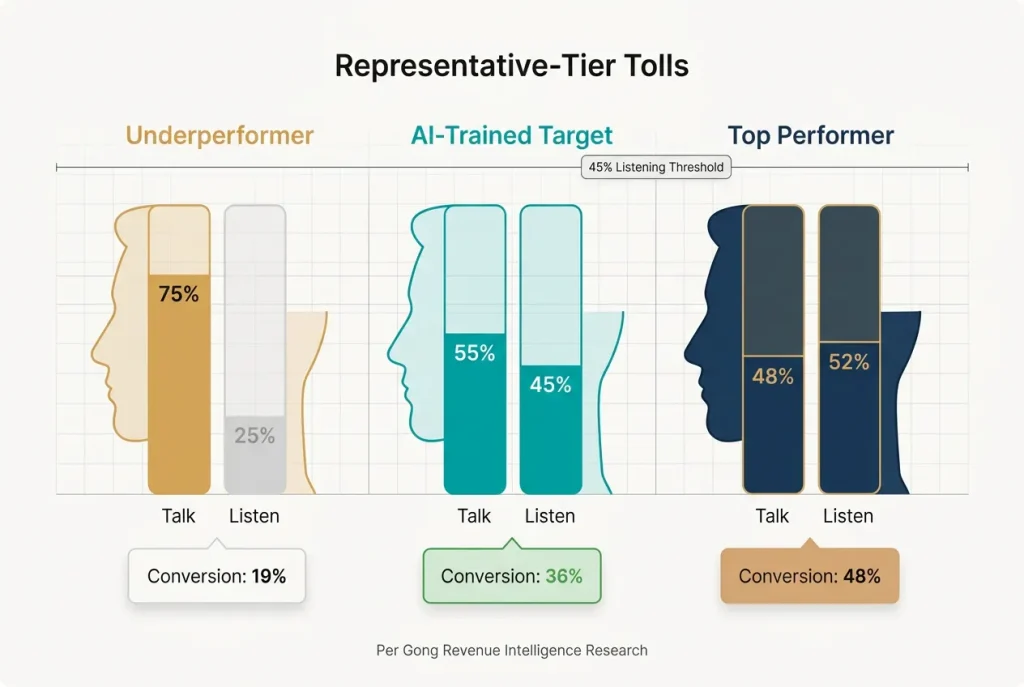
The 45 percent listening ratio is the second most actionable insight. It is also the hardest behavior to change because the reflex when a buyer asks a question is to answer it fully, which crowds out the rep's chance to ask the next question back.
AI training around listening has three habits.
- The two-second pause. After a buyer finishes speaking, count two seconds before responding. The pause does two things: it lets the buyer fill the silence with additional context, and it signals to the buyer that the rep is processing rather than waiting to talk.
- Answer with a question. When a buyer asks a technical question, answer briefly and then redirect: "Yes, we support that; how are you currently solving that without it?" The reflex of full-answer-then-stop kills discovery time.
- Summarize before moving on. After a buyer describes a problem, summarize back in their language before proceeding. This both confirms understanding and forces the rep to listen well enough to summarize accurately.
Reps who practice these three habits in simulation move their listening ratio from 25 percent toward 45 percent within four to six weeks of dedicated coaching. The metric is observable in every recorded call, so the improvement is measurable in real time.
The Manager View
Sales managers running AI-trained teams operate differently than managers running traditional teams.
The Monday pipeline review changes. Instead of asking each rep to recite the status of their top 5 deals (an activity that produces optimistic narratives), the manager opens Gong, plays 30-second clips from the rep's most recent discovery calls, and asks the rep to assess the deal based on what the buyer actually said. Two-thirds of the meeting time goes to evidence-driven coaching; one-third to forecast roll-up. Managers report higher forecast accuracy and faster deal velocity from this single shift.
The weekly 1:1 changes. Instead of generic "how can I help" coaching, the manager arrives with three specific AI-flagged moments from the rep's calls: one strong (replay and reinforce), one weak (replay and adjust), one ambiguous (discuss together). Coaching becomes targeted and observable rather than abstract.
Hiring changes. Sales leaders who watch AI-revealed conversation patterns hire differently than leaders who watch resumes. The patterns that predict performance (genuine curiosity, comfort with silence, ability to summarize) show up in interviews when the interviewer knows what to look for.
What an AI Training Program Looks Like in Practice
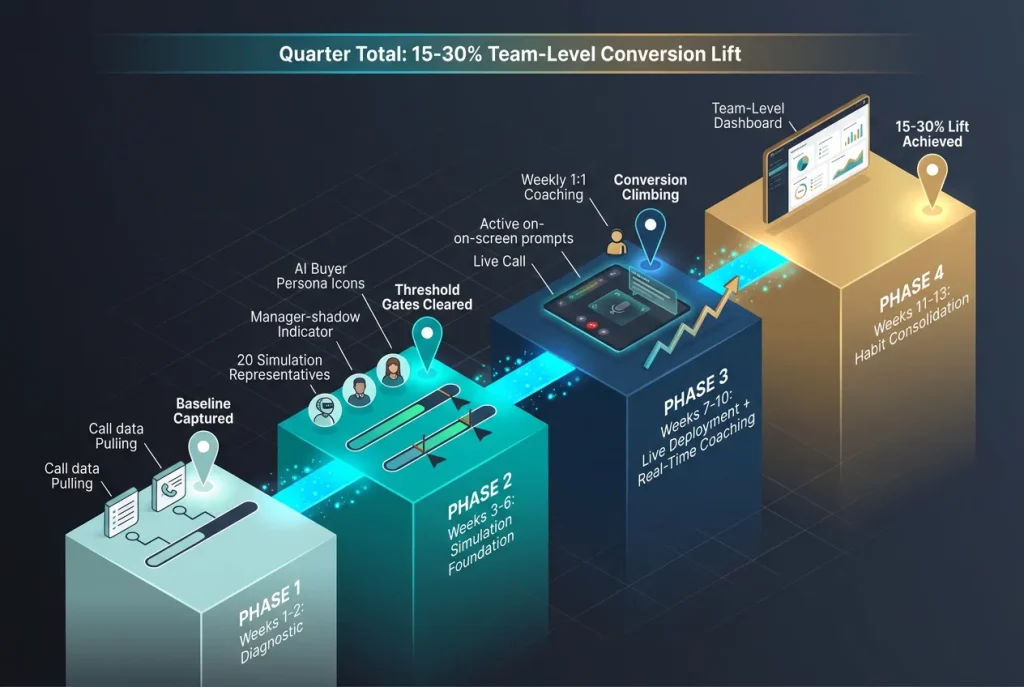
A program that produces the 77 percent revenue gap closure has four components, sequenced over a quarter.
- Weeks 1 to 2: Diagnostic. Pull the team's current conversation data from Gong or equivalent. Score every rep on question count, listening ratio, summary frequency, and conversion at each stage. Identify the top three behavior gaps for the team and the top one gap per rep.
- Weeks 3 to 6: Simulation foundation. Every rep runs 20 simulation discovery calls against AI buyer personas tuned to the team's ICP. The simulator scores them on the target behaviors. Reps cannot move to the next module until they hit threshold on each behavior in simulation. Managers shadow simulations and coach actively.
- Weeks 7 to 10: Live deployment with real-time coaching. Real calls resume with AI coaching active during the call. The rep gets discrete on-screen prompts when below threshold. Weekly 1:1s replay specific moments. Conversion data tracked weekly.
- Weeks 11 to 13: Habit consolidation. Real-time prompts dial back to optional. Weekly 1:1s shift from behavior coaching to deal coaching. Team-level metrics (avg question count, avg listening ratio, win rate by behavior tier) become the new operational dashboard.
By the end of the quarter, reps who started below threshold are at or above threshold, and the team-level conversion lift typically lands in the 15 to 30 percent range. The reps who plateau or refuse to adopt the behaviors become observable in the data, which makes performance management cleaner than it has ever been.
What This Looks Like in the Dashboard
| Metric | Underperformer Baseline | AI-Trained Target | Top Performer Baseline |
| Question count per discovery call | 6 to 8 | 12+ | 16 to 22 |
| Listening ratio (% of call time) | 22 to 28% | 40 to 45% | 45 to 52% |
| Summary frequency per call | 1 to 2 | 4 to 6 | 6 to 10 |
| Talk-to-listen ratio | 3:1 | 1.2:1 | 1:1.1 |
| Discovery-to-opportunity conversion | 18 to 24% | 32 to 40% | 42 to 55% |
The numbers vary by industry and deal size; the pattern does not. Reps who move their behavioral metrics into the AI-trained target column see their conversion metric move with them within a quarter.
Where to Start
Pull last month's call data. Score every rep on question count and listening ratio. Identify the three reps furthest from threshold and the three closest. Start the simulation training with the three closest because they will produce visible wins fastest and create internal advocates for the program.
The three furthest get coaching alongside the simulation work, but the program survives or dies on whether the early-adopter group can prove the lift on real deals inside the first six weeks.
Key Takeaways
- The 77 percent revenue gap between AI-effective and AI-ignoring sales teams (Gong research) is the largest performance differentiator currently available in B2B sales
- Top performers spend 45 percent of calls listening; underperformers spend 25 percent; the 20-point gap is consistent across segments
- Discovery calls with 12+ open-ended questions convert materially higher than calls with 8 or fewer, regardless of rep tenure or product knowledge
- AI simulation training cuts SDR ramp from 8 months to 4.2 months in SaaS B2B deployments
- Three teachable listening habits: the two-second pause, answer-with-a-question, summarize-before-moving-on
- Manager workflows change with AI training: pipeline review based on actual call clips, 1:1s on specific AI-flagged moments, hiring decisions informed by conversation patterns
- A quarter-long program (diagnostic, simulation, live deployment, habit consolidation) typically produces 15 to 30 percent conversion lift at team level
Frequently Asked Questions
What does AI training for sales teams actually teach?
It teaches the behaviors that conversation intelligence data shows separate top performers from underperformers: asking 12+ open-ended questions per discovery, listening 45 percent of call time, summarizing buyer responses before moving on, and using AI tools to compress research and drafting time. The training is behavioral, measurable, and tied to recorded call data.
What is the 77 percent revenue gap?
Per Gong's research on revenue intelligence, sales teams that adopt AI effectively generate 77 percent more revenue per rep than teams that do not. For enterprise B2B teams, this represents a six-figu
re annual difference per salesperson. The gap is the largest performance differentiator currently available in sales operations.
How important is the 12-question threshold in discovery?
Discovery calls with 12 or more open-ended questions convert materially higher than calls with 8 or fewer, regardless of rep tenure or product knowledge. The threshold is teachable, measurable in recorded calls, and tied directly to conversion. It is the most actionable training target available.
What does the 45 percent listening ratio mean?
Top-performing reps spend 45 percent of their call time listening; underperformers spend only 25 percent. The 20-point gap is consistent across industries, deal sizes, and buyer profiles. AI training teaches three habits that close the gap: the two-second pause after a buyer speaks, answering with a question, and summarizing buyer responses before moving on.
How does AI simulation training work?
Reps practice live conversations with AI buyer personas tuned to specific archetypes, industries, and objection patterns. The simulator scores each call on question count, open-ended ratio, listening time, discovery coverage, and tone. Reps run 15 to 20 simulations before the first real call. SaaS B2B companies report ramp-time reductions from 8 months to 4.2 months.
Should AI sales training be role-specific?
Yes. SDRs need prospecting and outreach personalization. AEs need discovery and deal intelligence. Sales engineers need technical demo personalization. Sales leaders need coaching workflows and forecasting. Generic AI sales training that bundles all roles into one course underperforms because the skills are genuinely different.
How does AI change what a sales manager does?
The Monday pipeline review uses actual call clips rather than rep narratives. Weekly 1:1s focus on three specific AI-flagged moments (one strong, one weak, one ambiguous). Hiring criteria shift toward the conversation patterns that predict performance (genuine curiosity, comfort with silence, ability to summarize). Coaching becomes targeted and observable.
How long does an AI sales training program take?
A quarter-long sequence: 2 weeks of diagnostic against current call data, 4 weeks of simulation foundation with threshold-gated progression, 4 weeks of live deployment with real-time coaching, 3 weeks of habit consolidation. Team-level conversion lift typically lands in the 15 to 30 percent range by end of quarter.
How do I measure if AI sales training is working?
Five behavioral metrics: question count per discovery call, listening ratio, summary frequency, talk-to-listen ratio, and discovery-to-opportunity conversion rate. Pull baseline from the current call data, set targets at the AI-trained tier, measure weekly. The metrics are observable on every recorded call so the improvement is real-time, not lagging.
What happens to underperformers in an AI-trained sales team?
The data makes performance visible in ways traditional management could not. Reps who plateau or refuse to adopt the behaviors show up clearly in the dashboards (question count stays low, listening ratio does not improve, conversion does not move). This makes performance management cleaner: coaching gets specific, decisions get evidence-based, and the conversation around who fits the team gets honest.
Conclusion
The 77 percent revenue gap is the single most important number in B2B sales operations right now because it is the size of the prize for getting AI training right. The training is not abstract; it is behavioral. The behaviors are not preferences; they are measurable in recorded call data. The simulation tools, the coaching tools, and the evidence-driven manager workflows all exist and work. Pull last month's call data, score the team, pick the three closest-to-threshold reps, and let the simulation work prove itself on real deals inside six weeks.
Book your AI Sales Training Assessment today.
Equip your reps to close in an AI-driven discovery market.