
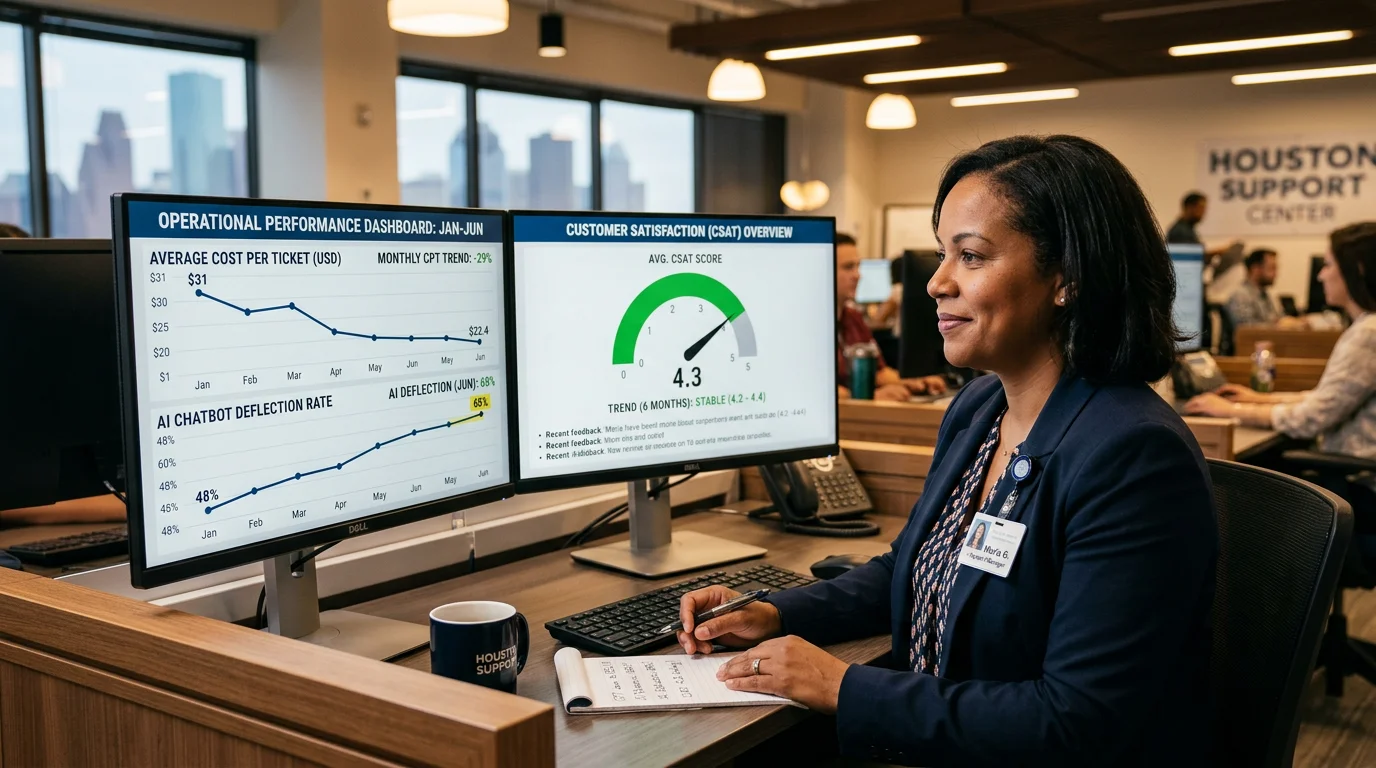
AI chatbots reduce customer support costs by deflecting 60–75% of Tier 1 support inquiries to automated self-service resolution — eliminating the labor cost of human agent handling for each deflected ticket while maintaining or improving customer satisfaction scores through faster resolution times and 24/7 availability. The cost reduction is structural and permanent: unlike staffing reductions, chatbot deflection scales with inquiry volume without proportional cost increase.
The prevailing concern about AI chatbot deployment for customer support — that cost savings come at the expense of customer experience — is empirically addressable. The data across deployed implementations shows a more nuanced outcome: CSAT scores for well-designed AI chatbot implementations either hold steady or improve, primarily because the improvement in response time and availability outweighs the reduction in human conversational warmth for Tier 1 inquiry categories. The key qualifier is "well-designed" — poorly designed chatbots with inadequate escalation logic genuinely do damage satisfaction scores, which is why AI chatbot implementation quality determines whether you get the outcome data supports or the outcome the concern anticipates.
This article provides the specific cost reduction mechanisms, the CSAT data by implementation quality tier, and the escalation design principles that protect satisfaction while the chatbot handles volume.
The Four Cost Reduction Mechanisms of AI Chatbot Deployment
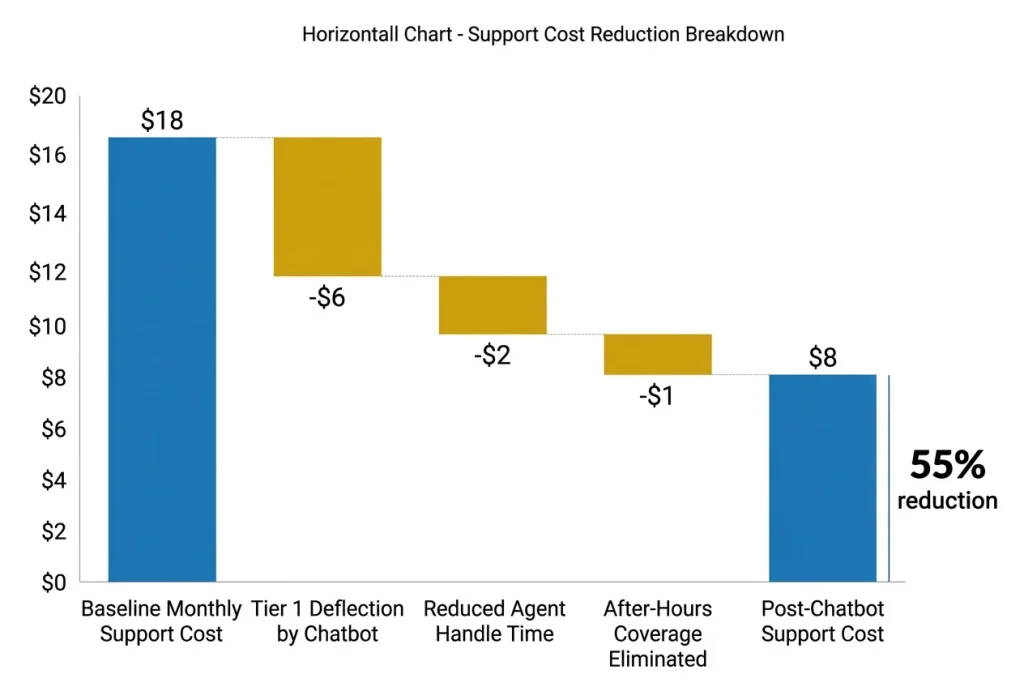
AI chatbots reduce customer support costs through four distinct mechanisms: Tier 1 inquiry deflection (the largest cost driver), reduction in average handle time for escalated tickets, elimination of after-hours staffing requirements, and reduction in agent burnout-driven turnover costs. Organizations that deploy chatbots targeting only the first mechanism leave 30–40% of total available cost savings unrealized by failing to optimize the downstream effects on escalated ticket handling and staffing architecture.
Understanding the full cost reduction stack is essential for building an accurate ROI case before deployment, setting realistic savings expectations for stakeholders, and designing the chatbot implementation to capture all four mechanisms rather than just the most visible one.
Mechanism 1: Tier 1 Inquiry Deflection
Tier 1 deflection is the direct elimination of human agent handling cost for inquiries the chatbot resolves without escalation. The deflection rate — the percentage of incoming inquiries resolved by the chatbot without human involvement — is the primary cost driver and the metric most commonly cited in chatbot ROI calculations.
Industry-average deflection rates by inquiry category:
- FAQs and policy questions (hours, pricing, service area, return policy): 80–92% deflection
- Account status and order tracking: 70–85% deflection
- Basic troubleshooting (step-by-step guides): 60–75% deflection
- Appointment scheduling and rescheduling: 65–80% deflection
- Password reset and access issues: 85–95% deflection
Overall portfolio deflection rates for well-designed implementations average 60–75% across all incoming inquiry types — meaning 60–75 of every 100 support interactions are resolved without agent involvement.
Mechanism 2: Reduced Handle Time on Escalated Tickets
When a chatbot escalates to a human agent, it passes the full conversation transcript, the contact's behavioral history, and a structured summary of the issue category and attempted resolutions. An agent receiving this context starts the conversation at the resolution stage rather than the information-gathering stage — reducing average handle time for escalated tickets by 25–40% compared to cold-transfer escalations from IVR or direct inbound contacts.
Mechanism 3: After-Hours Coverage Cost Elimination
Staffing customer support outside business hours is expensive. AI chatbots handle after-hours inquiry volume at zero incremental staffing cost — no overtime, no shift differential, no coverage scheduling. For businesses with significant after-hours inquiry volume (a common profile for e-commerce, SaaS, and service businesses with national or global customer bases), this mechanism alone can justify chatbot deployment.
Mechanism 4: Agent Burnout and Turnover Cost Reduction
Customer service agent turnover averages 30–45% annually across industries — one of the highest voluntary turnover rates in any business function. A significant driver is inquiry monotony: agents handling the same repetitive Tier 1 questions hundreds of times weekly report higher burnout rates than those handling complex, varied interactions. Chatbot deflection of Tier 1 volume shifts agent workload toward complex, varied interactions that both increase job satisfaction and build more transferable skill — reducing burnout-driven turnover and the $3,000–$7,000 per-agent replacement cost that turnover produces.
| Cost Reduction Mechanism | Typical Savings Range | Dependency |
| Tier 1 deflection (60–75% of tickets) | 35–55% of total support labor cost | Chatbot quality and knowledge base depth |
| Reduced escalated handle time | 10–20% of escalated ticket labor cost | Context handoff quality at escalation |
| After-hours staffing elimination | Varies by business hours profile | Inquiry volume outside staffed hours |
| Reduced agent turnover cost | $90K–$315K annually per 10-agent team | Workload mix improvement for agents |
According to IBM's research on conversational AI in customer service, businesses deploying AI chatbots report average support cost reductions of 30% in the first year of deployment — with implementations featuring strong escalation design and high knowledge base coverage achieving reductions of 40–55%.
The CSAT Question: What the Data Actually Shows
Customer satisfaction scores for AI chatbot-handled support interactions depend more heavily on escalation design quality and resolution speed than on whether the interaction was human or automated. Well-designed chatbot implementations consistently achieve CSAT scores within 0.2–0.4 points of human agent baselines for Tier 1 inquiries — and often exceed human agent CSAT for availability-driven satisfaction dimensions (no hold time, 24/7 access, instant response). The satisfaction gap appears and widens specifically in complex, emotionally charged, or multi-party dispute interactions that should be escalated, not automated.
This nuance is critical for setting accurate expectations before deployment. Measuring overall CSAT before and after chatbot deployment without controlling for interaction type produces misleading results — if the chatbot handles only Tier 1 simple inquiries while agents handle the complex and emotionally charged ones, the agent-handled average CSAT will appear to decline even though agent performance hasn't changed, because the easy interactions that artificially inflated average CSAT are now handled by the bot.
The correct measurement framework compares:
- CSAT for chatbot-handled Tier 1 interactions vs. pre-deployment CSAT for the same interaction categories handled by agents
- Overall CSAT trend controlling for interaction complexity distribution
- Resolution rate — the percentage of contacts whose issue was fully resolved without requiring a repeat contact
Satisfaction Factors Where Chatbots Outperform Human Agents
Response time and availability: Customers waiting 4 minutes on hold before reaching an agent who then resolves a simple FAQ in 90 seconds have a fundamentally different experience than customers who receive an instant chatbot response and resolution in 45 seconds. In availability-constrained support environments, chatbot CSAT for simple inquiries frequently exceeds hold-impacted human agent CSAT simply because speed matters more than warmth for information retrieval interactions.
Consistency of information: Human agents give subtly different answers to the same question based on individual knowledge, interpretation, and fatigue. A chatbot drawing from a single verified knowledge base gives identical answers to identical questions — a consistency that customers and compliance teams both value.
Satisfaction Factors Where Human Agents Outperform Chatbots
Complex, multi-step problem resolution: Interactions requiring judgment, creative problem-solving, or multiple system actions benefit from human continuity of context that chatbots struggle to maintain across complex branching scenarios.
Emotionally charged interactions: Customer frustration, escalated complaints, billing disputes, and relationship-risk situations require empathy, tone calibration, and situational judgment that well-designed escalation routes to human agents — not the chatbot.
The design implication: escalation logic that correctly identifies the interaction types where human handling produces materially higher satisfaction, and routes them to agents before the customer becomes frustrated with automated handling, is the mechanism that protects CSAT while the chatbot handles the volume that doesn't require it.
Escalation Design: The Architecture That Protects Satisfaction While Reducing Cost

Escalation design — the logic defining when, how, and with what context a chatbot hands off to a human agent — is the highest-leverage architectural decision in AI chatbot deployment. A chatbot with outstanding NLP capability and a well-populated knowledge base will still produce poor CSAT outcomes if its escalation logic routes too aggressively (deflecting interactions that should escalate), too passively (holding interactions past the customer's tolerance), or without context transfer (forcing customers to repeat their situation to the agent). All three failure modes are preventable with deliberate escalation architecture.
The five escalation trigger categories that every support chatbot deployment should configure:
Explicit human request: Any phrasing that indicates a customer wants to speak with a person — "let me talk to someone," "I want a real person," "connect me to an agent" — must trigger immediate escalation with zero additional chatbot response. Continuing to ask clarifying questions after a human request is the fastest path to a 1-star support review.
Negative sentiment threshold: Sentiment analysis detecting frustration, anger, or distress above a defined threshold triggers escalation — even if the issue type is technically within chatbot resolution scope. An angry customer who technically has an FAQ question is not a Tier 1 automation candidate.
Unresolved after two clarification attempts: If the chatbot cannot resolve an inquiry after two rounds of clarification exchange, the probability of successful automated resolution drops sharply. The third attempt should be an escalation offer, not a third clarification question.
High-value contact identification: Contacts whose CRM profile indicates high deal value, active negotiation, or VIP status should trigger optional human routing — even for interactions the chatbot could technically handle — because the relationship risk of an automated interaction for a high-value account exceeds the cost savings.
Issue category flags: Specific issue categories — billing disputes, legal inquiries, security concerns, account closure requests — should be categorically escalated regardless of apparent simplicity, because the downstream risk of automated handling in these categories exceeds any deflection cost savings.
Key Takeaways
- AI chatbots reduce support costs across four distinct mechanisms — Tier 1 deflection, reduced handle time on escalated tickets, after-hours staffing elimination, and agent turnover reduction — with organizations capturing all four achieving 40–55% total support cost reduction.
- IBM research benchmarks average first-year cost reduction at 30% for chatbot deployments, with implementations featuring strong escalation design and high knowledge base coverage reaching 40–55%.
- CSAT is protected, not compromised, by well-designed chatbots — response speed and availability improvements offset warmth reduction for Tier 1 inquiries; the satisfaction gap appears only in complex or emotionally charged interactions that escalation design should already route to humans.
- Escalation design is the highest-leverage architectural decision — the five trigger categories (explicit human request, negative sentiment, unresolved after two attempts, high-value contacts, categorical issue types) define the line between cost-saving automation and satisfaction-damaging over-automation.
- Measure CSAT correctly: compare chatbot-handled Tier 1 CSAT against pre-deployment agent CSAT for the same interaction categories — overall CSAT comparisons without controlling for interaction type produce systematically misleading results.
- Agent burnout reduction compounds ROI beyond the deflection calculation: shifting agent workload from monotonous Tier 1 repetition to complex, varied interactions reduces the 30–45% annual turnover rate that costs $3,000–$7,000 per replacement across the support team.
Conclusion
AI chatbots reduce customer support costs structurally and permanently — not through one-time efficiency gains that erode over time, but through a deflection architecture that scales with inquiry volume at zero incremental cost. The CSAT concern that most often delays deployment is addressable through escalation design: build the system to correctly identify which interactions require human judgment and route them accordingly, and the cost reduction and satisfaction outcomes coexist rather than trade off against each other.
The implementation quality variable is the determinant. A poorly configured chatbot with inadequate knowledge base coverage and missing escalation triggers produces exactly the poor CSAT outcomes the concern anticipates. A well-designed implementation produces the outcome the data supports — material cost reduction with maintained or improved satisfaction for the majority of your support interaction volume. Authority Solutions® AI chatbot solutions are architected around both dimensions simultaneously. Contact our team to discuss how the cost reduction and satisfaction framework applies to your specific support volume and interaction mix.
Frequently Asked Questions
How much do AI chatbots actually reduce customer support costs?
Well-designed AI chatbot deployments reduce total support costs by 30–55% in the first year, depending on implementation quality and knowledge base coverage depth. The primary driver is Tier 1 inquiry deflection (60–75% of incoming tickets resolved without agent involvement), with additional savings from reduced handle time on escalated tickets, after-hours staffing elimination, and reduced agent turnover.
Do AI chatbots hurt customer satisfaction scores?
Well-designed chatbots maintain or improve CSAT for Tier 1 inquiry categories, primarily because response speed and 24/7 availability improvements outweigh the reduction in human conversational warmth for information retrieval interactions. CSAT degradation occurs when escalation logic routes interactions requiring human judgment into automated resolution — a design failure, not a technology limitation.
What is chatbot ticket deflection rate and what's a realistic benchmark?
Deflection rate is the percentage of incoming support inquiries resolved by the chatbot without human agent escalation. Realistic benchmarks for well-designed implementations: 80–92% for FAQs and policy questions, 70–85% for account status inquiries, 60–75% for basic troubleshooting, and 65–80% for appointment scheduling. Overall portfolio deflection averages 60–75% across all inquiry types for implementations with comprehensive knowledge bases.
How do you prevent a chatbot from damaging customer relationships on complex issues?
Escalation design: configure explicit escalation triggers for human requests (any indication the customer wants a person), negative sentiment above defined thresholds, unresolved issues after two clarification attempts, high-value account identification, and categorical issue types (billing disputes, legal inquiries, security concerns). Escalation should pass full conversation context to the human agent so the customer never repeats their situation.
What metrics should I track to measure AI chatbot support ROI?
Track six metrics: deflection rate (percentage of tickets resolved without human escalation), cost per ticket before and after deployment, CSAT for chatbot-handled vs. agent-handled interactions by category, average handle time for escalated tickets, first contact resolution rate, and agent utilization shift (hours moved from Tier 1 to complex interactions). Together these metrics provide a complete picture of both cost and quality impact.