

The Voicemail That Cost the Repeat Job
Every service business owner has lived this scene. The tech finishes a job at 5:30 p.m., the customer is happy, the office is closed, the after-hours calls are rolling to voicemail. A former customer calls at 6:15 needing a same-week appointment for a different problem. The voicemail sits until 8:20 the next morning. By 10 a.m. the customer has booked with the first competitor who answered a live call at breakfast. The lifetime value of that customer just walked away, and the business owner never knew the call happened.
HubSpot's State of Service research documents the pattern consistently. Response speed and communication consistency are the two service-quality signals customers use to judge providers, and small service businesses are the segment most likely to lose repeat work because those two signals are hard to sustain manually. The office manager who does it all does it well until the day she is on vacation, out sick, or handling a stack of paperwork. The AI CRM does it every day, at the same standard, without vacation or sick days or paperwork excuses.
This article walks through what an AI customer relationship management system does specifically for service businesses (HVAC, plumbing, electrical, dental, home services, professional services), the four client communications it owns end-to-end, the retention motion that produces most of the ROI, the metrics that prove it is working, and the Authority Solutions® AI Services path for landing the deployment in six to eight weeks without disrupting the way the business already runs.
What Makes Service Businesses Different
Service businesses are not just smaller versions of B2B SaaS or big enterprise. The operating shape is different, and the CRM has to reflect it.
Service business operating realities:
- Recurring but irregular work. The customer needs a service today, needs it again in eighteen months, needs it again in three years. The interval varies by service, by seasonality, by house age. The CRM has to remember and prompt.
- Trust as the primary buying signal. Customers buy service providers who feel reliable. Communication consistency is the leading indicator of trust in a low-consideration category.
- Technician-facing operational reality. The tech in the truck is the frontline touchpoint. Anything that steals time from techs to answer texts or update paperwork produces less service capacity.
- Reviews are load-bearing marketing. A steady stream of positive reviews is worth more than any ad spend for most service businesses.
- Referrals still dominate. Even in 2026 the primary acquisition channel is the neighbor who says "call these guys" at a barbecue.
The AI CRM for a service business is not a scaled-down enterprise CRM. It is a purpose-built motion around these realities. Authority Solutions® CRM Implementation selects and configures the right platform per business shape.
The Four Client Communications the AI CRM Owns
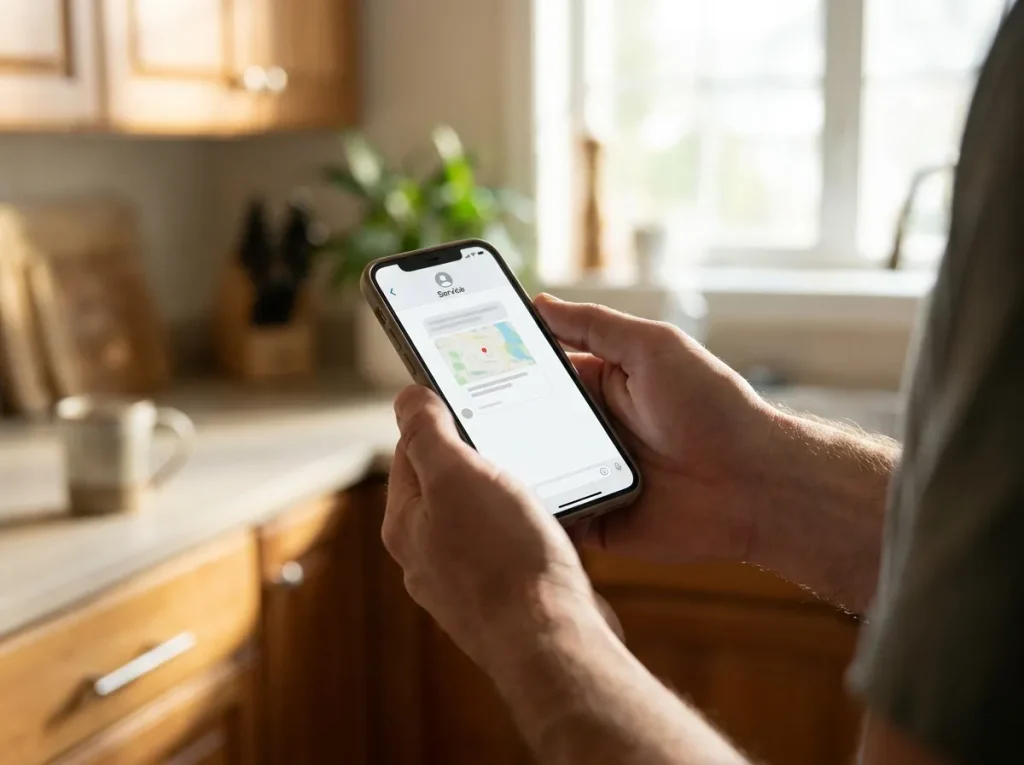
The AI CRM handles four specific communication motions end-to-end, and these four are responsible for most of the business value.
The four owned communications:
- Appointment confirmation. SMS confirmation on booking, reminder 24 hours before, morning-of reminder with the tech's name and photo, and a live ETA when the tech dispatches. This alone reduces no-shows by half in most deployments.
- In-flight status. "Tech is on the way, ETA 10:47" with a live tracking link. The customer stops calling to ask; the office stops fielding those calls; the tech gets to focus on driving.
- Post-service follow-up. Same-day thank-you text, next-day review request (if the tech marked the job as a "good candidate for review"), and a two-week satisfaction check. Review velocity climbs; problems surface early enough to fix.
- Retention outreach. Twelve-month maintenance reminder, seasonal service prompt, warranty expiration prompt, upgrade opportunity based on the age of the equipment on record. This is where most of the ROI sits.
Each of the four uses SMS as primary channel (SMS opens dramatically outperform email for service businesses), with email as backup and a phone call as escalation for the ones that matter. Authority Solutions® Marketing Automation wires the four motions on top of the CRM so they run without touching the office manager's day.
The Retention Motion Is Where the Real Money Sits

Every service business owner knows the math. Acquiring a new customer costs many times more than keeping an existing one. What they usually do not have is the operational discipline to systematically nurture the existing customer base back into repeat work. The retention motion is the AI CRM's most valuable output.
Retention motion components:
- Service history record. Every job on every customer, dated, categorized, with the equipment installed or worked on. This is the substrate for everything else.
- Interval-based prompts. HVAC gets a spring tune-up prompt each March. Plumbers get a water heater flush prompt at year five. Electricians get a panel inspection prompt at year seven. The intervals are business-specific and are configured once.
- Life-event triggers. Customer bought a house six years ago; the water heater is on its expected replacement clock. Customer moved last year; the new address triggers a "welcome to your new area" outreach.
- Seasonal campaigns. Pre-summer AC tune-up, fall furnace inspection, holiday hosting reminders for kitchen and bath plumbing. Timed to weather patterns in the local market.
- Warranty and maintenance-plan renewal. The system prompts the customer to renew before the coverage lapses. Renewal rates climb sharply with the prompt versus without.
The retention motion produces a steady stream of pre-qualified return work that the office manager could not have scheduled manually. Retention lift of 15 to 30 percent in the first year is typical for a well-instrumented deployment.
The Review Motion That Compounds
Reviews are the highest-leverage marketing asset a service business owns, and the AI CRM's review motion is what turns satisfied customers into a steady stream of five-star reviews.
Review motion mechanics:
- Tech signal. The tech marks the job on their tablet: was the customer happy, was there friction, is this a candidate for a review request. The tech knows the customer's mood better than any survey.
- Timed request. The review request goes out same-day for happy jobs. Same-day requests convert dramatically better than three-day-later requests.
- Multi-platform. The request offers Google, Facebook, and (where applicable) BBB or industry-specific platforms. Customer picks the one they use.
- Friction check. If the customer starts a review and gives 3 stars or fewer, the flow routes to the office instead of publishing. The office manager handles the recovery before the review goes public.
- Response cadence. The office manager reviews new incoming reviews weekly and responds to each. AI drafts the response; the office edits and posts.
A service business running this motion goes from a handful of reviews a year to a hundred or more, with an average rating that reflects the actual customer experience. Authority Solutions® Chatbot Development integrates a chat handoff on the recovery flow so the escalated customer reaches a real person fast.
The Technician Workflow the AI CRM Preserves
The failure mode most service-business CRM projects hit is the tech workflow. If the tech has to type more, stop for more forms, or fight the app in the field, the deployment loses to the paper clipboard within a month.
The tech workflow discipline:
- Voice input at the tech's discretion. The tech dictates the job notes and the AI transcribes and structures. The tech does not fight a form.
- Photo capture with auto-tagging. The tech takes photos; the AI tags them (equipment brand, installed date, condition observed) and files them against the customer record.
- One-tap job disposition. Complete, complete-with-follow-up, needs-parts, needs-office. Four options; not fifteen.
- Auto-generated invoice. The AI drafts the invoice from the job notes, the pricing, and the completed disposition. The office reviews and sends.
- Zero forced admin between jobs. The tech gets to the next job without a twenty-minute admin gate.
A CRM that respects the tech workflow gets adopted. A CRM that ignores it produces a folder of paper clipboards on the ride-along, which is where the deployment fails.
Integration With What the Business Already Has
Service businesses rarely arrive at an AI CRM with a clean slate. They have a scheduling system, an accounting package, a phone answering service, and a review platform. The deployment respects what works and replaces only what does not.
Common integration points:
- Scheduling and dispatch. ServiceTitan, Housecall Pro, Jobber, FieldEdge, or the operator's system. The CRM does not replace dispatch; it reads from it.
- Accounting. QuickBooks, Xero, or the operator's package. The CRM invoices post to accounting; the CRM does not re-invent accounting.
- Phone answering. The AI CRM handles most inbound after-hours communication, with human answering service or voice AI as backup for the calls that require a live voice.
- Payment processing. Stripe, Square, or the operator's processor. Payments post to the CRM and the accounting; the customer sees one integrated experience.
- Google Business Profile. Review flow, GBP messaging, GBP appointment links. The CRM manages the connections; the office does not maintain them by hand.
Authority Solutions® Operations Consulting maps the integrations during discovery so the deployment strengthens the stack rather than replacing it.
The Metrics That Prove the Motion Is Working
A service business AI CRM produces measurable lift on a small number of load-bearing metrics. Reporting these six is enough.
Motion metrics:
- Response time. Median minutes from inbound signal (call, form, chat) to first human or AI response. Target: under 10 minutes during business hours, under 2 hours overnight.
- No-show rate. Percentage of confirmed appointments the customer misses. Target: below 3 percent for residential services, below 1 percent for commercial.
- Review velocity. Reviews received per month. Target: above one per five completed jobs.
- Average rating. Star rating on primary platforms. Target: 4.7 or higher on Google.
- Retention rate. Percentage of prior-year customers who booked additional work in the current year. Target: above 40 percent for annual-service categories, above 25 percent for irregular categories.
- Referral rate. Percentage of new customers who mentioned "referred by an existing customer" on their booking form. Target: above 30 percent for mature service businesses.
The metrics show up on the office manager's weekly report and the owner's monthly report. The owner does not need to fly the dashboard; the dashboard flies itself.
The Authority Solutions® AI CRM for Service Businesses Path
Our engagement to stand up the motion runs roughly six to eight weeks:
- Weeks 1 and 2. Discovery and setup. Business intake, scheduling and accounting integration mapping, communication template design in the business's voice, review motion configuration, tech workflow validation.
- Weeks 3 and 4. Build. Four communication motions live, retention motion configured with intervals per service, review motion with tech-signal integration, tech app configured with voice input and one-tap disposition.
- Weeks 5 and 6. Soft launch. Run new bookings through the AI CRM for two weeks alongside the existing motion, measure response time and review velocity, tune the messaging voice to match the business.
- Weeks 7 and 8 (optional for larger businesses). Full launch and instrumentation. All communications route through the AI CRM, all metrics report weekly, the office manager owns the ongoing tuning cadence.
By the end of the engagement the business is answering every inbound signal fast, confirming every appointment, following up on every completed job, running retention on every customer, and collecting reviews at multiples of what it was capturing before. The office manager gets her attention back for the work that actually needs her.
Key Takeaways
Service businesses lose repeat work to response-speed failures and communication inconsistency, not to price or product quality. HubSpot's State of Service research documents both signals as the top service-quality judgments customers make.
The AI CRM owns four client communications end-to-end: appointment confirmation, in-flight status, post-service follow-up, and retention outreach. Each uses SMS as primary channel because SMS opens dramatically outperform email for service businesses.
The retention motion is where the ROI sits. Service history record, interval-based prompts, life-event triggers, seasonal campaigns, and warranty renewal prompts produce retention lift of 15 to 30 percent in the first year.
The review motion compounds. Tech-signaled candidates, same-day timed requests, multi-platform choice, friction-check recovery, and cadenced response turn satisfied customers into a steady stream of five-star reviews.
The tech workflow discipline is what makes the CRM adoptable. Voice input at tech's discretion, photo capture with auto-tagging, one-tap disposition, auto-generated invoices, and zero forced admin between jobs preserve tech productivity.
The metrics that matter are response time, no-show rate, review velocity, average rating, retention rate, and referral rate. Reporting these six weekly to the office and monthly to the owner is enough.
FAQ
What is an AI CRM for service businesses?
An AI CRM for service businesses (HVAC, plumbing, electrical, dental, home services, professional services) is a purpose-built system that handles appointment confirmation, in-flight status, post-service follow-up, and retention outreach automatically, so response speed and communication consistency stay high without adding headcount.
How is it different from an enterprise CRM?
Enterprise CRMs are built for B2B sales pipelines with complex deal cycles. A service business AI CRM is built for recurring but irregular service work, tech-in-the-field workflows, review-driven marketing, and trust-as-the-primary-buying-signal operating shape. The features and the integrations are different.
What communications does the AI CRM handle?
Four: appointment confirmation (with tech name and live ETA), in-flight status, post-service follow-up (thank-you, review request, satisfaction check), and retention outreach (interval prompts, seasonal campaigns, warranty renewal). Each uses SMS as primary channel with email backup and phone escalation.
How does the AI CRM handle reviews?
The tech signals which jobs are review candidates on their tablet. The system sends a same-day request with multi-platform choice (Google, Facebook, industry-specific). If a customer starts a review at 3 stars or fewer, the flow routes to the office for recovery before publication. Reviews get responded to weekly.
Will it disrupt the tech workflow?
No, when deployed properly. The tech uses voice input at their discretion, takes photos that auto-tag, chooses one of four job dispositions, and gets zero forced admin between jobs. CRMs that ignore the tech workflow fail; the ones that respect it get adopted.
What integrations do I need?
Scheduling and dispatch (ServiceTitan, Housecall Pro, Jobber, FieldEdge), accounting (QuickBooks, Xero), payment processing (Stripe, Square), and Google Business Profile. The AI CRM reads from and writes to these systems; it does not replace them.
How much retention lift should I expect?
Well-instrumented deployments produce retention lift of 15 to 30 percent in the first year, driven by interval-based prompts on recurring services, seasonal campaigns, and warranty renewal outreach. The exact number varies by service category and by the size of the existing customer base.
How does the AI CRM handle after-hours calls?
After-hours inbound calls route to the AI CRM, which handles the common inquiries (hours, service scope, booking a next-available slot) and takes messages with context for the ones it cannot handle. A live answering service or voice AI covers escalations that require a live voice.
What does it cost?
Pricing varies by business size and integration scope. Typical monthly subscriptions for small service businesses run 200 to 800 US dollars per month; implementation runs 5,000 to 25,000 US dollars for a full deployment with the four communication motions and the retention motion configured.
How long does deployment take?
Authority Solutions® delivers a focused deployment in roughly six to eight weeks: two weeks of discovery and integration mapping, two weeks of build with communication templates in the business's voice, two weeks of soft launch alongside the existing motion, and two weeks of full launch and instrumentation for larger businesses.
Conclusion
The voicemail that cost the repeat job is the operational cost every service business has been absorbing without noticing. The AI CRM closes that gap by handling every inbound signal fast, confirming every appointment, following up on every completed job, running retention on every customer, and collecting reviews at multiples of what was captured before. The office manager gets her attention back for the work that actually needs her, and the owner gets a steady stream of repeat work that grows the business without growing the acquisition budget.
Authority Solutions® stands up AI CRMs for HVAC, plumbing, electrical, dental, home services, and professional services businesses across Texas and beyond. We map the integrations, configure the communication motions in the business's own voice, wire the retention prompts, and instrument the metrics leadership actually uses. By week six the business is operating differently and the phone stops missing calls it should have caught.
Book your Service Business AI CRM Assessment today. Stop losing repeat work to missed calls and quiet voicemails.