
Training an AI chatbot in 2026 means engineering the retrieval architecture, not adjusting the model. Contextual retrieval, hybrid search with reranking, and prompt caching cut retrieval failures by 49 to 67 percent and slash inference costs by 87 percent. The knowledge base, not the LLM, is where competitive advantage now lives.
A buyer asks your chatbot a specific question about return policy on a discontinued SKU. The bot answers confidently, citing your help center, and gets the policy wrong. The buyer screenshots the answer, sends it to support, and the conversation that should have closed a sale becomes a complaint thread. The model is not at fault. The retrieval is. The chunk the bot pulled was about returns generally, not returns for that SKU, and there was no contextual signal to disambiguate.
This is the failure mode that defines chatbot training in 2026. The competitive surface has shifted from "which LLM did you choose" to "how well does your retrieval architecture surface the right passage, with the right context, at the right confidence threshold." Below: why generic RAG fails, what contextual retrieval changes, the hybrid search and reranking pipeline that fixes most accuracy gaps, the evaluation discipline most teams skip, the cost math that prompt caching unlocks, and the maturity ladder from templated chatbot to agentic assistant.
Why Generic RAG Fails
The standard RAG approach embeds a document into chunks of 200 to 500 tokens, stores them in a vector database, and at query time retrieves the top N by cosine similarity. It works on simple, well-structured content where each chunk is self-contained. It fails on real business content where chunks need surrounding context to be meaningful.
A paragraph about return policy in your help center reads: "The return window is 30 days from delivery." That sentence is useless when retrieved in isolation because it does not say what product category the 30 days applies to, whether holiday extensions exist, or whether the policy applies to discounted items. The chunk lost its context when it was separated from the surrounding section headings. Retrieval gets the right document but the wrong slice.
Per Anthropic research on contextual retrieval, this context-loss problem is responsible for most production RAG failures. The fix is not larger chunks (which dilute relevance) or smaller chunks (which lose context further). The fix is changing what gets embedded in the first place.
Contextual Retrieval: The Architecture Change
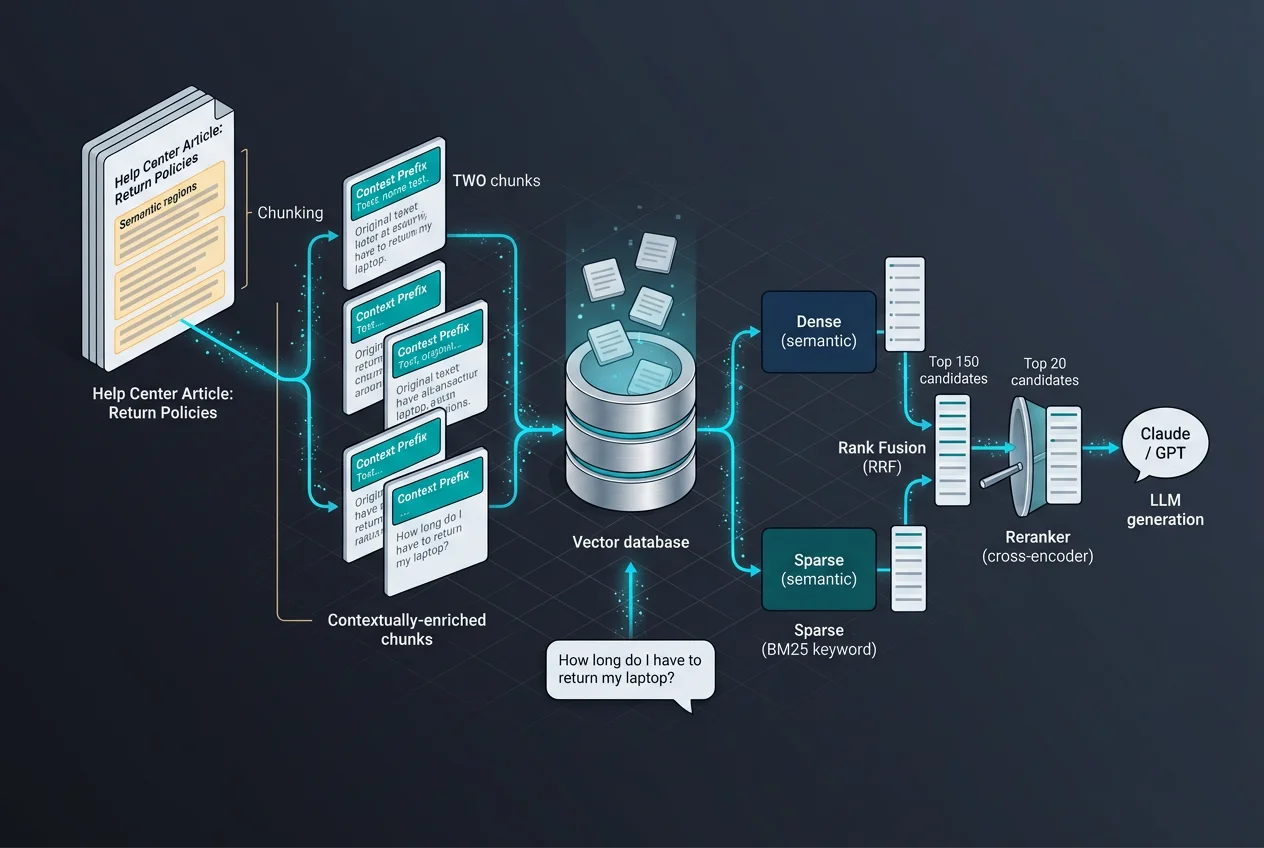
Contextual retrieval prepends each chunk with an LLM-generated 50 to 100 token explanation of where that chunk sits in the parent document before embedding. Instead of embedding "The return window is 30 days from delivery," you embed: "In the section discussing return policies for full-price electronics purchased between November and January, the document states: The return window is 30 days from delivery."
That second version retrieves correctly for queries about electronics returns, holiday returns, and full-price product returns, none of which the original chunk would have matched cleanly. Anthropic's internal testing shows 49 percent reduction in retrieval failures from contextual retrieval alone, and 67 percent reduction when combined with reranking.
The cost of generating the contextual prefix is modest because Claude or another LLM only needs to read the chunk and its parent document once at indexing time. With prompt caching applied to the document context, the indexing cost stays bounded even for large knowledge bases.
The Hybrid Search and Reranking Pipeline
The mature 2026 retrieval pipeline combines four techniques into a single flow.
- Dense embedding (semantic search). Standard vector similarity against the contextually-enriched chunks. Catches semantic matches even when the query and chunk share no exact keywords.
- Sparse embedding (keyword search). BM25 or similar over the same chunks. Catches keyword matches when semantic similarity would miss them, particularly for proper nouns, product names, and codes.
- Rank fusion. Reciprocal Rank Fusion (RRF) or weighted combination merges the dense and sparse rankings into a unified top 150 candidates.
- Reranker. A cross-encoder model (Cohere Rerank, Voyage Rerank, or open-source alternatives) takes the top 150 and produces a final top 20 ranked by direct query-chunk relevance scoring. The final 20 chunks pass to the LLM for answer generation.
| Pipeline Stage | What It Does | Latency Cost | Accuracy Contribution |
| Dense embedding retrieval | Top 100 by semantic similarity | 10 to 30ms | Strong baseline, weak on rare terms |
| Sparse embedding retrieval | Top 100 by keyword match | 5 to 20ms | Catches what semantic misses |
| Rank fusion (RRF) | Unified top 150 | Negligible | Combines both signal types |
| Reranker (cross-encoder) | Top 20 final ranked | 100 to 300ms | Largest single accuracy boost |
| LLM generation | Final answer from top 20 chunks | 500 to 2000ms | The answer the user sees |
Skipping the reranker is the most common cost-saving mistake in production RAG. The 100 to 300ms latency is worth the accuracy lift in almost every business chatbot use case.
Evaluation: Why Most Teams Measure the Wrong Thing
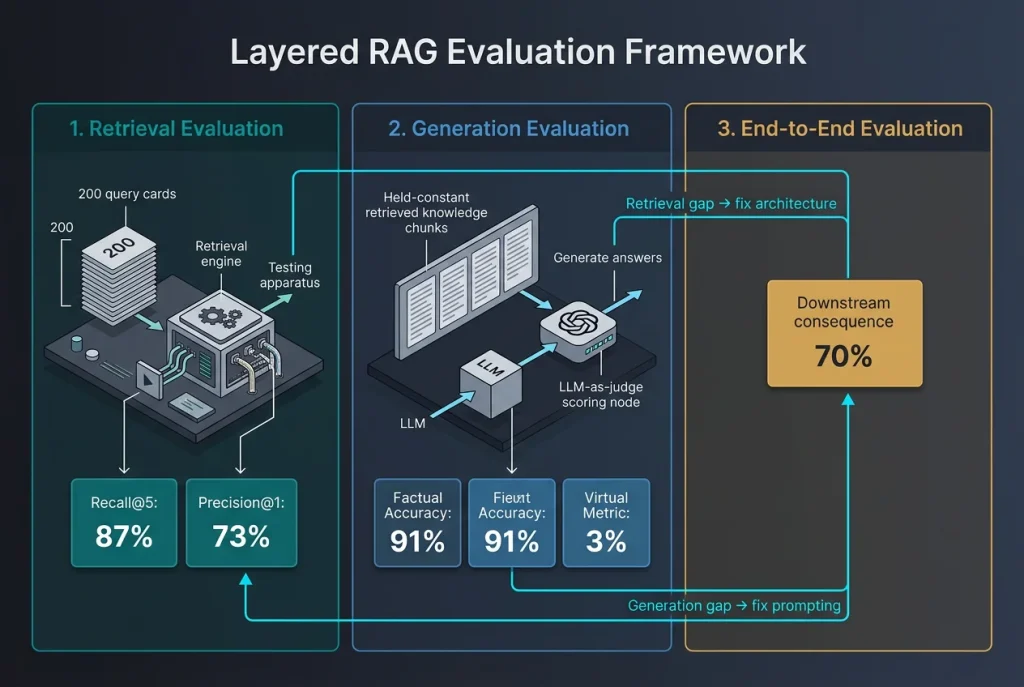
A RAG chatbot has two failure points: retrieval can return wrong chunks, or the LLM can generate poorly from correct chunks. Most teams measure only end-to-end accuracy (was the final answer right?), which conflates the two failure modes and makes debugging impossible.
The production-grade approach measures retrieval and generation separately.
- Retrieval evaluation. Build a test set of 50 to 200 questions with the known-correct chunks. For each query, measure whether the correct chunk appears in the top 5 retrieved (recall@5) and whether it appears in the top 1 (precision@1). Run this every time the knowledge base, chunking, embedding model, or reranker changes.
- Generation evaluation. Hold the retrieved chunks constant. For each (question, retrieved chunks) pair, score the LLM answer for factual accuracy, completeness, and tone. LLM-as-judge approaches work well for scaling this evaluation, with periodic human spot-checks.
- End-to-end evaluation. Only after retrieval and generation evaluation are healthy does end-to-end accuracy become meaningful. A team that evaluates only end-to-end accuracy spends weeks debugging without knowing whether to tune retrieval or prompting.
Cost: What Prompt Caching Actually Saves
LLM inference is the recurring cost of a deployed chatbot. For high-traffic deployments, it can dominate the total cost of ownership. Prompt caching (Anthropic, OpenAI, and others now offer it) writes the static portion of the prompt (system instructions, retrieved context, brand voice rules) to a cache that costs roughly 10 percent of the original input token price when reused within the cache window.
In practice, this produces an 87 percent reduction in input token cost for chatbots where the system prompt and retrieved context dominate the total prompt size. For a chatbot handling 100,000 conversations per month with 3,000 input tokens per conversation, that is the difference between $9,000 per month in input costs and $1,170 per month. The activation cost is configuring caching correctly; the savings compound every month.
The Maturity Ladder: From Templated Chatbot to Agentic Assistant
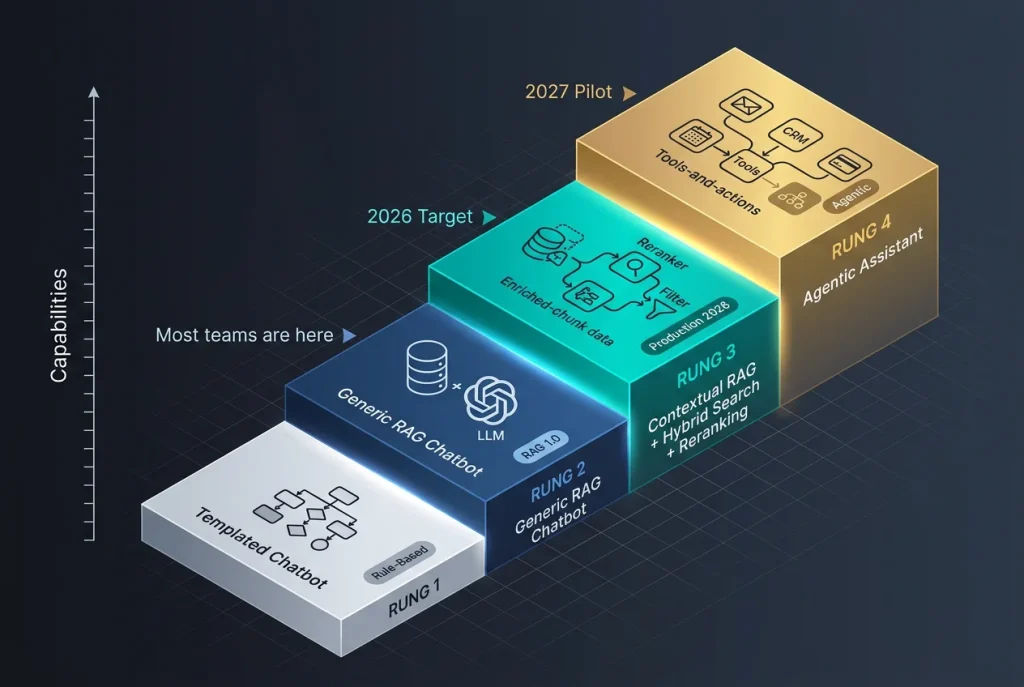
Teams deploying chatbots in 2026 sit somewhere on a four-rung capability ladder. Knowing your rung clarifies what to invest in next.
- Rung 1: Templated chatbot. Rules-based flows, no LLM in the loop. Cheap to run, cheap to break. Reserved for narrow use cases (appointment booking, FAQs with known finite answer set).
- Rung 2: Generic RAG chatbot. LLM with vector retrieval over chunked documents. Easy first build. Common failure mode: hallucination on edge cases, wrong-chunk retrieval on context-dependent queries. Most 2025-vintage production deployments live here.
- Rung 3: Contextual RAG with hybrid search and reranking. The architecture this article describes. Materially higher accuracy on real business content. Worth the engineering investment for any deployment with meaningful conversion or support volume.
- Rung 4: Agentic assistant. The chatbot reasons through multi-step tasks, calls tools (calendar, CRM, payment), and takes actions inside business systems with appropriate guardrails. The 2026 frontier; pilot-stage for most companies, production-stage for a handful of mature deployments.
Most companies should target Rung 3 production by end of 2026 with Rung 4 pilots running in low-risk workflows. Skipping rungs causes operational pain disproportionate to the capability gain.
Where to Start Your Implementation
Audit your current chatbot against the contextual retrieval test. Pull 50 customer questions from chat transcripts where the bot gave a wrong or unhelpful answer. For each, check whether the correct chunk exists in the knowledge base and whether retrieval found it. If retrieval failed on more than 20 percent, contextual retrieval is your highest-leverage next investment. If retrieval found the right chunk but generation went wrong, prompting and evaluation discipline matter more.
The fastest production path: implement contextual retrieval and reranking on your existing knowledge base before adding new content sources. Architecture improvements compound across every existing chunk; new content sources only help where queries map to them.
Key Takeaways
- Generic RAG fails on real business content because chunks lose context when separated from parent documents
- Contextual retrieval (LLM-generated context prepended to each chunk before embedding) reduces retrieval failures 49 percent on its own, 67 percent with reranking
- The mature pipeline combines dense embedding, sparse keyword search, rank fusion, and a cross-encoder reranker before LLM generation
- Evaluate retrieval and generation separately; end-to-end accuracy alone makes debugging impossible
- Prompt caching cuts input token cost roughly 87 percent for chatbots with sizable system prompts and retrieved context
- The capability ladder: templated → generic RAG → contextual RAG with reranking → agentic assistant; Rung 3 is the 2026 production target
- The fastest production gain comes from architecture improvements to existing content, not from adding new content sources
Frequently Asked Questions
What is contextual retrieval and how is it different from standard RAG?
Contextual retrieval prepends each chunk with an LLM-generated 50 to 100 token explanation of where the chunk sits in the parent document before embedding it in the vector database. Standard RAG embeds the raw chunk and loses surrounding context. Per Anthropic's internal testing, contextual retrieval reduces retrieval failures 49 percent on its own and 67 percent when combined with a reranker.
How much accuracy gain does contextual retrieval actually deliver?
Anthropic's published benchmarks show 49 percent reduction in retrieval failures from contextual retrieval alone and 67 percent reduction when combined with reranking. In production deployments on heterogeneous business content, the realized lift varies between 30 and 65 percent depending on how context-dependent your source documents are. Help centers and product documentation typically see the high end.
What is reranking and when do I need it?
Reranking applies a cross-encoder model (Cohere Rerank, Voyage Rerank, or open-source alternatives) to the top 100 to 150 chunks returned by initial retrieval and produces a final top 20 ranked by direct query-chunk relevance. It adds 100 to 300ms of latency and is the single largest accuracy contributor in the modern RAG pipeline. Skip it only for prototypes; production deployments should include it.
How do I evaluate a RAG-based chatbot?
Evaluate retrieval and generation separately. Build a test set of 50 to 200 questions with known-correct chunks; measure recall@5 and precision@1 for retrieval. Hold the retrieved chunks constant and score the LLM answer for factual accuracy, completeness, and tone; LLM-as-judge approaches scale this well with periodic human spot-checks. Only after both are healthy does end-to-end accuracy become meaningful.
What does prompt caching cost reduction look like in practice?
Prompt caching writes static portions of the prompt (system instructions, retrieved context) to a cache that costs roughly 10 percent of the original input token price on reuse. For a chatbot handling 100,000 monthly conversations at 3,000 input tokens each, that is the difference between approximately $9,000 and $1,170 per month in input token costs, an 87 percent reduction.
Should I use Pinecone, Weaviate, Qdrant, or a managed service?
The choice depends on scale and team capability. Pinecone is the lowest-friction managed service for teams that want SaaS. Weaviate and Qdrant are stronger for teams running self-hosted or hybrid (open source plus managed). For deployments under 10 million chunks, all three perform well; for larger scale, benchmark on your specific access patterns. Avoid building a vector database from scratch unless you have a specific reason none of the existing options can satisfy.
How do I handle multi-modal content (PDFs with images, video transcripts)?
For PDFs with diagrams or tables, use a layout-aware parser (LlamaParse, AWS Textract, or similar) that preserves structural relationships rather than flattening to text. For video, store the transcript with timestamps and chunk by topical segment rather than fixed duration. For images that contain meaningful information (product photos, screenshots), generate descriptive captions at indexing time and embed the captions alongside the surrounding text.
What chunk size and overlap should I use?
Start with 200 to 500 token chunks and 50 to 100 token overlap. Smaller chunks (200 tokens) improve precision but reduce context per retrieval; larger chunks (500 tokens) preserve context but dilute relevance. The right answer is content-dependent: dense technical documentation tolerates larger chunks; FAQ-style content benefits from smaller chunks. Test on your actual content using your retrieval test set.
How often should I update the knowledge base?
Continuous for fast-moving content (pricing, inventory, policy), weekly or monthly for slower-moving content (product documentation, training materials). The technical work is keeping embeddings synchronized with source updates; the operational work is ensuring updates flow through your contextual-retrieval pipeline rather than reverting to bare-chunk embedding. Automate the pipeline so updates do not bypass the architecture.
When does fine-tuning become better than RAG?
Fine-tuning makes sense for replicating a specific writing style consistently, handling proprietary vocabulary that base models do not understand, or operating in an on-premise environment without internet access. For 95 percent of business chatbot use cases, RAG with contextual retrieval outperforms fine-tuning on cost, freshness, citation accuracy, and time-to-improvement. The hybrid approach (RAG plus light fine-tuning on style) covers most remaining use cases.
Conclusion
The hard work of chatbot training in 2026 is upstream of the model. Contextual retrieval changes what gets embedded. Hybrid search plus reranking changes how retrieval surfaces the right chunk. Prompt caching changes what the deployment costs to run. Separate evaluation of retrieval and generation makes debugging tractable. None of this requires a different LLM than the one you are already using; all of it requires engineering discipline applied to the retrieval architecture. Audit your wrong-answer transcripts, find the rung you are on, and the next investment becomes obvious.