
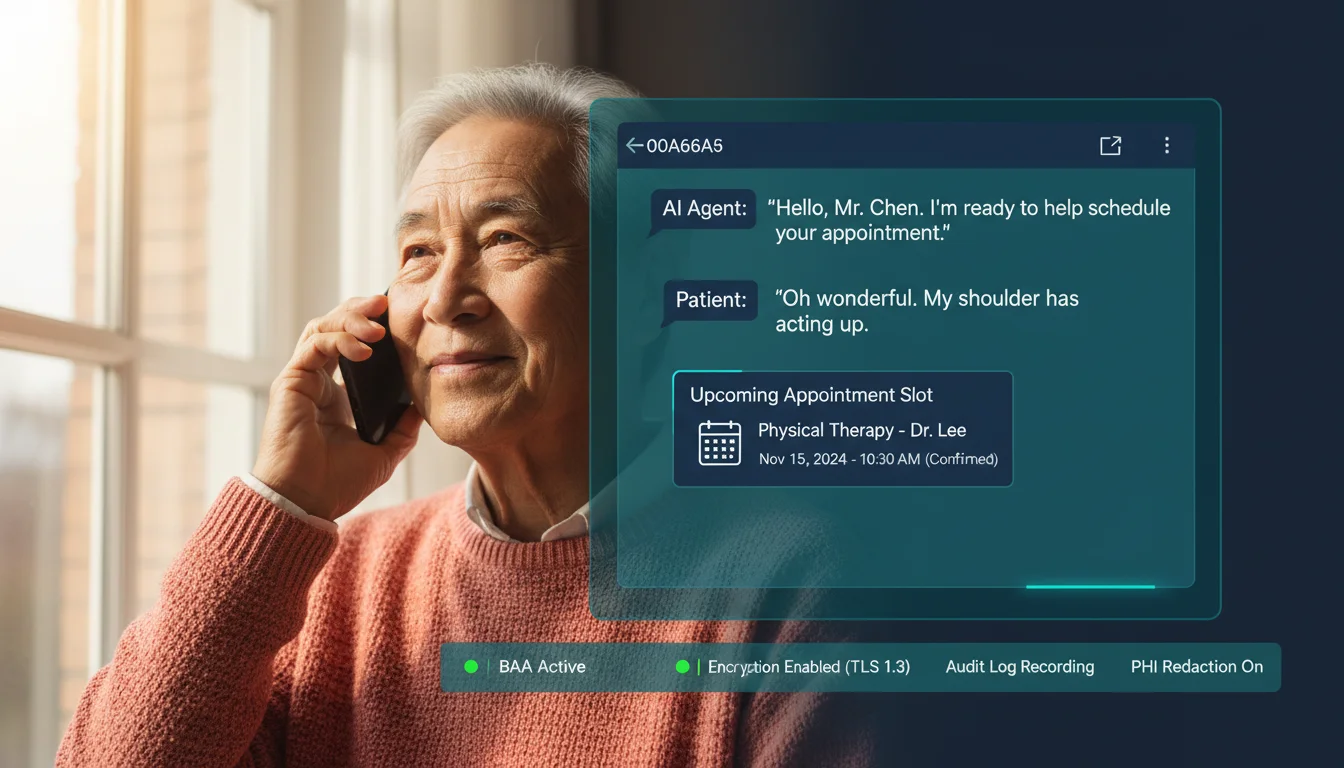
Important notice: This article describes administrative and operational applications of AI voice technology in healthcare (scheduling, intake, routine triage routing, and EHR integration). It does not address AI for clinical diagnosis, treatment decisions, or any substitute for licensed medical judgment. Healthcare organizations must verify HIPAA compliance, state regulations, and vendor BAAs independently before deployment. Consult your compliance and legal teams for jurisdiction-specific requirements.
HIPAA-compliant AI voice agents handle patient scheduling, intake, routine triage routing, and EHR integration around the clock without crossing into clinical decisioning. Defensible deployment requires signed BAAs, end-to-end encryption, certified EHR integration, clinical safety guardrails, and continuous quality monitoring. Per the American Medical Association, physician AI adoption nearly doubled to 66% in a single year, and healthcare voice AI is one of the fastest-growing segments inside that wave.
Phone-based patient access is the single highest-friction interaction in most practices. Call volume peaks when staff capacity is lowest. Hold times drive abandonment. After-hours calls route to voicemail that nobody answers until Monday. Missed appointments and no-shows accumulate. According to the American Medical Association Augmented Intelligence Research, physician AI use jumped from 38% in 2023 to 66% in 2024, and the wave has continued to accelerate. Healthcare voice AI sits inside that wave, and the reason is the same everywhere: phone access is breaking, and AI is the first scalable fix.
The fix only works when deployed with HIPAA discipline and clinical safety guardrails baked in from day one. Below, you will learn what AI voice agents do and do not belong doing in healthcare, the HIPAA compliance requirements that are non-negotiable, how voice AI integrates with major EHRs, the clinical safety guardrails that separate defensible deployments from malpractice exposure, the measurable impact on answer rates and no-shows, and the 90-day deployment sequence that lands voice AI without exposing the organization to regulatory or safety risk.
What AI Voice Agents Do in Healthcare (and What They Do Not)
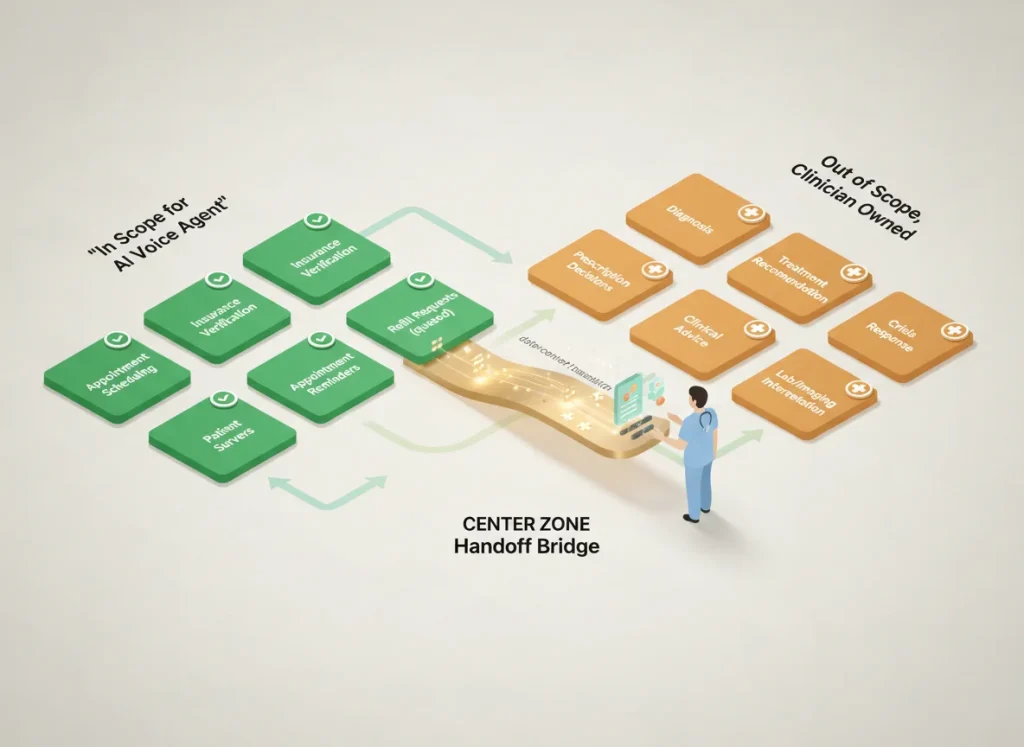
The distinction between in-scope and out-of-scope is the single most important design decision in any healthcare voice AI deployment. It determines the regulatory posture, the liability profile, and the clinical safety boundary. Hard-coding the line is what protects the organization, the patient, and the AI vendor relationship simultaneously, and the line cannot be added later as a feature.
In-scope work for AI voice agents includes the following. These are administrative and routing workflows where the AI never touches clinical judgment:
- Answering inbound patient calls 24/7
- Scheduling, rescheduling, and cancelling appointments with provider and location matching
- Verifying insurance and collecting pre-visit information
- Routing urgent calls to on-call clinicians with protocol-driven triage questions
- Sending appointment reminders and handling confirmations
- Processing refill requests with a nurse review queue
- Collecting patient-reported outcomes and survey responses
- Transferring to human staff when the interaction moves beyond defined scope
Out-of-scope work (without clinical review) includes anything that involves judgment about a patient's clinical state, treatment, or outcomes. The AI does not engage in diagnostic conversations, treatment recommendations, prescription decisions, clinical advice of any kind, interpretation of lab or imaging results, or any interaction that a reasonable patient might interpret as clinical advice. The hand-off the moment the conversation approaches that boundary is what makes the deployment defensible. A well-designed AI voice agent handles administrative and low-acuity routing scope exceptionally well and routes to clinicians the moment the conversation approaches clinical decisioning.
Table 1: In-Scope vs Out-of-Scope for Healthcare Voice AI
| In-Scope (Administrative and Routing) | Out-of-Scope Without Clinical Review |
| Answering calls and scheduling appointments | Diagnostic conversations |
| Insurance verification and intake | Treatment recommendations |
| Routine triage routing with protocol questions | Prescription decisions |
| Refill requests with nurse review queue | Interpretation of labs or imaging |
| Reminders, confirmations, surveys | Clinical advice of any kind |
| Hand-off to human staff outside scope | Anything a patient could interpret as clinical advice |
HIPAA Compliance Requirements
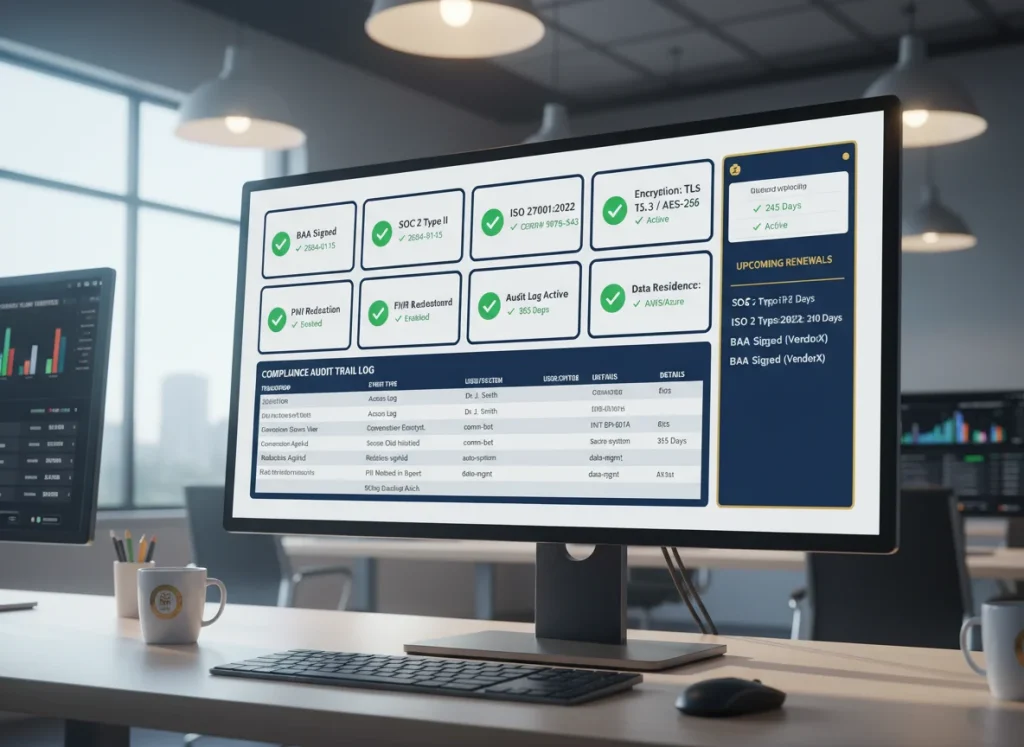
A HIPAA-compliant AI voice agent deployment requires specific vendor capabilities and organizational policies in tandem. The list below is informational rather than legal advice, and compliance counsel should verify each item against the organization's specific use case and jurisdiction. Each item is a deal-breaker on its own. A vendor missing any one is not ready for healthcare deployment regardless of feature parity, demo quality, or price.
The minimum HIPAA-compliance posture for healthcare voice AI:
- Signed Business Associate Agreement (BAA). The vendor contractually assumes HIPAA Business Associate responsibilities. No BAA, no conversation.
- End-to-end encryption. TLS 1.3 in transit and AES-256 at rest, applied across call audio, transcripts, and any derived data.
- Secure call recording and transcript storage. Access controls, audit logs, and retention policies that match the organization's compliance program.
- PHI-aware processing with automatic redaction. The system recognizes protected health information and handles it appropriately rather than treating it as generic conversational text.
- Model training exclusions. PHI is not used for training, and customer data is not shared across customers under any circumstance.
- Security certifications. ISO 27001:2022 and SOC 2 Type II are the minimum. HITRUST is increasingly expected for larger deployments.
- Access controls and audit logging. Role-based access, multi-factor authentication, and queryable audit logs available on request.
- Data residency. Processing and storage in approved jurisdictions that match the organization's privacy and regulatory profile.
The list looks long, but most healthcare-ready vendors satisfy it as table stakes by 2026. The vendors that struggle to satisfy it are the ones repurposing general-purpose voice AI products for healthcare without the specific compliance investment. Verifying each item with current attestations (not vendor marketing claims) is the difference between a deployment that survives a HIPAA audit and one that creates regulatory exposure on day one.
Table 2: HIPAA Compliance Requirements for Healthcare Voice AI
| Requirement | What It Means | Non-Negotiable |
| Signed BAA | Vendor assumes HIPAA Business Associate responsibilities | Yes |
| End-to-end encryption | TLS 1.3 in transit, AES-256 at rest | Yes |
| Training-data exclusions | PHI not used for training, no customer cross-pollination | Yes |
| Security certifications | ISO 27001:2022 and SOC 2 Type II minimum | Yes |
| Access controls and audit logging | Role-based access, MFA, queryable logs | Yes |
| Data residency | Processing and storage in approved jurisdictions | Yes |
EHR Integration: Where Voice AI Delivers Real Value
An AI voice agent that does not talk to the EHR is a more sophisticated auto-attendant. An AI voice agent with bidirectional EHR integration is a genuine operational layer that reads patient context and writes the outcomes of the conversation back into the chart. The depth of integration is what determines whether the deployment changes operations or just improves the phone tree.
Read capabilities power the inbound side of every conversation. The voice agent verifies patient identity against the EHR, reads the active provider schedule to find genuine availability, surfaces existing appointments to support reschedules, checks insurance on file before booking, references the medication list for refill workflows, and confirms chart status before any action that depends on it. Without these reads, the agent is making scheduling decisions blind to the constraints that matter, which produces errors that downstream staff have to clean up.
Write capabilities close the loop. The agent creates and updates appointments, posts demographic and insurance updates to the patient record, logs interaction history, and records triage outcomes against the correct note type in the EHR. Writes require strict validation, and for specific actions (anything that touches treatment continuity), they require clinician confirmation before commit. The 2026 generation of voice AI platforms integrates with major EHRs (Epic, Cerner/Oracle Health, eClinicalWorks, Athena, NextGen, and specialty systems) via certified APIs with PHI-safe handling. Surface-level "integration" varies widely in practice, and a demo environment is not the same as a production-certified connection. Verify integration depth with any vendor before selection and ask for a reference customer running the same EHR version in production.
Table 3: EHR Integration Read and Write Capabilities
| Capability | Reads From EHR | Writes To EHR |
| Identity verification | Patient demographics, MRN | Updates to demographics if changed |
| Appointment scheduling | Provider schedule, existing appointments | New appointment, reschedule, cancel |
| Insurance | Coverage on file | Updated insurance info |
| Refills | Medication list | Refill request to nurse review queue |
| Triage routing | Chart status, recent visits | Triage outcome note in correct note type |
| Interaction history | Prior calls, prior visits | Logged interaction with timestamp and outcome |
Clinical Safety Guardrails
AI voice agents in healthcare operate under guardrails that are as important as the HIPAA requirements. The HIPAA controls protect data. The clinical safety guardrails protect patients. Both layers are needed, and skipping either one creates exposure that the vendor will not absorb. The five guardrails:
- Scope enforcement. The agent has an explicit, tested scope. When a caller's intent moves outside scope, the agent routes to a human. This behavior is tested continuously, with callers attempting edge cases, and the agent must hand off reliably.
- Symptom-based triage escalation. For triage workflows, the agent follows a protocol that escalates to clinicians when any red-flag symptom is mentioned. Chest pain, shortness of breath, stroke symptoms, pediatric fevers, and mental health crisis language all trigger immediate human handoff with priority flagging.
- Confirmation on all clinical-adjacent actions. Refill requests, appointment changes that affect ongoing care plans, and any action that could affect treatment are flagged for clinician review rather than executed autonomously.
- Continuous quality monitoring. A sample of conversations is reviewed by clinicians and quality teams weekly. Any miss is logged, root-caused, and used to update scope or training.
- Incident reporting. Any patient safety concern, compliance concern, or complaint has a documented reporting pathway that leadership monitors monthly.
The combination of scope enforcement and symptom-based escalation does most of the work. Quality monitoring and incident reporting are the discipline layers that catch what the live guardrails miss, and the monthly leadership review is what ensures the program does not drift over the 12 to 24 months following deployment.
Measurable Impact and the 90-Day Deployment Sequence
Mature healthcare voice AI deployments produce a consistent set of outcomes. Call answer rates climb to 98%+ from a baseline of 60 to 75% typical without voice AI. Average hold times drop under 30 seconds from a baseline of 3 to 8 minutes. After-hours appointment booking becomes available where it was previously not offered at all. No-show rates fall 20 to 35% from proactive reminders and easier rescheduling. Front-desk staff reclaim 4 to 8 hours per week, which is then redeployed to higher-value patient-facing work that drives satisfaction scores and visit volume.
The business case is often straightforward. The operational case requires deliberate deployment, which is where most programs succeed or stall. A defensible deployment built on AI orchestration infrastructure follows a measured 90-day sequence. The first 30 days are scope definition and compliance alignment: define the exact scope, complete vendor due diligence including BAA review and EHR integration verification, develop clinical safety guardrails with clinical leadership, and produce the internal runbook that defines what the agent handles, what triggers escalation, and what constitutes an incident.
Days 31 through 60 are narrow deployment and monitoring. Launch on one intent (typically appointment scheduling for one practice location or service line), conduct human shadow review of every conversation in the first two weeks transitioning to sampled review thereafter, and run a daily quality huddle between operations and the vendor. Days 61 through 90 are scope expansion with safeguards. Expand to additional intents and locations based on the quality data from the first phase, continue sampled clinical review, and publish internal metrics weekly and external patient-experience metrics monthly. Beyond day 90, the deployment moves into steady-state operations with continuous quality monitoring, quarterly scope review, and annual compliance re-attestation. Treat the first year as continuous improvement rather than set-and-forget, because the conversations the system handles in month 12 are different from the conversations it handled in month 1.
Vendor Evaluation Criteria
When evaluating AI voice agent platforms for healthcare, the criteria matter in a specific order. Skipping any of the first three disqualifies the vendor regardless of how strong the others look in a demo environment. The six criteria in priority order:
- BAA and security posture. No BAA, no conversation. SOC 2 Type II and ISO 27001 are the minimum certifications. HITRUST is increasingly expected for larger deployments.
- EHR integration depth. Certified, production-ready bidirectional integration with the specific EHR in use. Not a generic HL7 claim, not a demo environment, and not a reference deployment on a different EHR version.
- Clinical safety architecture. How does the platform enforce scope? How does it escalate on red-flag symptoms? What is the review queue interface for clinician oversight?
- Quality monitoring tooling. Can clinical and operations leadership sample, review, classify, and feed back into training? The tooling should make the governance layer easy rather than optional.
- Voice quality and natural language handling. Does the agent handle accents, acoustic noise, elderly patients, pediatric patients, and multilingual callers at the quality your patient population expects?
- Incident and escalation workflows. How are incidents logged, reviewed, and learned from? What is the formal feedback loop from front-line clinical review back to platform improvement?
Vendors that cannot answer these six clearly are not healthcare-ready regardless of demo impressiveness. The scripted demo is rarely the version of the product that ships into production, and the gap between demo and reality is exactly where compliance and safety incidents originate.
Key Takeaways
- AI voice agents belong in administrative and low-acuity routing workflows: scheduling, intake, refill processing with nurse review, and protocol-driven triage routing. They do not belong in clinical decisioning without explicit clinician review.
- HIPAA compliance requires signed BAAs, end-to-end encryption, training-data exclusions, SOC 2 Type II and ISO 27001:2022 certifications, and audit logging. Each item is a deal-breaker on its own.
- EHR integration spans Epic, Cerner/Oracle Health, eClinicalWorks, Athena, NextGen, and specialty systems through certified bidirectional APIs with PHI-safe handling rather than generic HL7 claims.
- Clinical safety guardrails include explicit scope enforcement, symptom-based triage escalation, confirmation on clinical-adjacent actions, continuous quality monitoring, and documented incident reporting reviewed monthly by leadership.
- Typical impact: 98%+ call answer rate, hold times under 30 seconds, 20 to 35% no-show reduction, and 4 to 8 hours per week reclaimed per front-desk staff member, redeployed to higher-value patient-facing work.
- A defensible deployment follows a 90-day sequence: scope and compliance alignment, narrow launch with shadow review, supervised scope expansion, then steady-state operations with quarterly reviews.
Getting Started With Healthcare Voice AI
The right starting point depends on where your operational pain is loudest. If it is call abandonment, start with inbound call answering and appointment scheduling. If it is no-shows, start with proactive reminders and rescheduling workflows. If it is after-hours access, start with 24/7 appointment booking and clinical-triage routing. The single-intent, single-location pilot pattern produces visible wins inside 60 days and builds the organizational confidence needed to expand scope, which is the political fuel that funds the rest of the deployment.
The mistake organizations make at this step is to deploy across multiple intents and locations simultaneously to "prove value at scale." That approach almost always extends the timeline by 6 to 9 months because every additional intent adds clinical safety scope, every additional location adds change management, and the compound complexity overwhelms the small team running the program. Single-intent pilots produce wins inside 60 days, and those wins fund the second and third deployments politically rather than financially. As a leading digital marketing agency working with healthcare organizations, the engagement model evaluates voice AI platforms against HIPAA requirements, EHR integration depth, and clinical safety guardrails, then sequences deployment so the compliance and quality work is right-sized at every phase.
To evaluate platforms against HIPAA, EHR integration, and clinical safety requirements, and map a 90-day deployment sequence, request an assessment for a Healthcare Voice AI review.
Conclusion
The technology is mature. The deployment discipline is what separates outcome from liability. Respect the line between administrative workflow and clinical judgment. Deploy with the HIPAA controls, EHR integration depth, and clinical safety guardrails in place from day one. Sequence the 90-day launch deliberately and let quality data drive scope expansion rather than vendor enthusiasm.
Frequently Asked Questions
Is an AI voice agent HIPAA-compliant?
AI voice agents can be HIPAA-compliant when the vendor provides a signed BAA, end-to-end encryption, secure PHI handling, training-data exclusions, appropriate certifications (SOC 2 Type II, ISO 27001), and data residency that matches policy. Compliance is a vendor-plus-organization responsibility, not a vendor-only claim.
What can AI voice agents do in healthcare?
They answer patient calls 24/7, book and reschedule appointments, verify insurance, collect pre-visit information, route urgent calls to on-call clinicians, send reminders, handle confirmations, process refill requests with nurse review, and transfer to human staff when the conversation moves beyond defined scope.
What should AI voice agents not do in healthcare?
They should not diagnose, recommend treatment, make prescription decisions, give clinical advice, interpret lab or imaging results, or engage in any interaction a reasonable patient might interpret as clinical advice. Clinical decisioning stays with licensed clinicians.
How do AI voice agents integrate with EHRs?
The 2026 generation integrates with major EHRs (Epic, Cerner/Oracle Health, eClinicalWorks, Athena, NextGen) via certified APIs. Bidirectional integration supports identity verification, schedule reads, appointment creation and updates, demographic updates, and interaction logging with PHI-safe handling throughout.
What is the typical impact of AI voice agents in healthcare?
Mature deployments typically produce call answer rates above 98%, hold times under 30 seconds, 20 to 35% reduction in no-shows, enabled after-hours scheduling, and 4 to 8 hours of staff time reclaimed per front-desk staff member per week.
How long does HIPAA-compliant voice AI deployment take?
A defensible deployment follows a 90-day sequence: 30 days for scope and compliance alignment, 30 days for narrow deployment with shadow review, and 30 days for supervised scope expansion. Steady-state continues with quarterly scope review and annual compliance re-attestation.
What are red-flag symptoms that trigger human handoff?
Chest pain, shortness of breath, stroke symptoms (FAST criteria), severe headache of sudden onset, pediatric fever thresholds, mental health crisis language, severe allergic reaction symptoms, and any language suggesting imminent harm to self or others. Each triggers immediate handoff with priority flagging.
What certifications should a healthcare voice AI vendor hold?
At minimum: SOC 2 Type II and ISO 27001:2022. For larger deployments or higher-risk use cases, HITRUST is increasingly expected. Verify with current audit reports. Claiming a certification is not the same as holding a current attestation, and the gap matters during a HIPAA audit.
Can AI voice agents handle multiple languages?
Yes. The 2026 generation supports multilingual deployment. English and Spanish are standard. Mandarin, Vietnamese, Arabic, French, Tagalog, and other major population languages are increasingly available. Verify each language's production readiness rather than treating "multilingual" as a binary vendor claim.
How do AI voice agents handle calls from elderly or pediatric patients?
Well-designed platforms tune for elderly patients (slower pace, clearer enunciation, tolerance for repetition) and pediatric scenarios (handoff to parent or guardian, appropriate tone, strict triage escalation). Test these populations explicitly during evaluation. They are where voice AI quality matters most.