

AI automation reduces human error in data entry and document processing from 1 to 5% per field to 0.1% per field through optical character recognition, natural language processing, and continuous validation. The mature 2026 deployment pattern is human-in-the-loop intelligent document processing, where AI handles 95% of work automatically and humans verify flagged fields and own exceptions.
Human error in manual data entry runs between 1% and 5% per field. That sounds small until you multiply it across a mid-size operations team processing ten thousand records a month. Suddenly you are looking at 100 to 500 downstream mistakes flowing into your CRM, your billing system, your reports, and your AI models. Every one of them costs something downstream, often more than the original entry cost to produce.
The fix is intelligent document processing built on top of AI automation infrastructure that catches errors before they enter the system rather than cleaning them up after they have spread. Below, you will learn where human error actually happens, how the modern IDP stack catches it, the accuracy math that justifies the investment, the human-in-the-loop pattern that produces the best outcomes in 2026, where to deploy IDP first, and the governance layer that most teams underbuild and later regret.
Where Human Error Actually Happens
Three failure modes drive the vast majority of data-entry errors. Each one is invisible at the level of the individual record but becomes obvious in aggregate. Diagnosing which mode dominates in your operation matters because the fix is different for each one, and treating all errors as the same kind of problem produces remediation work that does not actually move the error rate. The three failure modes:
- Transcription errors. Numbers and letters swapped, extra digits, missing fields. Runs 1 to 5% per field in manual entry. The same operator who is 99% accurate at the start of a shift drifts toward 95% by the end of one as fatigue accumulates.
- Consistency drift. Same data recorded different ways across records ("ABC Inc." vs "ABC, Inc." vs "ABC Incorporated"), breaking downstream deduplication, reporting, and AI processing. Drift is invisible to the operator entering each individual record correctly. It only shows up at the aggregate level.
- Skipped validation. A phone number that looks right but is not a valid format. An email that passes visual inspection but bounces. A date in the wrong timezone. Manual entry skips validation under time pressure, especially when the operator is incentivized on throughput rather than accuracy.
AI handles all three at once. Optical character recognition (OCR) reads source documents. Natural language processing (NLP) extracts intent and relationships. Validation layers catch format errors before the record is created. The same rules apply to every record, every time, regardless of whether it is the first record of the shift or the thousandth.
Table 1: The Three Manual Error Modes
| Mode | Where It Happens | Why It Persists | What AI Catches |
| Transcription errors | Individual fields | Operator fatigue compounds over a shift | Format and pattern checks on every entry |
| Consistency drift | Across records | Invisible at the single-record level | Standardization rules applied uniformly |
| Skipped validation | Format and external checks | Throughput pressure overrides care | Validation runs before record commit |
The Intelligent Document Processing Stack
Modern intelligent document processing combines three technologies into a single workflow. Each component is necessary but not sufficient on its own, and the value comes from integrating all three into a pipeline rather than treating them as separate tools. Skipping any one of them produces an incomplete system that looks like IDP but does not deliver IDP results. The three components:
- OCR plus layout understanding. Reads structured forms, invoices, contracts, IDs, and free-form documents. The 2025 to 2026 generation handles handwriting, rotated scans, and multi-column layouts at production accuracy, which represents a meaningful step up from the OCR generation that powered scanning workflows for two decades.
- NLP-driven extraction. Pulls specific fields from the OCR output. Not just "what does the document say" but "who is the payer, what is the invoice total, what is the due date, which line items are taxable." Extraction understands context rather than just reading characters.
- Validation and enrichment. Cross-checks extracted values against expected formats, against the CRM, against vendor databases, and against historical records. Flags anomalies for human review and enriches fields where data is incomplete.
The result is a document that arrives as a PDF and exits as a validated, structured record in the system of record, in seconds rather than days. The compression of cycle time is what makes IDP economically attractive. The accuracy improvement is the secondary benefit that pays back over the long run, but the cycle-time compression is what makes leadership notice in the first 60 days.
Table 2: The Three Components of Modern IDP
| Component | What It Does | What It Replaces |
| OCR + layout | Reads source documents including handwriting and multi-column | Manual transcription from physical or scanned documents |
| NLP extraction | Understands context to pull specific fields with meaning | Manual interpretation and field-by-field data entry |
| Validation + enrichment | Cross-checks against expected formats and external sources | Downstream cleanup of records that should have been correct on entry |
The Accuracy Math
The 99.9% accuracy figure makes a strong headline, but the operational math is what justifies the investment to a CFO. Manual entry runs 1 to 5% error per field. Across a 10-field record, that compounds to 10 to 40% of records carrying at least one error. AI document processing runs 0.1% error per field, which translates to roughly 1% of records carrying at least one error. The gap is large enough that it changes the economic profile of any process built on top of the records.
Per Forrester research on process automation, autonomous AI agents are projected to handle 60% of routine business tasks by 2026, with operational error rates reduced 85 to 90%. Businesses leveraging AI document processing report reducing processing time by up to 80%. The economic impact compounds across both axes: fewer errors and faster cycles. The error reduction shows up in downstream cleanup costs that disappear, while the cycle-time compression shows up in customer-facing metrics like onboarding speed and invoice processing time.
Throughput is the third axis where the math runs in IDP's favor. Manual entry tops out at 100 to 200 records per hour per operator. IDP runs at 1,000 to 10,000 records per hour at a fraction of the cost per record. Combined with operators who do not fatigue and who apply the same rules to record one and record ten thousand, the unit economics of IDP make the deployment self-funding within the first 60 to 90 days for most high-volume document types.
Table 3: Manual Entry vs AI Document Processing
| Metric | Human Manual Entry | AI Document Processing |
| Error per field | 1 to 5% | 0.1% |
| Records with at least 1 error (10-field) | 10 to 40% | ~1% |
| Error distribution | Random, one-by-one | Systematic, findable at class level |
| Throughput | 100 to 200 records/hour | 1,000 to 10,000 records/hour |
| Cost per record | $0.10 to $0.50 | $0.01 to $0.05 |
| Operator fatigue effect | Significant | None |
Human-in-the-Loop: The Pattern That Actually Works
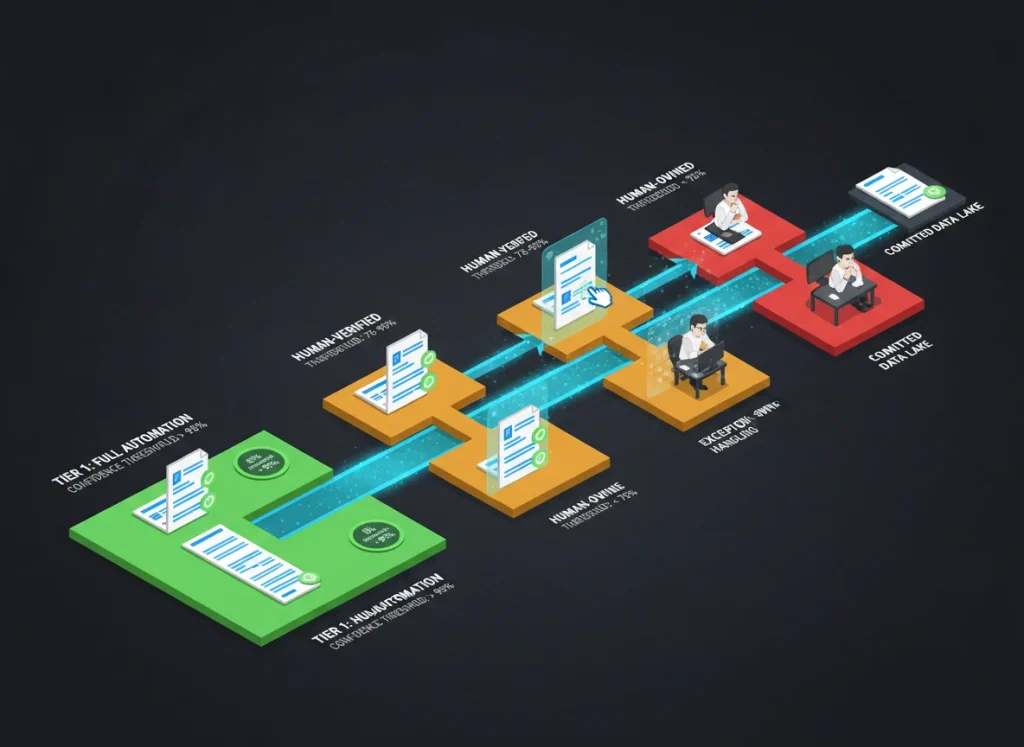
The mature 2026 pattern is not "AI replaces humans." It is "AI handles the 95% that follow a pattern, humans handle the 5% that do not, and AI flags which 5% needs review." This tiered approach captures AI's accuracy advantage while keeping human judgment where it adds value, and it produces the most defensible compliance posture because every record has a clear processing tier and every exception has a documented decision. The three tiers:
- Tier 1: Full automation. AI processes and commits records where confidence is high and all validations pass. No human touch.
- Tier 2: Human-verified. AI processes the record and flags specific fields for human review. A human clicks through a queue of flagged items at 10 to 20 times the speed of manual entry.
- Tier 3: Human-owned exceptions. AI escalates anomalies that fall outside trained patterns. The human owns the decision and, where appropriate, the exception becomes a new training example that improves Tier 1 accuracy over time.
The role of the human in this model is different from the role of the human in pure manual entry. Manual entry asks operators to perform repetitive transcription and pattern-matching, which is exactly what fatigue degrades. The human-in-the-loop model asks operators to handle exceptions and ambiguity, which is exactly where human judgment outperforms automation. Operators trained for this model report higher job satisfaction and lower attrition, both of which feed back into stable accuracy over time. The shift to exception handling also creates room for team AI training investments that build the judgment skills the new role requires rather than the rote skills the old role demanded.
Where to Deploy AI Document Automation First
Four use cases produce the fastest, most defensible ROI when used as the entry point for IDP. Picking the right starting use case matters more than picking the right tool, because a poor starting choice produces six months of frustration before the team builds confidence. The four use cases that consistently work:
- Invoice processing. Structured vendor documents with predictable fields. AI extracts vendor, amount, line items, tax, and due date, validates against purchase orders, and routes for approval. 80%+ reduction in processing time is typical. Often the first deployment because every business has invoices and the comparison is easy.
- New-customer onboarding. Intake forms, ID documents, and proof-of-address. AI extracts, validates, runs fraud and compliance checks, and creates the new customer record. Same-day onboarding replaces week-long queues. Particularly high ROI in financial services, healthcare, and regulated industries.
- Expense reports. Receipts, mileage logs, and credit-card statements. AI parses receipts, matches to card transactions, applies policy rules, and routes exceptions. Employee time savings are immediate, and the policy-compliance gain often exceeds the time savings.
- Contract metadata extraction. AI pulls party names, effective dates, renewal dates, payment terms, and obligation clauses from signed contracts into a searchable registry. Legal and procurement teams get visibility that was previously locked in PDFs. The first time a CFO can pull every renewal in the next 90 days with one query, the investment justifies itself.
The principle behind these four is the same: high volume, structured fields, predictable variation, and a clear comparison to a manual baseline that generates the business case. Resist the temptation to start with the most painful use case (often complex multi-page free-form contracts) because that is where IDP struggles hardest in early deployment and where unsuccessful first attempts kill organizational momentum.
The Governance Layer Most Teams Underbuild
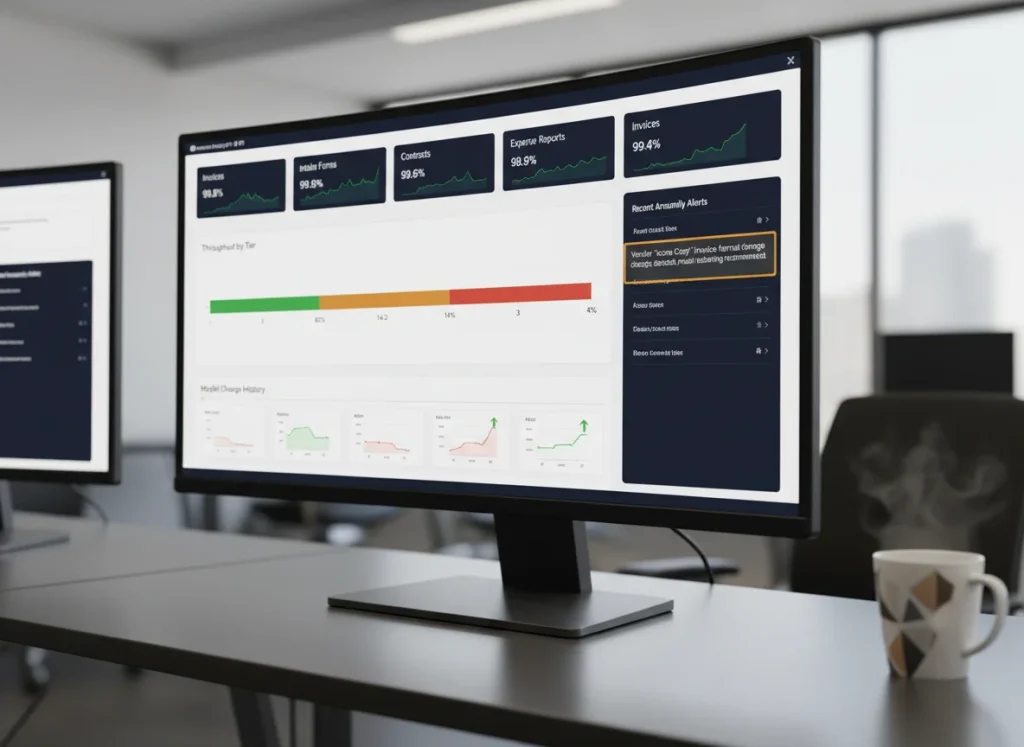
Error reduction is not a one-time deployment. It requires a governance layer that most teams underbuild and later regret. As a Houston-based digital marketing agency builds IDP systems, the governance layer is engineered in from day one rather than bolted on after a quality incident, which is the difference between IDP that holds up over years and IDP that quietly degrades over six months. Four pillars matter:
- Ongoing accuracy measurement. Random sample audits of Tier 1 (fully automated) records to verify accuracy stays at target. Benchmarks drift when document types change, and accuracy drift is invisible without sampling.
- Exception classification. Every Tier 3 exception is logged, classified, and, where appropriate, fed back as a training example. Exception volume should decline month over month, and a flat or rising exception trend signals the system needs attention.
- Model change logs. Every update to the IDP model is logged with before-and-after accuracy metrics. When something regresses, you know exactly when and why, which turns a multi-week debugging exercise into a 30-minute investigation.
- Compliance audit trail. Every extracted field, every validation decision, and every human review is logged for regulatory or legal inspection. In regulated industries, this is non-negotiable rather than nice-to-have.
Three patterns derail otherwise-promising IDP deployments and most of them are governance failures in disguise. Starting with the hardest document type produces six months of work with low accuracy and demoralizes the team before the easy wins land. Skipping the validation layer produces high extraction speed with low downstream accuracy, filling the CRM with garbage data faster than ever. Deploying without a clear owner means accuracy drifts, exceptions accumulate, and the deployment quietly degrades. Each of these is recoverable but each costs months of momentum that the program would otherwise spend compounding gains.
Key Takeaways
- Human data entry runs 1 to 5% error per field while AI document processing runs at 99.9% accuracy when properly tuned. The 50x gap changes the economic profile of any process built on top of the records.
- Three failure modes drive most manual error: transcription errors, consistency drift, and skipped validation. AI handles all three at once because the same rules apply to every record regardless of operator fatigue or throughput pressure.
- Modern intelligent document processing combines OCR plus layout understanding, NLP extraction, and validation plus enrichment into one pipeline. Skipping any component produces an incomplete system that looks like IDP but does not deliver IDP results.
- Forrester projects autonomous AI agents will handle 60% of routine business tasks by 2026 with operational error rates reduced 85 to 90% and processing time cut by up to 80%.
- The best deployment pattern is human-in-the-loop with three tiers: full automation, human-verified, and human-owned exceptions. AI handles the 95% that follow a pattern, humans handle the 5% that do not.
- High-ROI starting use cases are invoice processing, customer onboarding, expense reports, and contract metadata extraction. The governance layer (accuracy monitoring, exception classification, change logs, audit trails) is what makes the gains hold over time.
Getting Started With AI Document Automation
Start with the single highest-volume document type in your operation. Invoice processing, intake forms, or expense reports usually top the list. Run a 30-day measurement of current error rate and processing time on that one document type to establish your baseline. Deploy IDP on the same document type for the next 60 days. The delta is your proof of concept, the math for the business case, and the confidence to scale to the next document type.
The mistake teams make at this step is to try to deploy across multiple document types simultaneously to "prove value at scale." That approach almost always extends the timeline by 6 to 9 months because every document type adds configuration work, validation rules, and exception patterns. Single-document-type pilots produce wins inside 60 days, and those wins fund the second and third deployments politically. The build-once-deploy-everywhere fantasy that vendors sometimes pitch consistently underperforms the build-one-then-replicate pattern that operations teams actually run successfully.
To baseline your highest-volume document type and map a 60-day deployment with the governance layer built in, request a consultation for an Intelligent Document Processing Assessment.
Conclusion
The accuracy math is decisive: 1 to 5% human error vs 0.1% AI error per field, at 5 to 50 times the throughput and a fraction of the cost. The deployment pattern that wins is human-in-the-loop with clear tiers, named ownership, and a governance layer engineered in from day one. Start with the highest-volume structured document type, prove the math in 60 days, then scale.
Frequently Asked Questions
How accurate is AI data entry compared to humans?
AI document processing runs at 99.9% field accuracy in well-tuned production deployments. Human data entry runs 1 to 5% error per field. Error distribution also differs: AI errors are systematic and findable at the class level, while human errors are random and one-by-one.
What is intelligent document processing (IDP)?
IDP combines optical character recognition, natural language processing, and validation/enrichment into a single pipeline that converts incoming documents into validated structured records. It is the current-generation successor to traditional rules-based OCR and adds context-aware extraction and systematic validation.
How much time does AI document processing save?
Businesses using AI document processing report up to 80% reduction in processing time, with some use cases (invoice processing, expense reports) collapsing week-long cycles into same-day or same-hour throughput. Throughput improvements typically run 5 to 50 times depending on document type.
Does AI document processing replace human workers?
The mature 2026 pattern is human-in-the-loop. AI handles high-confidence extractions automatically, humans review flagged fields at 10 to 20 times manual speed, and humans own exceptions outside trained patterns. Human judgment moves up the value chain to exception handling rather than rote entry.
What should a company deploy AI document automation on first?
High-volume, structured document types with predictable fields: invoices, intake forms, expense reports, or contract metadata extraction. These four use cases produce the fastest, most defensible ROI and the measurement data needed to justify broader deployment to leadership.
How does AI document processing handle handwriting?
The 2025 to 2026 generation of OCR plus layout understanding handles handwriting at production accuracy on common forms (medical intake, applications, claim forms). Cursive and highly stylized handwriting still routes to human review more often than printed text, but the gap has narrowed substantially.
What is the difference between OCR and IDP?
OCR reads characters off a document. IDP reads characters, understands what they mean in context, validates them against expected formats and external sources, enriches them with related data, and commits a structured record to the system of record. OCR is a feature; IDP is the pipeline.
How do I measure AI document processing ROI?
Three metrics: error rate (target 99.9%+ on Tier 1 records), processing time (typical 80%+ reduction vs manual baseline), and cost per record (typical 5 to 10 times reduction). Run a 30-day baseline before deployment, then a 60-day measurement after, and the math is straightforward.
Is AI document processing safe for sensitive documents?
Yes, with appropriate controls: deployment in the firm's controlled environment (not consumer SaaS), vendor contracts that prohibit using firm data for training, encryption in transit and at rest, role-based access, and audit logs. Regulated industries also need certifications matching the regulatory profile.
What governance does an IDP deployment require?
Four pillars: ongoing accuracy measurement (random audits of Tier 1 records), exception classification (logging and feedback into training), model change logs (every update tracked), and compliance audit trail. Skipping any one of these is how IDP deployments degrade silently over six months.