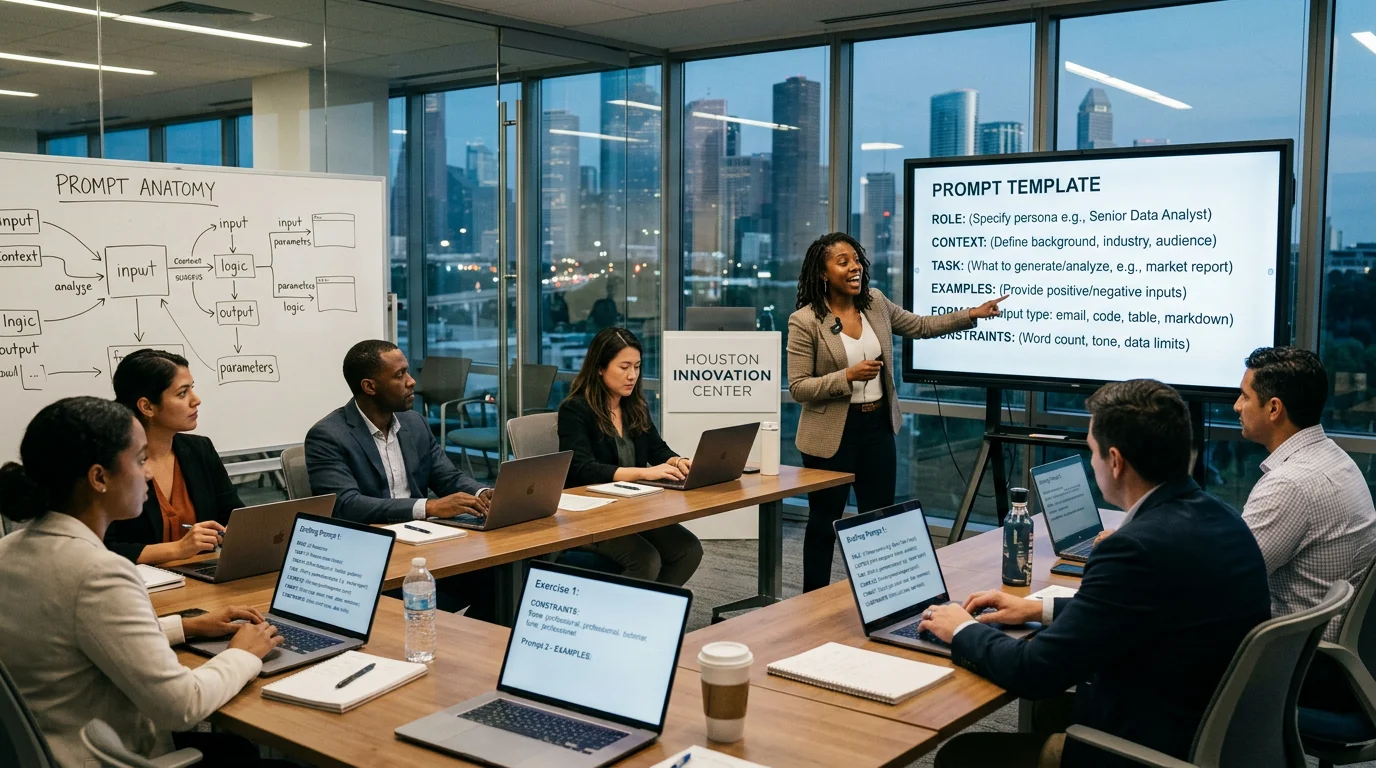
An AI prompt engineering workshop trains employees to move from one-line prompts to structured instructions that include role, context, examples, constraints, and output format. The OpenAI Cookbook codifies the techniques as a discipline, and teams that complete a structured workshop produce dramatically higher-quality AI output across writing, analysis, and code than teams that learn by trial and error.
What "10x Better" Actually Means
Every team that adopts ChatGPT, Claude, Gemini, or Copilot goes through the same cycle. Week one: enthusiasm and a stream of "write me a..." prompts. Week three: disappointment as the outputs read generic, miss the audience, or hallucinate the facts. Week six: a quiet retreat back to the old workflow, with a stated conclusion that "AI is not ready for our work."
The conclusion is almost always wrong. The AI is ready. The prompts are not. The broader prompt engineering literature has spent three years codifying the techniques that turn the same underlying model from generic to genuinely useful, and those techniques are teachable in a structured workshop. A team that completes one through Authority Solutions® AI Training Programs ships outputs that are sharper, more on-brand, more factually grounded, and more aligned with how the work actually gets done.
This article walks through the workshop curriculum Authority Solutions® AI Services delivers for operational teams, the five lessons that move the team from one-line prompts to a real prompt library, and what the measurable lift looks like in the first month after deployment.
Lesson One: Anatomy of a Strong Prompt
The single largest behavior change in any prompt engineering workshop is the move from prompts that look like sentences to prompts that look like briefs. The trained prompt has explicit sections, each doing a specific job:
- Role. Who is the AI in this conversation. "You are a senior B2B copywriter specializing in enterprise SaaS positioning." The role primes the model's tone, vocabulary, and judgment.
- Context. The background the AI needs to do the work. The company, the audience, the brand voice, the recent decisions, the constraints the AI cannot see otherwise.
- Task. The specific deliverable in clear language. "Write three subject-line options for the email below" beats "help me with this email."
- Examples. One to three sample outputs in the desired style. Examples teach the model what good looks like more efficiently than any instruction can.
- Format. The structural shape of the output. Bulleted, numbered, table, markdown, JSON, length range. The model otherwise picks; the prompt should pick instead.
- Constraints. What to avoid, what to never claim, what tone to refuse. "Do not use em-dashes. Do not invent statistics. Do not write more than 200 words."
The team learns to assemble these six sections every time. The first week is awkward; the second week feels natural; the third week the outputs are unrecognizable next to the team's previous work.
Lesson Two: The Reps That Build Intuition
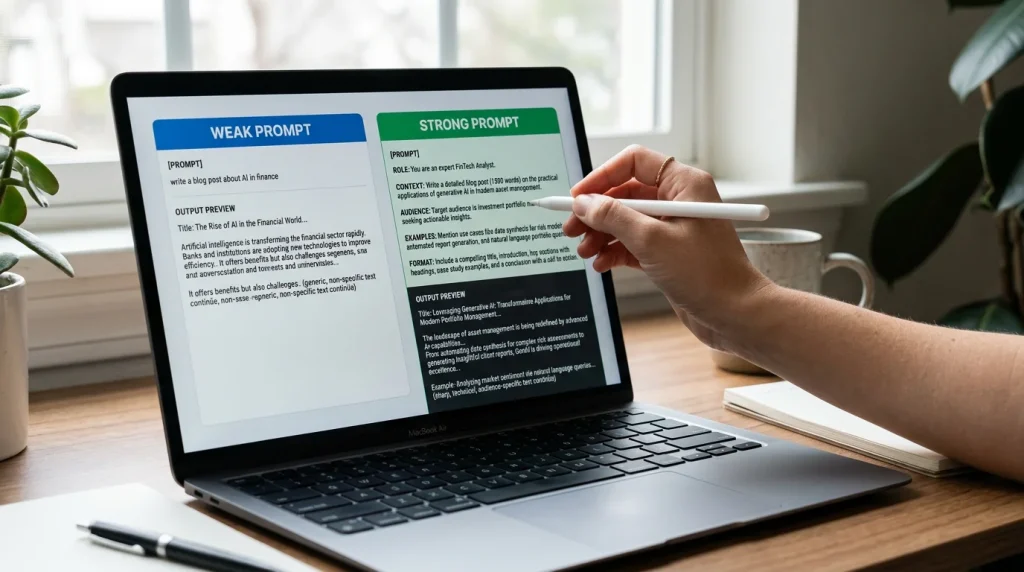
Anatomy is the theory. Reps are the practice. The workshop dedicates the second lesson to side-by-side comparison drills, the single most effective intuition-builder in prompt engineering pedagogy.
The structure of a comparison drill:
- Same task, two prompts. The trainee writes a weak prompt and a strong prompt for the same deliverable.
- Run both, read both outputs. Side by side, in the actual tool the team uses.
- Diff and discuss. What changed in the output, and which prompt element caused it.
- Iterate. Tweak the strong prompt once, run again, diff again.
After ten drills the team has internalized which prompt elements move which output dimensions. Adding an example changes voice. Adding constraints kills hallucination. Adding format collapses verbosity. Adding role changes vocabulary. The intuition is durable; the team continues to apply it months after the workshop ends.
Lesson Three: Reasoning, Chain of Thought, and the Model's Hidden Work
The third lesson covers what the OpenAI Cookbook calls "reasoning effort." Modern models can either answer fast or think first; the right choice depends on the task. The workshop teaches when to ask the model to think before answering and when to let it answer quickly.
- Use chain-of-thought prompting for analysis. "Think step by step before answering" or "first list the assumptions, then evaluate each, then conclude" turns a generic summary into a defensible analysis.
- Skip the reasoning prompt for retrieval and formatting tasks. Asking the model to think about how to alphabetize a list wastes tokens and time.
- Use the new "reasoning" model tiers for genuinely hard problems. Decision logic, multi-step math, complex comparison. For everything else, the fast tiers are cheaper and sufficient.
The team finishes the lesson with a mental model: short tasks get short prompts to fast models, hard tasks get long prompts to reasoning models, and the rest is in between. This is the single most expensive prompt engineering mistake in production, and the workshop closes it.
Lesson Four: Grounding and the Fight Against Hallucination
Lesson four is the most important for any team handling factual content. The pattern that prevents hallucination is grounding, the technique of giving the model the source material to work from rather than asking it to recall.
- Paste the source. When summarizing or rewriting, include the source content in the prompt instead of expecting the model to remember it.
- Cite from context. Instruct the model to quote or reference the source material in its answer. "Cite the relevant section after each claim."
- Refuse without source. Instruct the model to say "I do not know" when the source does not contain the answer, rather than inventing one.
- Use retrieval when source is large. For knowledge bases that do not fit in context, the workshop introduces retrieval-augmented generation as the production pattern.
A team that adopts grounding as the default cuts hallucination rate from frequent to rare in the first week, and from rare to negligible after a month of practice. Authority Solutions® Marketing Automation carries the same grounding discipline into the campaign drafting workflow.
Lesson Five: Building the Team's Prompt Library

The fifth lesson is what turns a workshop into a permanent capability shift. The team builds a prompt library, a structured catalog of the prompts that produced the team's best outputs, organized by use case, with versioning and notes.
A working prompt library has:
- Categories that match the workflow. Sales discovery recap, proposal first draft, email sequence, account research, brief review, social caption, blog outline, code review, data exploration.
- Reusable templates with variables. "Discovery call recap" template takes the call transcript, the deal context, and the rep's notes as inputs and produces a structured summary.
- Version control. When a prompt improves, the new version replaces the old; the old version stays in history so the team can see why the change was made.
- Owner per prompt. Someone is responsible for each prompt's quality. The owner reviews failed outputs and tunes the prompt; the owner is not the trainer.
- Telemetry. The team tracks which prompts are used, which produce reusable output, which are abandoned. The data drives the next round of tuning.
The library is the deliverable the team owns long after the workshop ends. It is the asset that compounds, and Authority Solutions® Chatbot Development treats every customer-facing prompt as a library entry with the same governance.
What Changes in the First 30 Days
A team that completes the workshop and adopts the library produces measurably different output within thirty days. The patterns are consistent across the rollouts Authority Solutions® has delivered:
- Edit ratio drops. The percentage of AI output that requires substantive rewriting falls from 60 to 80 percent down to 20 to 35 percent. The first draft is closer to the final product.
- Hallucination incidents fall. Factual errors in finished work drop sharply because grounding becomes the default rather than the exception.
- Time per deliverable shortens. Even with the longer prompts, the round trips per deliverable drop, and the total time falls 30 to 50 percent for routine content work.
- Adoption breadth widens. Team members who quietly abandoned the AI tools in week six come back when they see their colleagues producing materially better work and ask for the same skills.
The hidden lift is morale. The team that was frustrated by generic AI output becomes the team that is enthusiastic about it. The change is psychological as much as technical, and it lasts.
What the Workshop Does Not Cover
A useful workshop is also honest about its scope. The Authority Solutions® workshop does not cover:
- Model selection at a research level. Which model is best for which benchmark is an engineering question and moves monthly.
- Building production agents or automations. Different practice. We have separate engagements for agent design and CRM automation.
- Fine-tuning custom models. Outside the scope of an operational team workshop; rarely worth the cost for most teams.
- Prompt injection security at the platform level. Important for teams building consumer-facing chatbots; addressed in a separate security-focused engagement.
The workshop covers the skills the operational team needs to produce excellent everyday AI output. The deeper engineering disciplines have their own training.
The Authority Solutions® Workshop Format
Our workshop runs as a two-day intensive followed by a four-week reinforcement engagement.
- Day 1. Lessons one through three, with hands-on drills against the team's actual work. Lunch break, afternoon role-specific breakouts (marketing, sales, ops) with use-case-specific prompt design.
- Day 2. Lessons four and five, with each participant building three prompts for their highest-frequency tasks. Library structure setup, owner assignment, telemetry instrumentation.
- Weeks 1 to 4 post-workshop. Weekly office hours, a shared channel for prompt review, monthly reinforcement on edge cases. The library grows from twenty prompts at launch to sixty-plus by week four.
By the end of week four, the team has internalized the discipline, the library is a working asset, and the AI output quality is in a different league from where the team started. Authority Solutions® CRM Implementation carries the library forward into sales and revenue operations workflows.
Key Takeaways
- The conclusion that "AI is not ready" is almost always a prompt skill gap, not a model limitation. The same model that produces generic output for an untrained team produces strong output for a trained one.
- Anatomy of a strong prompt: role, context, task, examples, format, constraints. Each section moves a specific output dimension; the workshop teaches which.
- Side-by-side comparison drills build intuition faster than any other exercise. Ten drills durably change how a team writes prompts.
- Chain-of-thought is for analysis, not for retrieval or formatting. The model tier and the prompt style should match the task complexity.
- Grounding is the technique that kills hallucination. Paste the source, instruct the model to cite, instruct it to refuse without source, and retrieve when the source does not fit in context.
- The prompt library is the workshop's permanent deliverable. It compounds; the team that builds and maintains one ships dramatically better AI output six months later.
FAQ
What is an AI prompt engineering workshop?
An AI prompt engineering workshop is a structured training program that teaches employees to write effective AI prompts using documented techniques: explicit roles, context, examples, format specifications, and constraints. It moves teams from trial-and-error prompting to a repeatable discipline that produces consistently better AI output.
Who should attend a prompt engineering workshop?
Knowledge workers who use AI tools regularly: marketers, sales operations, customer success, analysts, researchers, content producers, and team leaders. The workshop is not for engineers building AI systems; it is for the operational teams that use them daily.
How long is a prompt engineering workshop?
Authority Solutions® delivers a two-day intensive followed by four weeks of reinforcement. The two days cover the five core lessons with hands-on drills; the four weeks build the team's prompt library and address edge cases that emerge in production.
What measurable improvements should we expect?
Trained teams typically reduce edit ratio (AI output requiring rewrite) from 60 to 80 percent down to 20 to 35 percent, cut hallucination incidents sharply, shorten time per deliverable by 30 to 50 percent for routine content, and broaden AI adoption to team members who had previously abandoned the tools.
Does the workshop cover tools other than ChatGPT?
Yes. The techniques transfer across ChatGPT, Claude, Gemini, Copilot, and the AI features inside Salesforce, HubSpot, Microsoft 365, Google Workspace, and Notion. The workshop uses whichever tools the team actually deploys.
What is the difference between a prompt and a prompt template?
A prompt is a single instruction sent to an AI. A prompt template is a reusable structure with placeholder variables, designed to handle a recurring task. The workshop teaches the team to build templates for high-frequency work and to use one-off prompts only for novel tasks.
What is chain-of-thought prompting?
Chain-of-thought prompting asks the AI to reason step by step before producing the final answer. It improves output quality for analysis, comparison, and complex reasoning tasks. It is unnecessary for retrieval, formatting, or simple transformation tasks, where it adds cost and latency without lift.
How do we prevent AI hallucination?
The most effective technique is grounding: pasting the source material into the prompt, instructing the model to cite from the source, and instructing it to say "I do not know" when the source does not contain the answer. For larger source sets, retrieval-augmented generation is the production pattern.
What is a prompt library and why does it matter?
A prompt library is a structured catalog of the team's best prompts, organized by use case, with version control and telemetry. It is the asset that compounds: teams that build and maintain a library produce dramatically better AI output six months after a workshop than teams that rely on memory.
Should every employee attend, or only specific roles?
Start with the roles where AI usage is highest: marketing, sales operations, customer success, content production. Expand to additional teams as the prompt library matures and as use cases emerge. Universal training without role-specific application produces lower lift than targeted training with hands-on drills.
Conclusion
The team that has quietly given up on AI is not facing a model limitation; it is facing a skill gap. The OpenAI Cookbook and the broader prompt engineering literature have made the techniques explicit, and a structured workshop transfers them in two days. The team finishes with a prompt library that compounds, an edit ratio that drops in half, and a measurable lift in the quality of every deliverable that touches AI.
Authority Solutions® delivers prompt engineering workshops for marketing, sales, and operations teams across Texas and beyond. We bring the curriculum, the drills, and the library architecture. The team brings the work. By the end of the engagement, the team is producing AI output their leadership will recognize as a different league from where they started.