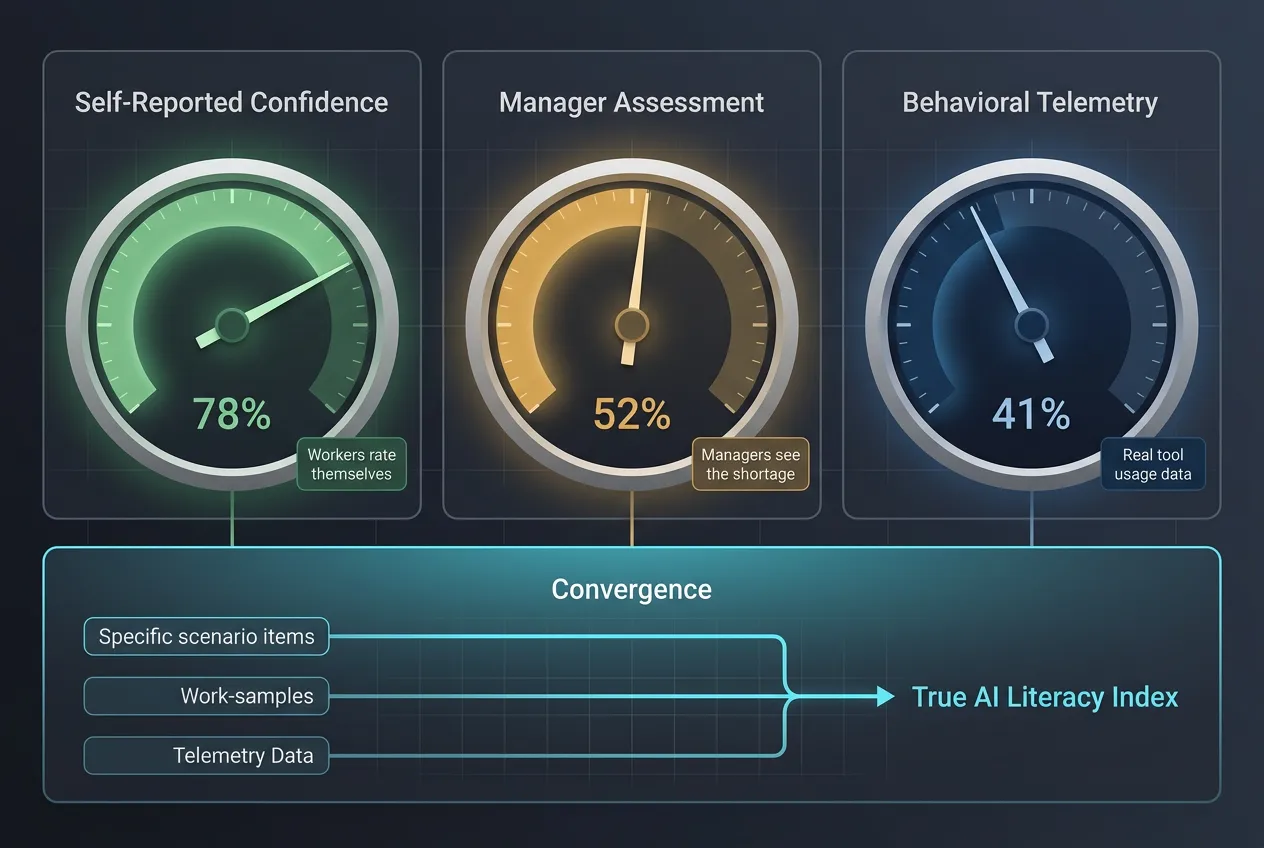
By 2030, 59 of every 100 workers will need AI-related retraining and 92 million jobs will be displaced as 170 million new ones emerge, per World Economic Forum data. An AI literacy assessment measures who is ready, who is at risk, and where investment moves the needle. The wrong measurement produces compliance theater; the right one produces capability.
Ask a hundred employees whether they are "AI literate" and 80 will say yes. Ask the same hundred to demonstrate what they would do with an AI tool to solve a specific problem in their actual job, and the number who can produce a meaningful answer drops below 30. This is the perception gap the World Economic Forum identified as the central workforce risk of 2026: workers do not know what they do not know, hiring managers see the skill shortage clearly, and most assessment programs measure neither the gap nor the readiness with any rigor.
Below: what AI literacy actually means in a measurement sense, why the WEF research changes how leaders should think about workforce readiness, the validity and reliability problem that breaks most assessment programs, how to build an assessment that predicts on-the-job behavior, what the score actually tells leadership about the next hire and the next training investment, and how to audit your current measurement approach in 60 days.
The Perception Gap Is the Problem
The 2026 World Economic Forum Future of Jobs report surfaced a finding that should reframe every literacy program: workers consistently overestimate their own AI capability, while hiring managers consistently identify deficiencies in the same workforce. The gap is not malicious; it is structural. People do not know what skills the future requires because the future is arriving faster than the conversation about it.
Per the WEF research on AI workforce transformation, 59 of every 100 workers will need some form of training by 2030 to remain employable in an AI-augmented economy. The training pause that AI-driven productivity has created at the entry level (where roughly 30 percent of work is ripe for automation) means the people most in need of literacy investment are the people most likely to be quietly cut rather than developed.
The implication for any leader running a literacy program: do not start by asking "are people ready?" Start by establishing what readiness looks like in your specific operational context, and measure against that, not against a generic AI quiz.
What "Literacy" Means When You Can Actually Measure It
A useful literacy definition has three properties:
- Operational. Tied to job-specific work, not abstract concepts.
- Observable. Someone could watch the employee work and verify it.
- Predictive. The score correlates with on-the-job outcomes you care about.
That eliminates 90 percent of what gets called AI literacy assessment in 2026. A 40-question multiple-choice quiz about transformer architecture is not operational, not observable, and not predictive of whether the salesperson will use AI effectively in a Tuesday afternoon discovery call. It is a credential, not a measurement.
The literacy that actually predicts behavior covers four observable abilities:
- Recognizing when AI can help with a specific task (judgment)
- Choosing the right tool from the available options (selection)
- Prompting or configuring the tool to produce useful output (skill)
- Evaluating the output critically before acting on it (verification)
Each of these is observable. Each can be scored against a job-specific work sample. Each predicts behavior in a way that quiz scores do not.
The Validity and Reliability Problem
Most assessment programs fail one of two classical measurement tests.
- Validity: does the assessment actually measure what it claims to measure? A quiz that tests AI vocabulary recall is valid as a measure of vocabulary recall, not as a measure of capability. If your assessment cannot predict on-the-job behavior with reasonable correlation, it is not valid for the purpose you are using it for.
- Reliability: does the assessment produce consistent scores when administered repeatedly to the same person? Self-reported confidence scales are notoriously unreliable; an employee may rate themselves 8/10 one week and 4/10 the next based on the previous day's experience, with no actual change in capability.
The assessments that satisfy both tests share a structure: scenario-based judgment items (test selection and verification), live work-sample tasks (test skill), and behavioral telemetry from real AI tool usage (test operational behavior over time). Each measures a different dimension, each on its own scale, each producing data you can act on.
How to Build an Assessment That Predicts Behavior
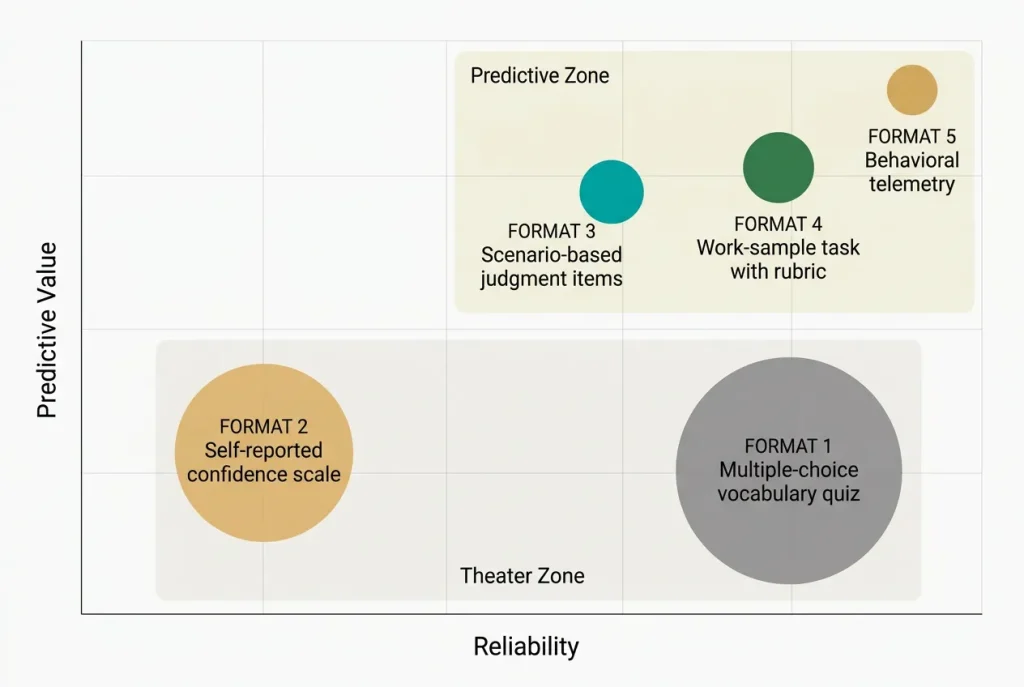
A predictive assessment uses three measurement formats in combination:
- Scenario judgment items. The employee reads a realistic work scenario and selects the most appropriate next action from several plausible options. Example for a marketer: "You need to produce five variations of a campaign headline by end of day. Which approach do you take?" The options range from "open ChatGPT and ask for headlines" to "use Claude with a structured prompt referencing the brand voice guide and the campaign brief" to "draft them yourself because AI sounds generic." The correct answer depends on the brand's documented stance, which is why job-specific calibration matters.
- Work-sample tasks. A 15 to 25 minute live exercise where the employee performs an actual task that mirrors their role. The marketer drafts a real campaign email using whichever AI tools they choose. A rubric scores the output and the process: tool selection, prompt quality, edit ratio, factual accuracy. The exercise is observable, gradable, and directly relevant.
- Behavioral telemetry. Real usage data from deployed AI tools: weekly active users, suggestion acceptance rate, prompt complexity over time, integration of AI outputs into deliverables. Telemetry is the only objective measurement of whether literacy translates to behavior at work.
A complete assessment combines all three. Scenario judgment establishes baseline awareness, work-samples validate applied skill, telemetry confirms the literacy is actually being used at work over time.
What the Score Tells Leadership
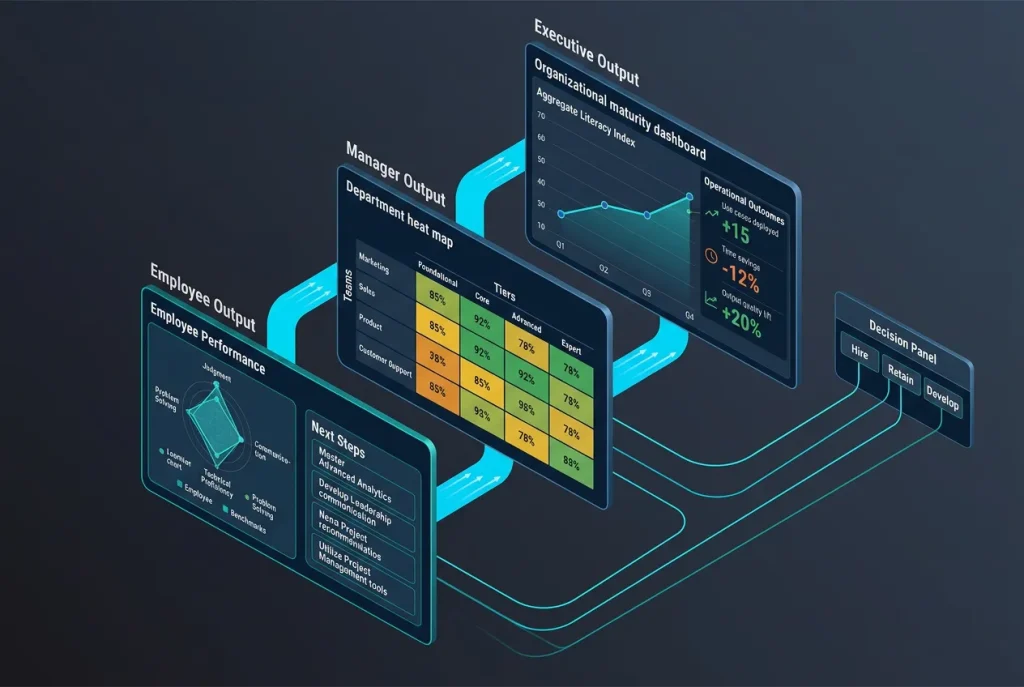
A literacy score by itself answers the wrong question. The right question is "what should this score change for this employee, this team, and this organization?"
- At the employee level. The score identifies the top two or three personalized learning recommendations. A scored employee should leave the assessment with a clear next step, not a number they cannot act on.
- At the team level. The score distribution reveals which teams are AI-ready and which need investment. The CSM team with 70 percent in the "intermediate" tier needs a different program than the engineering team with 40 percent in "advanced" and 30 percent in "foundational" (the bimodal distribution often signals adoption split between champions and refusers).
- At the organizational level. The aggregate score is the workforce maturity number leadership reports to the board. Trend that score quarterly. Tie it to specific operational outcomes (deployed AI use cases, time savings, output quality lift). The aggregate score that climbs without operational lift is theater; the aggregate score that climbs with operational lift is the proof point that the literacy investment is working.
| Measurement Format | What It Measures | Reliability | Predictive Value |
| Multiple-choice vocabulary quiz | Knowledge recall | High | Low |
| Self-reported confidence scale | Subjective belief | Low | Very low |
| Scenario-based judgment items | Applied decision-making | Medium-high | Medium-high |
| Work-sample task with rubric | Real skill on real task | High | High |
| Behavioral telemetry (tool usage) | Actual on-the-job behavior | Very high | Very high |
The combinations that work pull from rows 3, 4, and 5. The combinations that fail rely on rows 1 and 2.
The Hire-and-Retain Decision
A literacy program that does not change hiring decisions is decorative. The 2026 evidence reframes who to hire and who to keep.
- Hiring shift. Entry-level hiring criteria are changing toward candidates who can demonstrate AI fluency on a work-sample, not candidates with academic AI credentials. The work-sample portion of the assessment becomes a stage in the interview process for any role where AI usage is expected. Two candidates with similar resumes diverge sharply on the work-sample, and the work-sample is what predicts the next 12 months of performance.
- Retention shift. Internal talent who score in the advanced tier become the visible champions for adoption among their colleagues. Recognizing them publicly, promoting them, and tying their visibility to organizational AI maturity reduces flight risk and accelerates peer-level adoption. The advanced-tier employees are also disproportionately the ones who will leave for higher AI-paying roles (the 27 percent wage premium for AI-skilled workers is real), so retention investment matters.
- Performance shift. Employees scoring in the foundational tier for more than two consecutive quarters become a manager intervention. Either the learning program is failing them, or they are not engaging with it. Both are addressable; both require explicit attention, and both have implications for what the team can deliver.
How to Audit Your Current Approach
Before designing a new assessment, audit what you have. Ask three questions.
- Does it predict? Pull last year's assessment scores and last year's on-the-job AI adoption data. Do high scorers actually use AI more effectively than low scorers? If the correlation is weak, the assessment is not predictive and the scores you have been using to make decisions are noise.
- Is it operational? Read the items. Are they about AI in the abstract, or about AI applied to the specific work the employee does? Generic items produce generic scores. The fix is to rebuild items around the actual workflows of each major role.
- Is it observable? Could a skeptical observer verify the score by watching the employee work for a week? If the answer is no, the assessment is measuring belief rather than behavior. Add work-samples and telemetry until the answer becomes yes.
Most assessments fail one or more of these three. The audit takes a week; the fix takes a quarter; the payoff is decisions made on real data rather than confident guesswork.
Key Takeaways
- WEF projects 59 of 100 workers will need AI training by 2030; 92 million jobs eliminated, 170 million created, net gain 78 million
- The "perception gap" (workers overestimate their AI capability, managers see the gap clearly) is the central workforce risk of 2026
- Operational AI literacy has four observable abilities: judgment, selection, skill, verification
- Most assessments fail validity (do they measure what they claim) or reliability (do they produce consistent scores)
- Predictive assessments combine three formats: scenario judgment items, work-sample tasks with rubric, behavioral telemetry from real tool usage
- Score outputs serve three audiences: personalized learning recommendations per employee, team distribution heat maps, organizational maturity trend
- A literacy program that does not change hiring decisions, retention investment, and performance management is decorative
Frequently Asked Questions
What is an AI literacy assessment?
A measurement of an employee's ability to recognize when AI can help, select the right tool, produce useful output, and evaluate the output critically. A predictive assessment combines scenario-based judgment items, live work-sample tasks scored against a rubric, and behavioral telemetry from actual AI tool usage. It does not rely on vocabulary quizzes or self-reported confidence.
Why does the WEF perception gap matter?
Per the World Economic Forum's research, workers consistently overestimate their AI capability while hiring managers see the shortage clearly. This means self-reported readiness data, the input most leaders rely on, systematically misleads investment decisions. Objective assessment is the only way to close the loop between perceived and actual readiness.
What jobs and skills numbers should I anchor on?
WEF data: 59 of every 100 workers will need AI-related training by 2030, 92 million jobs are projected to be displaced and 170 million created (net gain 78 million), AI roles command roughly a 27 percent wage premium, and approximately 30 percent of entry-level work is ripe for automation, creating particular risk for early-career employees.
What is the validity problem with most AI assessments?
Validity asks whether the assessment measures what it claims to. A vocabulary quiz is valid for measuring vocabulary, not for predicting AI behavior on the job. Most assessments in market test recall rather than applied capability, which produces scores that correlate weakly with actual workplace AI use.
What is the reliability problem?
Reliability asks whether scores stay consistent when administered repeatedly to the same person. Self-reported confidence scales fluctuate based on the previous day's experience and produce unreliable data. Behavioral telemetry, by contrast, is highly reliable because it measures what the employee actually did rather than what they remember doing.
What does a predictive assessment include?
Three formats combined: scenario-based judgment items (test selection and verification ability), work-sample tasks with rubric (test applied skill on real work), and behavioral telemetry from deployed AI tools (test operational behavior over time). Each measures a different dimension; together they cover the construct.
How do I decide if my current assessment works?
Pull last year's scores and last year's adoption data. Correlate them. If high scorers actually use AI more effectively than low scorers in observable ways, the assessment is predictive. If the correlation is weak, the assessment is measuring something else (vocabulary, confidence, test-taking ability) and your decisions based on it are likely off.
What should leadership do with the score data?
Three audiences receive three different outputs. Each employee gets personalized learning recommendations tied to their score and role. Each team manager gets a distribution heat map showing where investment moves the needle. Leadership gets an aggregate maturity score trended quarterly against operational outcomes (use cases deployed, time savings, output quality lift).
How does AI literacy assessment change hiring?
Work-sample tasks become an interview stage for any role where AI usage is expected. Two candidates with similar resumes often diverge sharply on a real AI task, and the work-sample is what predicts the next 12 months of performance. Academic AI credentials matter less than demonstrated applied skill.
What about retention?
Advanced-tier employees are disproportionately the ones who will leave for higher AI-paying roles (the WEF data on the 27 percent AI wage premium is the relevant signal). Recognizing them publicly, promoting them as champions, and tying their visibility to organizational AI maturity reduces flight risk while accelerating peer-level adoption.
Conclusion
The teams that close the perception gap before the rest of the market do so with measurement rigor, not training volume. They define AI literacy operationally, build assessments that satisfy validity and reliability, combine scenario items with work-samples and behavioral telemetry, and turn the scores into action across hiring, retention, and performance management. The audit is a week. The build is a quarter. The compounding starts in the second quarter and never stops.
Book your AI Literacy Assessment today. See who is ready, who is at risk, and where investment moves the needle.