
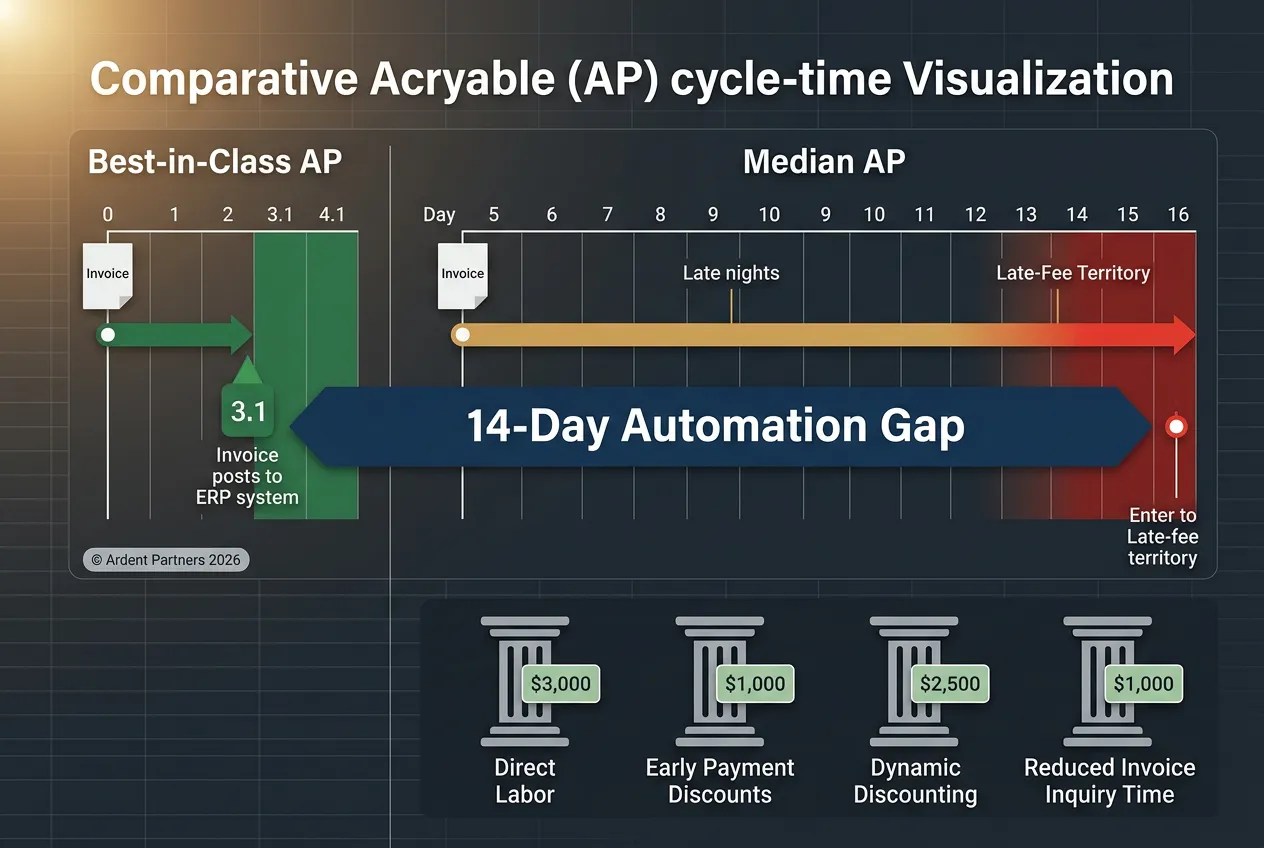
Best-in-class AP teams process invoices in 3.1 days versus 17.4 days for the median, per Ardent Partners 2026 ePayables research. The gap is AI. 75 percent of AP departments now use some form of AI, and the cost-per-invoice math shifts from $12 to $30 manual down to $2 to $5 automated. The CFO conversation is no longer about whether to automate but about how fast.
The CFO opens the close package on Tuesday and notices the same problem the close package showed last quarter: the AP team is two weeks behind on invoice processing, late-payment penalties accrued again, and three duplicate payments slipped through the matching process. The fix is not headcount. The fix is the 14-day gap between best-in-class AP performance and the team's actual performance, and the only structural lever that closes that gap in 2026 is AI.
Below: what Ardent Partners' 2026 ePayables research reveals about the best-in-class vs. median gap, where the dollars actually come from in an AI AP deployment, what three-way matching looks like when it runs at full coverage instead of on the 30 percent of invoices the team has time for, why 70 to 90 percent touchless processing is the new operational baseline, what breaks when you skip vendor master cleanup, and how to pick your first invoice cohort.
The 3.1-vs-17.4 Gap
Per Ardent Partners' 2026 ePayables research, best-in-class AP departments process invoices in 3.1 days end-to-end. The median performer takes 17.4 days. The gap is not labor; both sides hire from the same pool. The gap is automation depth.
Ardent's broader 2026 findings reframe the AP conversation:
- 75 percent of AP departments now use some form of AI, up sharply from prior years
- 37 percent of AP teams' annual strategic plans now get explicit CFO review
- 65 percent of AP teams actively support financial planning and forecasting
That third number is the leading indicator worth watching. When AP moves from cost center to FP&A contributor, the function has fundamentally repositioned. AI is what creates the time and the data quality that makes the repositioning possible.
For the CFO assessing AP automation in 2026, the diagnostic is the cycle-time question: where is your team between 3.1 and 17.4 days? If you are closer to 17.4, the ROI math is decisive and the only remaining question is which platform path matches your stack.
Where the Dollars Actually Come From
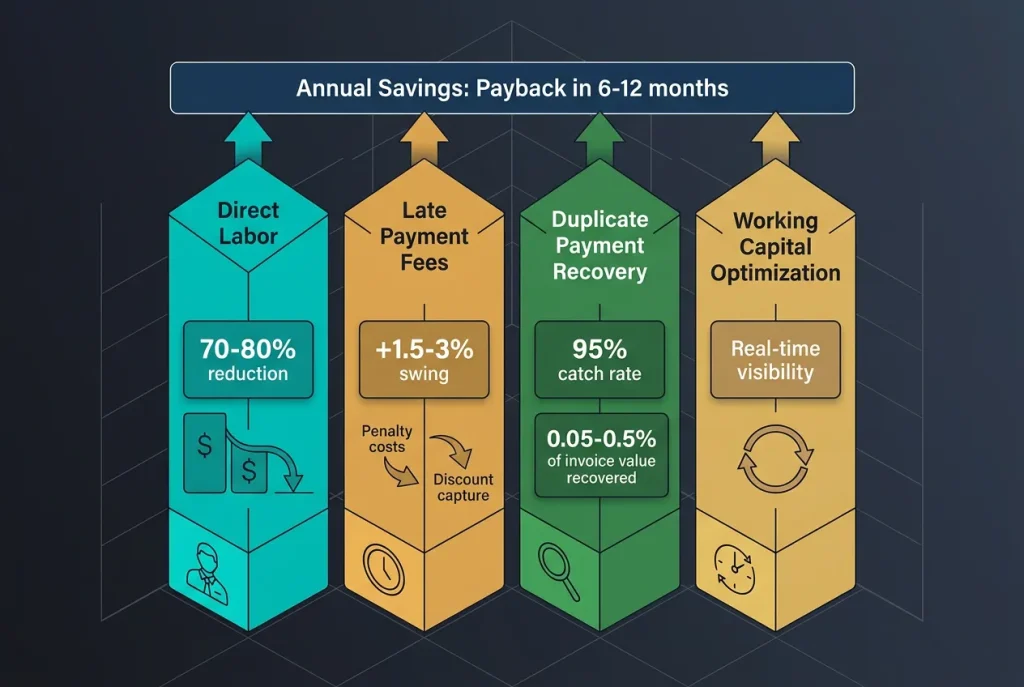
The headline cost-per-invoice number ($12 to $30 manual versus $2 to $5 automated) compresses four distinct savings streams that any rigorous business case should separate.
- Stream 1: Direct labor. Manual data entry, validation, and routing consume the largest single labor component. AI capture and routing eliminate roughly 70 to 80 percent of that work. For a team processing 10,000 invoices monthly at a fully-loaded $15 per invoice for labor, that is approximately $1.5 million in annual labor capacity unlocked.
- Stream 2: Late payment fees. Manual AP misses early payment discount windows and incurs late payment penalties. A median operation pays roughly 1.5 to 3 percent of total invoice value in either lost discounts or actual penalties. AI AP captures discount terms and routes for timely approval, swinging this number into a net positive on captured discounts.
- Stream 3: Duplicate payment recovery. Manual processes catch maybe 60 to 75 percent of duplicate-payment risks. AI catches 95 percent or better through fuzzy matching on vendor name, amount, date proximity, and PO reference. For a mid-market operation, duplicate payment losses can run 0.05 to 0.5 percent of total invoice value annually, recoverable in cash.
- Stream 4: Working capital optimization. Faster cycle time means earlier visibility into actual cash position, which means tighter working capital management. The CFO who could not see committed-but-unprocessed invoices is now operating with two-week-old visibility; the AI-enabled CFO sees today's position today.
The four streams together typically produce payback inside 6 to 12 months for any operation processing more than 5,000 invoices per year. Smaller operations should still automate but the payback calculation runs longer.
Three-Way Matching at Full Coverage
Three-way matching (purchase order + goods receipt + invoice) has been the AP control standard for decades. The dirty secret is that most teams quietly relax it for low-value invoices because the matching labor is prohibitive at full coverage. The relaxation is rational at scale and risky at the same scale, because the matching failures concentrate in the relaxed segments.
AI changes the economics. Matching cost drops to near zero per invoice because the AI handles the comparison automatically. Full coverage becomes feasible, which closes the control gap that drove the compliance exposure.
The matching itself runs three checks:
- Price match: invoice unit price against PO unit price within configured tolerance (typically 1 to 2 percent)
- Quantity match: invoice quantity against goods receipt quantity within configured tolerance
- Item match: invoice line items against PO line items by SKU, product code, or description
When all three match within tolerance, the invoice flows to payment without human review. When any check fails, the invoice routes to the AP team with the specific discrepancy highlighted and supporting documents pre-attached. The human time spent on AP shifts from data entry to exception resolution, which is dramatically higher-value work.
For non-PO invoices (services, recurring expenses, one-off purchases), AI applies two-way matching against vendor master data and policy rules. The same workflow handles both PO and non-PO invoices with different validation logic per category.
Why 70-90% Touchless Is Now the Baseline
A modern AP platform should achieve 70 to 90 percent touchless processing at maturity, meaning that share of invoices flows from arrival to ERP posting without human intervention. The Ardent Partners best-in-class cohort is at the high end of that range.
The remaining 10 to 30 percent surfaces to humans for exception handling. That percentage will never reach zero because some invoice exceptions require human judgment, and the value of an AP analyst is the judgment, not the data entry.
What the touchless rate enables operationally is what matters more than the number itself. Three changes worth tracking:
- AP analyst role redesign. When 80 percent of invoices process touchlessly, the AP analyst's day shifts from data entry queue to exception resolution, vendor relationship work, and FP&A support. The job becomes meaningfully more strategic and the talent profile shifts accordingly.
- Close-cycle compression. Touchless processing eliminates the close-week scramble to clear the backlog. The close gets faster, more accurate, and less stressful. Most CFOs report finance team retention improving alongside the automation.
- Spend visibility. Real-time touchless posting means real-time spend data. The CFO is no longer reconciling backwards from imperfect monthly snapshots; the dashboard reflects what is actually happening this week.
What Breaks If You Skip Vendor Master Cleanup
Three failure patterns destroy otherwise-promising AP automation deployments, and the worst of the three is dirty vendor master data.
- Duplicate vendor records. If "Acme Corp" exists in the vendor master three times (different spellings, different addresses, different bank accounts), AI invoice processing happily routes payments to all three. The fraud-prevention controls assume the vendor master is clean; if it is not, the controls are decorative.
- Stale tax and payment data. Vendor master records that have not been validated in two years may have outdated tax IDs, expired payment instructions, or incorrect remit-to addresses. The invoices process correctly and the payments fail or misroute, with the AP team unwinding the mess.
- Missing fields and inconsistent data. Vendor master records with incomplete tax classification, payment terms, or category assignment force the AI to flag every invoice from that vendor for human review, which collapses the touchless rate.
The fix is unglamorous: vendor master cleanup as the first 30-day deliverable of any AP automation deployment, before the AI gets switched on. Deduplicate. Verify. Validate tax information. Standardize payment instructions. Then deploy AI on the cleaned foundation.
Picking Your First Invoice Cohort
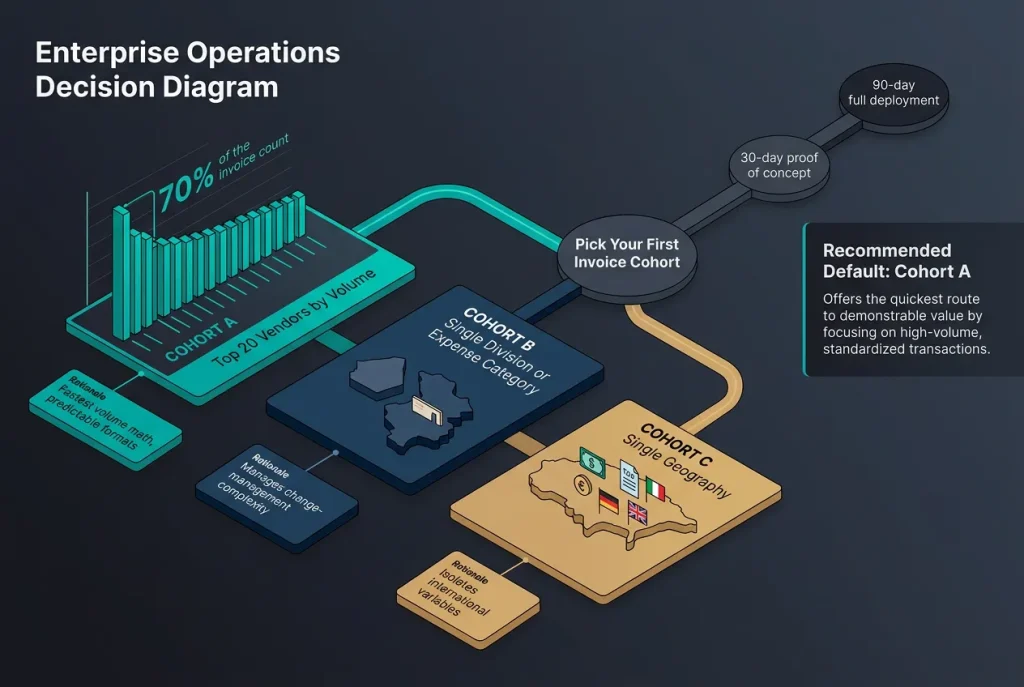
A 90-day deployment should not attempt full invoice volume from day one. Pick a controlled cohort that proves the workflow before scaling.
The cohort selection logic that produces the fastest credible wins:
Cohort A (highest-volume, lowest-complexity): the top 20 vendors by invoice volume typically account for 70 percent of total invoice count. Their invoices are predictable in format. Deploying capture and matching on this cohort proves the workflow on the largest single chunk of the operation.
Cohort B (one division or one expense category): isolating a single business unit (such as marketing services) or a single expense category (such as travel and entertainment) lets you tune validation rules for one context before scaling across contexts. Manages change management complexity.
Cohort C (one geography): for multi-country operations, starting with one country isolates currency, tax, and language variables to a single set of rules before expanding internationally.
The right choice depends on where your operation has the most repeatable structure. Most teams should start with Cohort A because the volume math drives the fastest ROI signal.
| AP Performance Tier | Cycle Time (days) | Cost per Invoice | Touchless Rate | Source |
| Best-in-class (per Ardent Partners) | 3.1 | $2 to $5 | 70-90% | 2026 ePayables Research |
| Mid-tier | 7 to 10 | $6 to $12 | 30-50% | Industry composite |
| Median performer | 17.4 | $12 to $20 | 0-20% | 2026 ePayables Research |
| Manual baseline | 21+ | $20 to $30+ | 0% | Pre-automation benchmark |
The tier-to-tier transitions are mostly automation depth, not headcount. A team that closes from median to mid-tier captures most of the available value; closing from mid-tier to best-in-class requires the deeper deployment of three-way matching at full coverage and exception-handling automation.
Putting the Business Case in Front of the CFO
The business case the CFO actually reads has four numbers, not forty.
- Current cycle time and current cost per invoice, baselined honestly
- Projected cycle time and cost at year-1 and year-2 maturity
- Total annual savings across the four streams (labor, late-fee, duplicate, working capital)
- Implementation cost and payback period
That fits on one page. Anything longer signals that the case is hiding something. The CFO who sees those four numbers makes the decision in the meeting; the CFO who sees a 30-slide deck punts to the next quarter.
Key Takeaways
- Per Ardent Partners' 2026 ePayables research, best-in-class AP processes invoices in 3.1 days vs 17.4 days for the median; the gap is automation depth
- 75 percent of AP departments now use AI; 65 percent now contribute to FP&A (the leading indicator of AP repositioning)
- Four savings streams in any rigorous AP business case: direct labor, late payment fees, duplicate payment recovery, working capital optimization
- Three-way matching at full coverage closes the compliance exposure that quiet relaxation created at scale
- 70-90 percent touchless processing is the new baseline; the operational shift is what matters more than the number
- Dirty vendor master data is the most destructive failure mode; cleanup is the first 30-day deliverable of any AP automation
- Start with the top-20-vendor cohort or a single division; full-volume rollout follows proof on the controlled cohort
Frequently Asked Questions
What does best-in-class AP performance look like in 2026?
Per Ardent Partners' 2026 ePayables research, best-in-class AP departments process invoices end-to-end in 3.1 days at a cost of $2 to $5 per invoice with 70 to 90 percent touchless processing. The median performer takes 17.4 days at $12 to $20 per invoice. The gap between tiers is almost entirely automation depth, not headcount.
How much of an AP team uses AI today?
Per Ardent Partners, 75 percent of AP departments now use some form of AI in their workflow. The 25 percent that does not is increasingly composed of organizations where structural constraints (legacy ERP, regulatory complexity, scale) make adoption harder rather than organizations choosing manual processing.
What savings actually fund the AP automation business case?
Four streams: direct labor (70 to 80 percent reduction of data entry, validation, routing work), late payment fees (swinging from a penalty cost to a discount-capture positive), duplicate payment recovery (95 percent catch rate vs. 60 to 75 percent manual), and working capital optimization (real-time spend visibility for tighter cash management).
How does three-way matching change with AI?
Matching becomes economical at full coverage instead of being relaxed for low-value invoices. AI compares invoice against PO and goods receipt across price, quantity, and item dimensions within configured tolerances. When all three pass, the invoice flows to payment; when any fail, the invoice routes to the AP team with the specific discrepancy highlighted.
What touchless processing rate should I target?
70 to 90 percent at maturity for most AP operations. The remaining 10 to 30 percent surfaces to humans for exception handling that legitimately requires judgment. The target depends on invoice complexity, vendor mix, and approval-policy depth, with simpler operations reaching the high end faster.
What is the most common reason AP automation fails?
Dirty vendor master data. Duplicate vendors, stale tax information, missing fields, and inconsistent records force AI to flag every invoice for human review (collapsing touchless rate) or, worse, route payments to incorrect destinations (creating financial loss). Vendor master cleanup must be the first 30-day deliverable of any deployment.
How do I pick the first invoice cohort for deployment?
Three viable starting points: the top 20 vendors by volume (accounting for 70 percent of total invoice count), a single division or expense category (managing change-management complexity), or one geography (isolating currency, tax, and language variables). Most teams should start with the top-20-vendor cohort because the volume math drives the fastest ROI signal.
What ERPs work with AI AP automation?
All major ERPs integrate with current-generation AI AP platforms: SAP, Oracle NetSuite, Microsoft Dynamics 365, Sage Intacct, Workday, and others. Best-of-breed AP platforms (Vic.ai, Stampli, Medius, Tipalti, AppZen) layer on top via certified integrations. ERP-native AI is the lowest-friction starting path; best-of-breed gives deeper capability.
How does AI AP change the AP analyst role?
When 80 percent of invoices process touchlessly, the analyst's day shifts from data entry queue to exception resolution, vendor relationship work, and FP&A support. The job becomes more strategic and the talent profile shifts accordingly. Per Ardent Partners, 65 percent of AP teams now actively support financial planning and forecasting.
What does the business case put in front of the CFO?
Four numbers on one page: current cycle time and cost per invoice baselined honestly, projected cycle time and cost at year-1 and year-2 maturity, total annual savings across the four streams, and implementation cost with payback period. Anything longer signals that the case is hiding something.
Conclusion
The 14-day gap between best-in-class AP (3.1 days) and median performance (17.4 days) is not headcount and not effort. It is automation depth, and AI is the lever that closes it in 2026. Pull your cycle-time number, build the four-stream savings case, pick the top-20-vendor cohort, clean the vendor master before switching on AI, and let the deployment fund the next phase from realized savings.
Book your AI Invoice Processing Assessment today. Close the gap between 17.4 days and 3.1.