
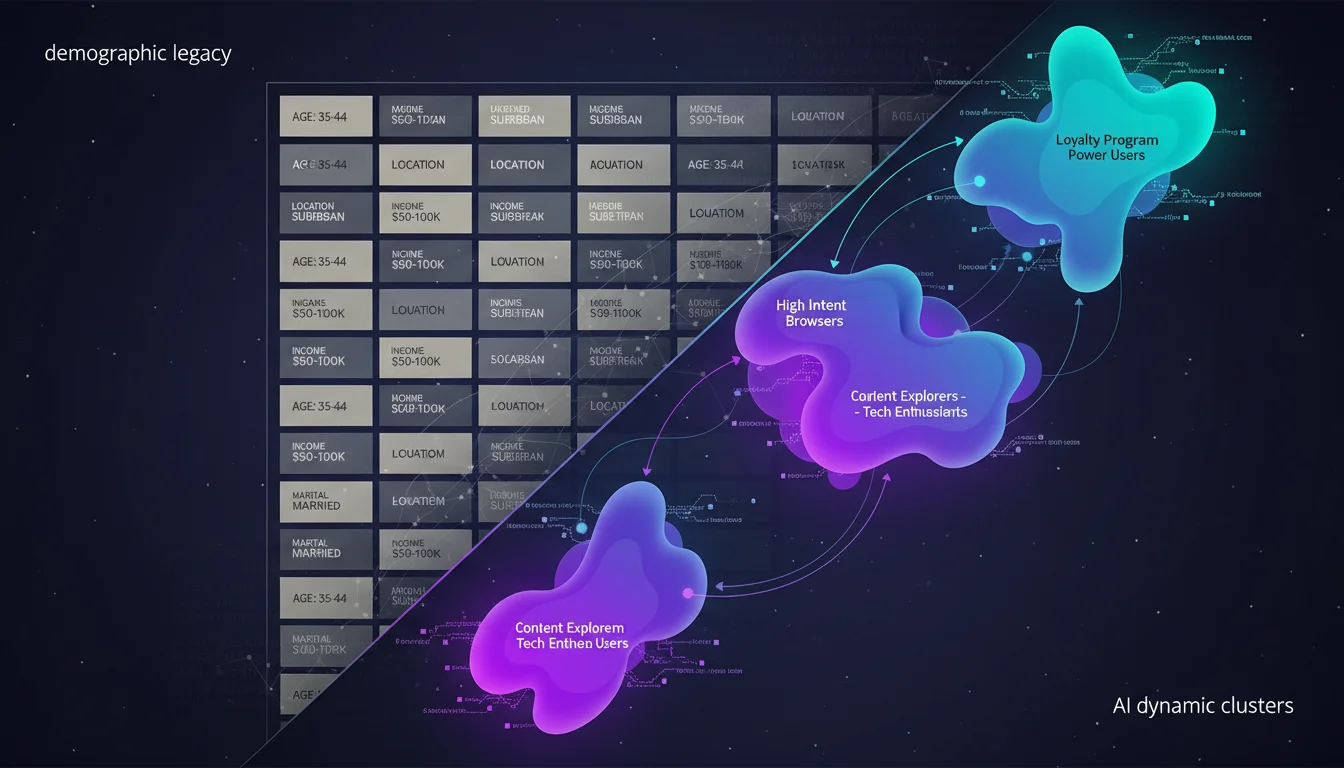
AI customer segmentation uses machine learning to group customers by similarity across behavioral, engagement, transactional, product-usage, firmographic, and intent signals, continuously updating segment membership as behavior changes. Per McKinsey research, companies that grow faster drive 40% more of their revenue from personalization than slower-growing counterparts, and shifting to top-quartile personalization performance would generate over $1 trillion in value across U.S. industries.
Demographic segmentation is over. Age brackets, income bands, job titles, and ZIP codes produce segments so broad that every message lands somewhere between generic and irrelevant. Your best customers disengage because the personalization does not match their reality. Customer acquisition costs climb because you are paying to reach lookalikes who are not actually like your best buyers. The math has shifted against demographic targeting for several quarters, and the gap between firms running AI-driven segmentation and firms running demographic-driven segmentation is widening fast enough to be structurally meaningful within a year.
The fix is dynamic AI segmentation built on top of a clean AI-powered CRM. Below, you will learn why demographic segmentation stopped working in 2026, the six signal types that power modern AI segmentation, how AI actually builds and updates segments in real time, where most programs fail at activation, the CRM-to-segmentation feedback loop that compounds, and the metrics that prove segmentation is driving revenue rather than just sitting in dashboards.
Why Demographic Segmentation Stopped Working
Three forces killed demographic segmentation at scale, and they are all accelerating rather than decelerating. Each force is independent of the others, but they compound when stacked, which is why demographic targeting has gone from "directionally useful" in 2020 to "actively counterproductive" in 2026 for most consumer and B2B programs. The three forces:
- Signal saturation. Every brand has access to the same demographic data. Segments built from demographics produce messaging that looks identical to every competitor's messaging. Nobody differentiates. The segment that made a brand stand out in 2015 is the baseline every brand uses in 2026.
- Privacy shifts. Third-party cookie deprecation, iOS tracking limits, and tightening regional privacy rules have reduced the reliability of purely demographic targeting. First-party behavioral data is the durable alternative. It belongs to the brand, respects user consent, and regulatory risk is managed rather than hoped for.
- Expectation shift. Consumers in 2026 actively ignore or block generic messaging. Hyper-relevance is not a nice-to-have. It is the baseline for getting attention at all. Customer acquisition costs spiral when segmentation stays generic, because every weakly targeted impression becomes a tax on acquisition.
The math shifts against demographic targeting every quarter. Each quarter that a brand stays on demographic segmentation, its acquisition cost rises relative to AI-segmenting competitors and its retention curve flattens because returning customers see the same generic experience as first-time visitors. The compound effect is what makes the segmentation question urgent rather than aspirational.
Table 1: The Three Forces Killing Demographic Segmentation
| Force | What It Does | Direction |
| Signal saturation | Every brand has the same data, no differentiation | Worsening as data brokers consolidate |
| Privacy shifts | Cookie deprecation and tracking limits erode reliability | Worsening as regulations tighten |
| Expectation shift | Consumers ignore or block generic messaging | Worsening as hyper-relevance becomes baseline |
The Six Signal Types That Power AI Segmentation

Modern AI segmentation combines signals across six categories. The richness and recency of these signals determines segmentation quality, and the value of the segmentation increases non-linearly as more signal categories feed in. With four categories connected, segmentation produces meaningful differentiation. With all six connected, segmentation produces the kind of predictive lift that changes acquisition economics. The six categories:
- Behavioral signals. Pages visited, content consumed, searches performed, features used, sessions per week, recency, depth. The single most predictive signal category and the one most underutilized by demographic-only programs.
- Engagement signals. Email opens, click patterns, reply behavior, unsubscribes, preference changes. The leading indicator for lifecycle stage shifts that demographic segmentation cannot detect at all.
- Transactional signals. Purchases, order values, product categories, frequency, refunds, churn events. The signals that actually tie to revenue rather than describing intent without conversion.
- Product usage signals. For SaaS and digital products: feature adoption depth, active days, power-user behaviors, adoption decay. Strong predictor of expansion or churn that lives entirely outside the CRM in most setups.
- Firmographic signals. Company size, industry, tech stack, growth stage, funding. Relevant for B2B and updated dynamically from enrichment sources rather than frozen at record creation.
- Intent signals. Research behavior on third-party platforms, review sites, competitor comparison searches, category interest spikes. The earliest predictor of in-market status.
Dynamic segmentation updates all six in real time. Customers who browse three product pages in five minutes move into "high intent" immediately. Customers showing disengagement across emails and logins move into "churn risk" without waiting for a quarterly review. The compound visibility is what makes the difference between a segmentation program that influences quarterly campaigns and one that influences hourly decisioning.
Table 2: The Six Signal Types and What They Predict
| Signal Type | Examples | Primary Use |
| Behavioral | Pages, sessions, features used | Most predictive overall |
| Engagement | Email opens, replies, unsubscribes | Lifecycle stage shifts |
| Transactional | Purchases, frequency, churn events | Revenue prediction |
| Product usage | Feature depth, active days, decay | Expansion vs churn (SaaS) |
| Firmographic | Company size, industry, tech stack | B2B targeting |
| Intent | Third-party research, comparison searches | Earliest in-market signal |
How AI Segmentation Actually Builds Segments
The mechanism underneath AI segmentation is straightforward, even if the math is not. Unsupervised learning clusters customers by similarity across the six signal categories. Supervised learning predicts which clusters are most valuable based on historical outcomes. Continuous retraining keeps segments current as behavior shifts. The pipeline produces segments that update in hours rather than quarters, which is what allows them to power decisioning rather than just reporting.
Step 1 is unsupervised clustering. Algorithms group customers by similarity without being told what to look for. Patterns emerge that manual segmentation would miss, including customer groups that share behavior profiles across channels rather than just age or geography. The clusters at this stage are not yet ranked or labeled. They are raw similarity groupings that the next steps interpret and prioritize.
Step 2 is outcome supervision. Segments are ranked by historical outcomes including which clusters produced the highest lifetime value, highest retention, highest expansion, and lowest churn. The ranking converts raw clusters into prioritized segments that the activation tools can target. Without this step, the team has interesting analytics but no operational signal.
Step 3 is prediction overlay. AI predicts which cluster each new or existing customer will eventually land in, based on their current and projected behavior. This enables "lookalike" targeting that goes deeper than demographic matching, because the lookalike model is trained on actual behavior patterns rather than surface attributes that correlate weakly with outcomes.
Step 4 is continuous retraining. Models retrain weekly or monthly as new behavior data arrives. Segments that decay in predictive power are retired. New patterns that emerge are elevated. The retraining cadence is what keeps the program from becoming the same kind of stale snapshot that demographic segmentation always was.
Table 3: How AI Builds Segments in Four Steps
| Step | Function | Output |
| 1. Unsupervised clustering | Group by similarity across signals | Raw clusters, unlabeled |
| 2. Outcome supervision | Rank clusters by historical outcomes | Prioritized segments tied to revenue |
| 3. Prediction overlay | Predict cluster membership for new customers | Behavioral lookalikes for acquisition |
| 4. Continuous retraining | Refresh models weekly/monthly | Segments that stay current as behavior shifts |
From Segment to Activation: Where Most Programs Fail
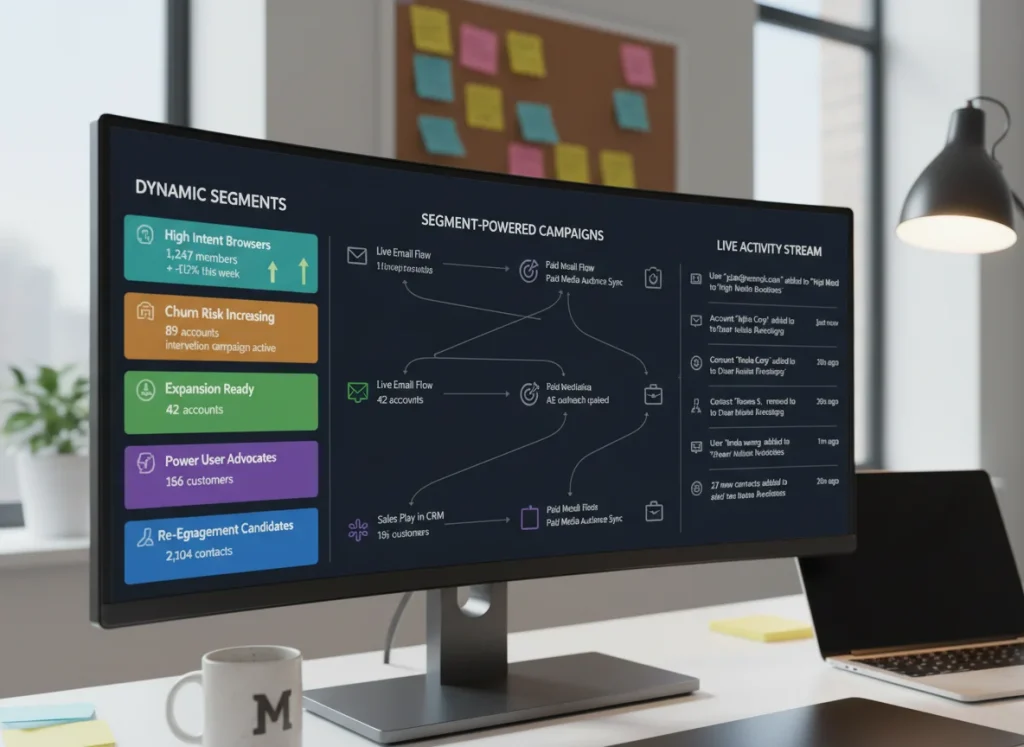
Building segments is half the job. Activating them inside CRM, email, paid media, and sales workflows is where most programs stall. The gap between "we have segments" and "the segments drive decisions" is usually the difference between a segmentation program that produces dashboards and one that produces revenue. Five activation gaps account for most of the stalling:
- Segments stuck in analytics. Marketing sees the segment in a BI tool but cannot use it operationally. Fix: sync segment membership into CRM and the marketing automation platform as dynamic lists that the activation tools read directly.
- Quarterly re-segmentation. Campaigns launch on stale segments because the segmentation refresh cycle does not match the campaign cadence. Fix: continuous sync where activation targets dynamic lists rather than snapshots.
- One-size-fits-all content. Segments exist but the messaging is identical across all of them, which collapses the segmentation back into a uniform broadcast. Fix: dynamic content generation with AI-driven variants tuned to each segment.
- No ad-platform sync. Paid media still targets demographics because the segmentation never reaches the ad platform. Fix: server-side Conversions API or CDP-to-ad-platform syndication that pushes segment membership into paid acquisition.
- No sales visibility. Reps do not see segment signals in their day-to-day tools, so the segmentation never affects outbound or expansion plays. Fix: segment fields in the CRM opportunity and account views where reps actually work.
Each gap has a straightforward fix. Skipping any one of them reduces segmentation from a revenue lever to an analytics exercise that produces decks for quarterly business reviews and nothing else. Programs that close all five gaps see segmentation become the connective tissue across acquisition, retention, and expansion, which is the state worth building toward rather than the state most programs settle for.
The CRM-to-Segmentation Feedback Loop
AI segmentation and CRM reinforce each other when connected correctly. Segmentation pushes dynamic segment membership into the CRM as a real-time field. CRM activity (closed deals, churned accounts, expansion contracts, support escalations) feeds back into the segmentation model as outcome data. The two systems improve together, and the rate of improvement compounds because every revenue outcome sharpens the next segment iteration.
The alternative, segmentation running as a siloed analytics exercise, is the reason 2020-era personalization programs produced underwhelming results. Without the feedback loop, segments age out, models retrain on shrinking signal, and the activation tools target whichever stale segment was most recently published. Connected properly, AI segmentation built on marketing automation infrastructure becomes one of the highest-ROI additions to a mature CRM stack, because every improvement in segmentation quality immediately reaches the activation tools.
The CRM data hygiene layer underneath is what makes the loop work. Dirty data breaks both directions of the loop. Duplicate contacts produce phantom segment members. Stale fields produce mis-segmented customers. Missing outcome data produces models that train on partial truth. Programs that invest in CRM hygiene before scaling segmentation see the segmentation work pay back faster, because the underlying signal is reliable enough to actually predict outcomes rather than amplify noise.
Measuring AI Segmentation Performance
Five metrics show whether segmentation is actually working. Tracking only volume metrics (segment count, customers per segment, segment refresh frequency) produces the same vanity-metric trap that derails analytics programs in adjacent disciplines. The metrics that matter all tie back to revenue or revenue-adjacent outcomes:
- Segment-level conversion lift vs an unsegmented control. The clearest signal that segmentation is causing the lift rather than coinciding with it.
- Revenue per segment normalized by segment size. Reveals which segments are pulling weight and which look strong by volume but underperform on revenue contribution.
- Segment accuracy. The percentage of customers who remain in the segment over a 30-day window. Segments that churn members weekly are noise, not signal.
- Activation coverage. The percentage of segments actually powering at least one live campaign or workflow. Segments that exist but never activate are inventory rather than capability.
- Customer acquisition cost by segment. Direct reduction in CAC when ad spend targets AI-built lookalikes rather than demographic targeting.
Per McKinsey's Next in Personalization research, companies that excel at personalization generate 40% more revenue from those activities than average players, and shifting to top-quartile performance in personalization would generate over $1 trillion in value across U.S. industries. Hyper-personalization powered by dynamic segmentation directly reduces CAC by focusing acquisition spend on high-propensity prospects, which is one of the fastest ROI demonstrations available inside a CRM stack and one of the easiest to defend in a CFO conversation.
Common Segmentation Failures and How to Avoid Them
Four failure patterns show up repeatedly in AI segmentation programs that stall, and each has a specific remediation that successful programs build in from day one:
- Starting with too many segments. Teams launch with 50+ micro-segments that are impossible to activate or message differently. Result: complexity burden without payoff. Fix: start with 5 to 8 high-impact segments, prove activation, then expand.
- Ignoring segment stability. Teams build segments but do not measure whether customers stay in them. Segments that churn members weekly are noise rather than signal. Fix: track 30-day stability and retire segments below 70%.
- Siloed segment ownership. Marketing builds segments for its own campaigns, sales ignores them, customer success has its own. Result: inconsistent customer experience across departments. Fix: one segmentation owner across go-to-market with cross-functional governance.
- No content strategy per segment. Teams build 10 segments and maintain 1 content library. Every segment gets the same messaging. Fix: dynamic content generation with AI-driven variants so segment-specific messaging scales without a 10x content burden.
Key Takeaways
- Demographic segmentation is commoditized and broken under 2026 conditions. Every competitor has the same data, privacy shifts have eroded reliability, and consumer expectation has moved past generic messaging.
- AI segmentation uses six signal categories: behavioral, engagement, transactional, product usage, firmographic, and intent. The compound visibility across all six is what produces predictive lift that demographic segmentation cannot match.
- AI builds segments in four steps: unsupervised clustering finds similarity patterns, supervised learning ranks clusters by outcome, prediction overlays target lookalikes, and continuous retraining keeps segments current.
- Activation is where most programs fail. Segments live in analytics tools but do not reach the CRM, MAP, ad platforms, or sales workflows. Closing all five activation gaps is what separates a revenue lever from a dashboard exercise.
- Per McKinsey, companies excelling at personalization drive 40% more revenue from those activities, and top-quartile personalization performance would generate over $1 trillion in value across U.S. industries.
- CRM data hygiene is the prerequisite for AI segmentation. Dirty data personalizes the mistakes, sending the wrong message to the wrong customer with high precision.
Getting Started With AI Customer Segmentation
Start with the highest-value outcome you are currently missing. If it is churn, build segmentation around churn-risk signals first. If it is expansion, build around expansion-readiness signals. If it is acquisition, build AI lookalike segments against closed-won patterns. Picking the right starting outcome matters more than picking the right tool, because a poor starting choice produces six months of frustration before the team has a visible win to defend the program.
Whichever outcome you pick, two prerequisites apply. CRM data hygiene must be healthy because segmentation on dirty data just personalizes the mistakes. Integration architecture must support real-time segment membership flowing into the activation tools, because segments stuck in analytics produce reports rather than revenue. Investments made in either prerequisite pay back across every subsequent segmentation initiative, while skipping either one produces a deployment that looks successful at launch and degrades silently over the following two quarters.
As a marketing agency in Houston deploying AI segmentation, the work is sequenced as part of the connected AI CRM stack rather than as a standalone analytics exercise. That is the difference between segments that sit in dashboards and segments that drive revenue. To map your current segments, identify activation gaps, and build the AI segmentation architecture that turns CRM intelligence into pipeline, get in touch for a Segmentation Audit.
Conclusion
Demographic segmentation has been commoditized. The companies still relying on it are paying a rising tax on acquisition, retention, and engagement. AI segmentation (dynamic, behavior-based, predictive, and continuously updating) is the durable alternative, and the economics favor it every quarter. Start with one high-value outcome, fix CRM data hygiene first, build 5 to 8 segments tied to revenue, and connect them into every activation tool.
Frequently Asked Questions
What is AI customer segmentation?
AI customer segmentation uses machine learning to group customers by similarity across behavioral, engagement, transactional, usage, firmographic, and intent signals, then continuously updates segment membership as behavior changes. It replaces static demographic segmentation with dynamic, predictive segments.
Why is AI segmentation better than demographic segmentation?
Demographic segmentation is broad, static, and widely available. Every competitor has the same data. AI behavioral segmentation is specific, dynamic, and first-party-data-based, producing segments that actually predict outcomes rather than just describe demographics.
What signals does AI segmentation use?
Six categories: behavioral (on-site and in-product), engagement (email and channel), transactional (purchase history), product usage (feature depth for SaaS), firmographic (company profile for B2B), and intent (third-party research and category signals).
How does AI segmentation improve revenue?
Per McKinsey, companies excelling at personalization drive 40% more revenue from those activities, with leaders generating most growth from personalized experiences. Better segmentation directly improves conversion, retention, and expansion while reducing customer acquisition cost.
What is dynamic segmentation?
Dynamic segmentation updates membership in real time as customer behavior changes. A customer showing high-intent signals moves into high-intent segments within minutes. A customer showing churn-risk signals moves into retention segments without waiting for a quarterly review.
How many segments should I have?
Start with 5 to 8 high-impact segments tied to specific business outcomes (acquisition lookalikes, expansion-ready, churn-risk, high-value retention). Expand only after proving activation on the initial set. Teams launching with 50+ micro-segments usually fail because they cannot activate or message them differently.
What is the difference between segmentation and personalization?
Segmentation groups customers. Personalization delivers different experiences to different groups. Segmentation is the foundation. Personalization is the activation. Both are needed. Segmentation without personalization is analytics. Personalization without segmentation is random.
How do I handle privacy and consent in AI segmentation?
By operating on first-party data the customer has consented to share, honoring preference-center signals as segmentation inputs rather than just suppressions, and treating sensitive attributes as excluded from targeting logic. Privacy-compliant segmentation survives regulatory scrutiny and customer trust checks.
How does AI segmentation connect to ad platforms?
Through server-side Conversions API integrations, CDP-to-ad-platform syndication, or lookalike modeling inside the ad platform based on AI-identified high-value segments. The goal is to target acquisition spend on prospects who match high-LTV segments rather than on demographic proxies.
Do I need clean CRM data before starting AI segmentation?
Yes. Segmentation amplifies both clean and dirty data. Running AI segmentation on a CRM with duplicates, missing fields, and stale entries produces segments that personalize the mistakes, sending the wrong message to the wrong customer with high precision.