
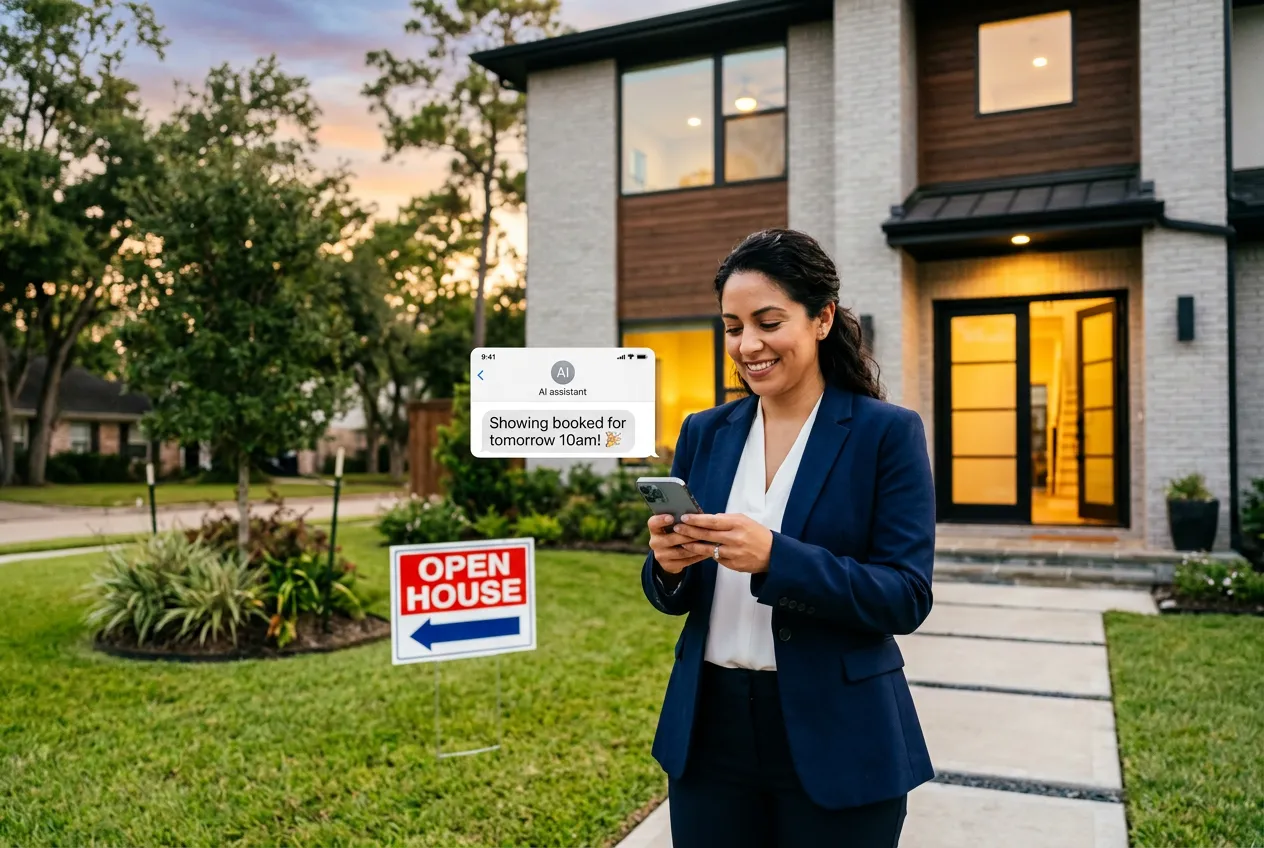
AI chatbots for real estate qualify leads, schedule showings, answer property questions, and route serious buyers to agents around the clock. With the National Association of REALTORS reporting 66 percent of agents embrace technology to save time and 14 percent existing-home sales growth expected in 2026, agencies that win the first five minutes after inquiry win the listing.
Why Five Minutes Decides the Listing
Every real estate agent eventually learns the same lesson. A lead inquires on Zillow at 9:47 p.m., the agent calls back at 8:30 a.m., and the lead has already toured a property with a competitor. The window between inquiry and first contact is shorter than most agencies behave as if it is, and the agencies that have figured this out are the ones expanding share through a soft market.
The National Association of REALTORS REALTOR Technology Survey gives the shape of the shift. Seventy-nine percent of agents use electronic signature, seventy-five percent use social media for client communication, fifty-two percent use drone photography, and sixty-six percent of REALTORS say they embrace technology to save time. Forty-five percent of clients respond positively to tech-forward agents, and NAR's 2026 forecast projects fourteen percent growth in existing-home sales. Volume is returning, but the agents who capture it are the ones whose technology is already calibrated.
An AI chatbot is the load-bearing piece of that calibration. Not because it replaces the agent's relationship, but because it owns the minutes between inquiry and conversation, the part of the funnel that human staffing alone cannot cover at 10 p.m., on Saturday morning, or during the open house when the agent is already with another buyer.
What follows is the practitioner's view of how agencies are actually deploying conversational AI in 2026: what the chatbot owns, what it routes, where the integration sits, how scheduling and listing search actually work, and the path Authority Solutions® uses to land a real estate chatbot in roughly sixty days.
The Inquiry That Comes In at 9:47 p.m.

Consider the specific case. A buyer searching on Zillow finds a listing they like, clicks "Contact agent," and types a question. Three things happen next, and the agency that handles them in seconds rather than hours wins the lead.
- First, qualification. Is the buyer pre-approved, what is the price band, what is the move-in timeline, are they working with another agent. A chatbot can ask each of these inside a single natural conversation without making the buyer feel processed.
- Second, listing answer. The buyer's question is rarely abstract. They want to know about the lot, the school district, the HOA, the renovation timing, or whether the basement is finished. A chatbot connected to the MLS and the listing detail can answer in the same moment the buyer asks.
- Third, conversion. The chatbot offers the next concrete action, whether that is a showing slot from the agent's calendar, a video tour link, a neighborhood comparison, or a financing pre-approval handoff. The buyer leaves the conversation with a scheduled tour, not a "we will reach out tomorrow."
By the time the agent opens the lead alert in the morning, the buyer is qualified, the question is answered, and the showing is on the calendar. The agency that does this wins the listing far more often than the agency that does not.
What the Chatbot Owns and What the Agent Owns
The healthy boundary between chatbot and agent is a matter of relationship depth. The chatbot owns the moments that do not require relationship. The agent owns the moments that do.
| Function | Owner | Why |
| First reply within 60 seconds | Chatbot | The five-minute window is real; only AI is fast enough across 24 hours |
| Lead qualification (price band, timeline, financing) | Chatbot | Repeatable, structured, low-friction |
| Listing detail answers (HOA, schools, square footage) | Chatbot | MLS-grounded factual retrieval |
| Showing scheduling against agent calendar | Chatbot | Calendar integration, no judgment required |
| First showing and rapport | Agent | Relationship begins here |
| Offer strategy and negotiation | Agent | Judgment, fiduciary duty, market read |
| Closing coordination | Agent + transaction coordinator | Multi-party, high-stakes |
| Post-close referral nurture | Chatbot (drip) + agent (touch) | Long-cycle; AI keeps cadence, agent maintains relationship |
The error in early real estate chatbot deployments was overreach. Chatbots tried to handle offer review or negotiation, gave wrong advice, and damaged trust. The error in the opposite direction is timidity, chatbots scoped only to "I will pass this along," which means the agency loses the inquiry to a faster competitor. The boundary above is the one we have found to land.
Listing Search That Actually Works
The most common request a real estate chatbot handles is some version of "show me three bedrooms in zip 77043 under six fifty with a yard." The early generation of chatbots failed at this because the listing data lived in the MLS, the chatbot lived in the website widget, and the integration between them was a contact form.
The 2026 generation works because the chatbot reads the MLS in real time, applies the buyer's criteria, and returns matching listings with photos, key facts, and a direct path to schedule a showing. The technical pattern is retrieval-augmented generation grounded on a live MLS feed, with the model citing the listing record and refusing to invent attributes that are not in the feed.
Three quality bars matter:
- Real-time availability. The chatbot must reflect listing status moment to moment, including the off-market events that happen within hours of a price change.
- Disclosure fidelity. The chatbot must surface listing-specific disclosures without paraphrasing, especially anything tied to HOA, easements, or known property conditions.
- Hard limits on opinion. The chatbot must refuse to make claims the MLS does not support, like "this neighborhood is appreciating fast," which crosses into agent territory.
Scheduling Is Where Lead Conversion Happens
The fastest way to lose a lead is to ask them to email back to schedule. The chatbot that holds the calendar integration converts at multiples of the chatbot that does not.
Integration patterns that work in practice:
- Calendar read and write. The chatbot reads the agent's Google or Outlook calendar, surfaces available windows within a defined buffer, and books the showing with confirmation to both parties.
- Multi-agent routing. For agencies with multiple agents, the chatbot routes to the agent whose territory or specialty matches the listing, using the same routing logic the agency would apply manually.
Friction reducers that move the conversion rate:
- Two or three options up front. Offer specific time windows rather than asking for preference.
- Video showing as alternative. Offer a video tour for buyers who cannot tour in person.
- SMS confirmation, not email. SMS opens at far higher rates than email for showings.
- 24-hour reconfirmation. Reconfirm the day before to suppress the no-show rate that haunts virtual leads.
Compliance considerations:
- No protected-class steering. The chatbot must not steer based on protected characteristics.
- No credit-based refusals. Do not reject a scheduling request based on credit assumptions.
- Audit trail logging. Every conversation must be retained for the audit log; vendors that cannot demonstrate fair housing-aware design should be off the shortlist.
Where the Chatbot Lives Matters More Than You Think
The chatbot is only as effective as its surface area. A chatbot buried behind a popup that requires opt-in converts a fraction of what an embedded chatbot on the listing page converts. Surface strategy is half the project.
The surfaces that drive the most volume in 2026:
- Listing detail page. The agency website, where the buyer is already evaluating.
- Facebook Messenger. Seventy-five percent of agents already maintain a social media presence; Messenger is where inquiries already land.
- SMS. For the buyer who left a number but did not reply to an email.
- Voice. For buyers calling the listed phone number after hours, where AI voice agents now handle inquiry, qualification, and warm hand-off to a human callback.
A unified chatbot that operates across all of these is far more valuable than four separate chatbots, because the buyer's conversation persists across channels.
What Compliance Looks Like in Real Estate AI

Real estate has a regulatory layer that other industries do not, and a chatbot that ignores it will get the brokerage in trouble.
- Fair Housing Act compliance. The bot must not ask questions or surface listings that steer protected classes. The training set, the prompt design, and the routing logic must be audited for bias. Most reputable platforms now provide a fair housing audit log; if the vendor cannot produce one, treat it as a red flag.
- Real estate license law. The bot must not give specific advice that crosses into licensed activity. Pricing strategy, offer review, and contract negotiation are agent territory. The bot can describe what a typical timeline looks like; it cannot tell a buyer "you should offer three percent under list."
- State-by-state AI disclosure. Some states require AI disclosure in consumer-facing automated communications. The chatbot should identify as AI within the first turn, and the disclosure language should match the strictest state the agency operates in.
- Recording and consent. Voice channels and SMS in some states require explicit consent for recording. The opening message should include the consent language, and the system should log acceptance for the audit trail.
The Agencies Winning the Soft Market
NAR's 2026 forecast of fourteen percent existing-home sales growth comes after a slow couple of years, and the agencies positioned to capture the rebound are not necessarily the biggest brokerages. They are the ones that figured out the operating model first.
Three patterns from the agencies pulling ahead. They treat the chatbot as the front door, not a feature. Every channel routes through it, and the agent's calendar is the asset the chatbot protects. They invest in MLS-grounded RAG so the chatbot can answer listing questions without hallucinating, which builds buyer trust faster than any other improvement. And they treat the chatbot as an evolving system, with weekly review of failed conversations and quarterly retraining, the same way a sales manager would review call recordings.
The agencies still struggling tend to make the inverse mistakes. The chatbot is a widget bolted onto a generic website, the integration to MLS and calendar is thin, the fair housing audit has never been run, and nobody owns continuous improvement. They get the technology in place but never the operating model.
The Authority Solutions® Real Estate Chatbot Path
Our deployment pattern for real estate runs roughly sixty days from kick-off to a chatbot that handles the five-minute window, schedules showings, and survives compliance audit.
- Weeks 1 and 2. Discovery, fair housing audit of existing customer journey, MLS integration scoping, agent calendar mapping. We identify the highest-value surfaces (listing pages, Messenger, SMS) and the routing logic for multi-agent brokerages.
- Weeks 3 through 5. Build. RAG grounding on the MLS feed, calendar integration with Google or Outlook, fair housing-aware prompt design, persona and tone tuned to the brokerage voice. Test against a corpus of representative buyer questions and edge cases.
- Weeks 6 through 8. Launch and tune. Soft launch on one or two listings, expand to the full inventory, instrument analytics on first-reply time, qualification completion, showings booked, and showing-to-tour conversion. Weekly review of failed conversations, retraining as needed.
By week eight, the chatbot answers within sixty seconds across the surfaces the agency cares about, books showings without agent intervention, and produces an audit log the broker of record can defend.
Key Takeaways
- The five-minute window decides the listing. AI chatbots are the only mechanism that covers that window across 24 hours and 7 days at the cost structure most brokerages can sustain.
- The chatbot owns inquiry, qualification, listing answer, and scheduling. The agent owns first showing, offer strategy, negotiation, and closing. The boundary is what makes the deployment defensible.
- Real-time MLS-grounded retrieval is the technical bar that separates the 2026 generation from earlier chatbots. The model must cite the listing and refuse to invent attributes.
- Scheduling is where the conversion happens. Calendar integration, two-or-three-option offers, SMS confirmation, and twenty-four-hour reconfirmation are non-negotiable.
- Fair housing, license law, and disclosure compliance must be architected in. A vendor without an audit log is a liability.
- The agencies winning the rebound treat the chatbot as the front door and the operating model, not as a widget.
FAQ
What does an AI chatbot do for a real estate agency?
An AI chatbot answers buyer and seller inquiries 24 hours a day, qualifies leads, answers listing-specific questions using the MLS feed, schedules showings against agent calendars, and routes serious buyers to the right agent. It owns the minutes between inquiry and first human contact, where most lead conversion is won or lost.
Why is the five-minute response window important in real estate?
Buyers contact multiple agents on multiple sites within a short window. The agent who responds first earns the conversation, and conversion rates drop sharply with each minute beyond the first five. AI chatbots are the only mechanism that consistently delivers first response inside that window across nights, weekends, and high-volume periods.
Can a real estate chatbot answer listing-specific questions?
Yes, when grounded on a live MLS feed using retrieval-augmented generation. The chatbot reads the listing record, answers questions about square footage, lot size, HOA, schools, and disclosures, and refuses to invent attributes not present in the feed. Implementation quality varies widely; ask for the grounding architecture before signing.
Does an AI chatbot replace real estate agents?
No. The chatbot owns the high-volume, low-judgment work: first reply, qualification, listing facts, and scheduling. The agent owns the relationship-bearing work: first showing, offer strategy, negotiation, and closing. The boundary is what makes the agency more productive without compromising service quality.
How does a real estate chatbot handle fair housing compliance?
Reputable platforms are designed to avoid steering on protected characteristics, do not ask discriminatory qualifying questions, and produce an audit log of every conversation. Brokers should run a fair housing review during evaluation and require the audit log as part of the contract.
Can the chatbot schedule showings automatically?
Yes. The chatbot integrates with the agent's Google or Outlook calendar, surfaces available windows respecting buffer time, books the showing, sends confirmation by SMS, and reconfirms twenty-four hours before the appointment to suppress no-shows. Multi-agent brokerages route by territory or specialty.
What does a real estate chatbot cost?
Pricing typically ranges from two hundred to fifteen hundred US dollars per month per brokerage depending on agent count, MLS integration depth, and channel surface. Implementation runs ten thousand to forty thousand US dollars for a brokerage-grade deployment with fair housing audit and calendar integration.
How long does it take to deploy an AI real estate chatbot?
A focused deployment runs roughly sixty days from discovery to full launch. The first two weeks are scoping and fair housing audit, the next three are build with MLS and calendar integration, and the final three are soft launch, tuning, and analytics instrumentation.
What channels should a real estate chatbot operate on?
Listing detail pages, Facebook Messenger, SMS, and increasingly voice for after-hours phone inquiries. Seventy-five percent of agents already use social media for client communication; a chatbot that operates only on the website misses where most buyers already are.
How is AI chatbot performance measured for real estate?
Core metrics include median first-reply time, qualification completion rate, showings booked per hundred inquiries, showing-to-tour conversion, agent time saved, and brokerage-wide lead-to-close rate. Compliance metrics include fair housing audit pass rate and disclosure acceptance rate.
Conclusion and CTA
NAR's 2026 forecast points to a market where volume returns and the brokerages with the best operating model take disproportionate share. The agencies positioned to win are not necessarily the largest. They are the ones whose chatbot owns the five-minute window, whose MLS integration produces answers buyers can trust, and whose scheduling pulls showings onto the calendar before the lead has time to call a competitor.
Authority Solutions® designs and deploys real estate chatbots for brokerages across Texas and beyond. We handle the MLS integration, the calendar logic, the fair housing audit, the multi-channel surface, and the operating model that keeps the bot improving after launch. The result is a chatbot the broker of record can defend, the agents will actually use, and the buyers will not abandon.
Book your Real Estate AI Chatbot Assessment today. Win the five-minute window before the next inquiry lands.