

Disclaimer: This article addresses administrative, operational, and client-intake workflow automation. It does not address the use of AI for legal analysis, advice generation, or judgment replacement. Attorneys remain responsible for the substantive legal work produced with or alongside any AI tool, and state bar rules on AI disclosure vary. Consult your jurisdiction's current guidance.
AI workflow automation for law firms streamlines administrative, intake, case management, calendar, and billing functions without crossing into legal judgment. The four mature 2026 deployment domains are client intake, case management and document assembly, deadline and calendar automation, and billable-hour capture, each with attorney-review checkpoints and bar-compliant guardrails.
The legal industry is past the "should we use AI" conversation. The 2026 question is "which workflows, with which guardrails, on which timeline." Per the American Bar Association 2024 Legal Technology Survey Report, AI adoption among lawyers nearly tripled in twelve months, from 11% in 2023 to 30% in 2024, with firms of 100 or more attorneys reaching 46% adoption. The 2025 ABA Task Force report subsequently described AI as having moved "from experiment to infrastructure" for the profession.
The urgency is matched by the ethical pressure. Below, you will learn where AI belongs in a law firm and where it does not, the four mature deployment domains, the compliance guardrails that make AI defensible (privilege protection, conflict checks, disclosure, audit logging), and the 60-day intake-first deployment sequence that lands the fastest, most defensible ROI. The framework draws on patterns from AI implementation consulting engagements with firms that respect the line between administrative automation and legal judgment.
Where AI Belongs in a Law Firm (and Where It Does Not)
The distinction that matters: AI belongs in administrative, operational, and intake workflows. AI does not belong in final client-facing legal judgments without attorney review. This is not a soft preference. It is a line that state bar authorities across the U.S. are actively enforcing in 2026, and the firms in disciplinary case studies are almost always the firms that crossed it.
The workflows where AI belongs share three characteristics. They are repeatable rather than novel. They produce outputs that an attorney reviews before acting. And they handle administrative or operational data rather than substantive legal analysis. The workflows where AI does not belong (without attorney sign-off) share the inverse characteristics. They produce outputs that affect client matters directly, they involve substantive legal judgment, and they touch privileged information that must remain inside the firm's controlled environment. Firms that respect this line capture 80% of the available AI ROI with 20% of the compliance risk. Firms that do not are the ones showing up in bar-association discipline case studies that other firms read as cautionary tales.
The economic framing matters when explaining the line to partners. Administrative automation produces direct, measurable savings without exposing the firm to ethics risk. Substantive legal automation, by contrast, produces savings that the firm cannot bank on because any single ethics incident can erase years of cumulative gains. The risk-adjusted return on staying inside the line is meaningfully higher than the return on pushing past it, even before the disciplinary consequences are weighed.
Table 1: Where AI Belongs vs Where It Needs Attorney Review
| AI Belongs (Administrative/Operational) | Requires Attorney Review and Sign-Off |
| New-matter intake forms | Legal analysis drafted for court |
| Conflict-check screening | Client advice delivered directly |
| Calendar and deadline automation | Judgment about privileged material |
| Document template assembly for routine matters | Final pleadings, motions, contracts |
| Billable-hour capture from activity logs | Client-facing letters with legal substance |
| Client communication scheduling | Strategic litigation decisions |
| Case-status summaries for routine updates | Substantive responses to opposing counsel |
The 4 Mature AI Deployment Domains
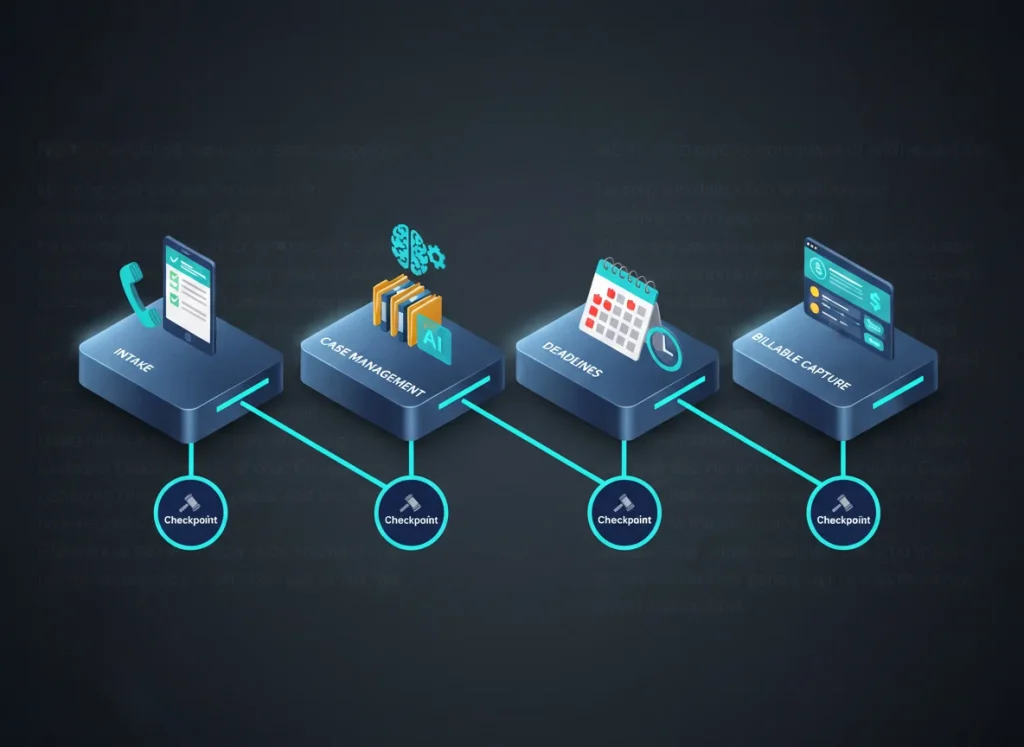
The 2026 deployment landscape has converged on four domains where AI is mature, defensible, and producing measurable ROI. Each one has its own time-to-value profile, risk profile, and required attorney-touch checkpoints. The four domains:
- Client intake. The highest-leverage automation target in most firms. AI-enabled intake handles inbound calls or forms at any hour, captures the required facts, runs an initial conflict check against the firm's database, routes the matter to the right practice group, generates a new-client packet, and produces an intake summary the assigned attorney reviews at the start of day one. AI-powered intake platforms for small to mid-size firms typically see 3 to 5 times ROI within six months. Every intake-generated conflict check is flagged for attorney review before the matter opens. No exception.
- Case management and document assembly. AI layers on top of data firms already maintain (matter records, document libraries, timekeeping, communication history). The gains show up in document assembly for routine matters, deposition and discovery summarization, and legal research triage. Attorney review replaces drafting time, applying the same legal judgment to a near-final document instead of a blank one. The 2025 to 2026 generation of legal AI tools cites sources verifiably to eliminate the fabrication risk that generated early disciplinary cases.
- Deadline and calendar automation. A first-line defense against malpractice claims, which most often originate in missed deadlines. The system reads incoming court orders, scheduling notices, and statute-of-limitations triggers, calculates downstream deadlines according to controlling rules, populates the firm calendar, and issues tiered reminders to attorneys, paralegals, and clients. Every calculated deadline requires attorney confirmation before it is treated as authoritative. The AI accelerates, it does not decide.
- Billable-hour capture. Closes the quiet revenue problem in most firms, where attorneys miss 8 to 15% of billable time because manual entry happens after the fact from imperfect memory. AI billable-capture systems aggregate time from email activity, document interactions, calendar entries, phone logs, and matter management activity. AI also validates each entry against client billing guidelines, block-billing restrictions, and task-code requirements, catching compliance issues before invoices go to the client.
Intake and billable capture deliver fastest. Case management and document assembly deliver deepest but require more change management. Sequencing the deployments in that order produces visible wins early, which is what builds the political momentum to fund the deeper work.
Table 2: Comparing the 4 Deployment Domains
| Domain | Time-to-Value | Risk Profile | Attorney Touch Required |
| Client Intake | 30 to 60 days | Low (with conflict-check guardrail) | Conflict-check confirmation, matter open |
| Case Management & Doc Assembly | 90 to 180 days | Medium (document review must remain) | Final review on every assembled document |
| Deadline & Calendar | 45 to 90 days | Low (with confirmation guardrail) | Confirmation on every calculated deadline |
| Billable-Hour Capture | 30 to 60 days | Very low | End-of-day entry review |
The Compliance Guardrails That Make AI Safe for Law Firms

Four guardrails differentiate a defensible deployment from a malpractice vector. Each one addresses a specific failure mode that has produced documented disciplinary outcomes elsewhere. Skipping any one of them creates ethics exposure that the vendor will not absorb on the firm's behalf, which is why the guardrails are baked into the deployment architecture from day one rather than treated as optional add-ons. The four:
- Privilege protection. Any AI tool touching client information must be deployed inside the firm's controlled environment with vendor contracts that explicitly prohibit training on firm data, guarantee data residency, and provide the access logs the firm needs for ethical audit trails.
- Conflict-check automation with human confirmation. AI runs the initial screen across the firm's matter history, and attorney confirmation opens the matter. The two-step model is the current standard, and skipping the second step is what produces the conflict failures that trigger malpractice claims.
- Disclosure where required. Several state bars now require disclosure to clients when AI is used in matter work. A firm-wide policy and engagement-letter language addressing this is the minimum bar, not a nice-to-have.
- Audit trail on every AI interaction. Every prompt, every retrieval, and every AI-generated output sits in a queryable log. If the firm ever has to defend its process, the log is the evidence.
A defensible deployment of process automation inside a law firm includes all four guardrails as architectural requirements rather than configuration options. The vendor selection process should explicitly verify each one, and the engagement letter with the AI vendor should reflect each one in writing. Treating the guardrails as living documents reviewed quarterly keeps the deployment aligned with the regulatory pace as state bars continue to publish new guidance.
Table 3: The Four Compliance Guardrails
| Guardrail | What It Protects | Implementation Standard |
| Privilege protection | Client confidentiality | Controlled environment + no-training contracts + access logs |
| Conflict-check + human confirmation | Conflict-of-interest exposure | Two-step model: AI screens, attorney confirms |
| Disclosure | Bar-rule compliance | Engagement-letter language + firm-wide policy |
| Audit trail | Defensibility in any inquiry | Every prompt, retrieval, and output logged |
State Bar Considerations and Disclosure Requirements
The state bar landscape on AI disclosure is fragmented and shifting. As of 2026, several jurisdictions have published explicit guidance requiring disclosure to clients when AI is used in matter work. Others have addressed AI use through existing competence and confidentiality rules. A handful are still evaluating. The practical implication is that firms operating across multiple states need a disclosure policy that satisfies the most stringent jurisdiction in which they practice, applied uniformly across all matters rather than varying by jurisdiction.
A defensible firm-wide AI policy includes engagement-letter language that addresses AI use, an internal sanctioned-tool list with explicit usage rules, ongoing monitoring of state bar updates, mandatory CLE on AI ethics for all attorneys, and an audit log retention policy that supports ethical defense in any subsequent inquiry. Treating the policy as a living document reviewed quarterly keeps it aligned with the regulatory pace, because the state bar landscape moves faster than annual policy reviews can absorb.
The interaction between state bar rules and federal practice adds another layer. Firms with multi-jurisdictional practices need to track not just the rules of each state where they are licensed but also the courts in which they appear, because some federal courts have published their own AI-use orders that operate independently of state bar guidance. The discipline of monitoring both layers is what separates firms that scale AI confidently from firms that pull back the moment a new rule lands.
Common Risks and How to Avoid Them
Four risks recur across firms that struggled with AI deployment. Each has a mature mitigation that successful firms build in from day one. Privilege loss, hallucinated citations, bar-rule violations on disclosure, and inadequate conflict-check rigor are the four, and each has produced documented disciplinary outcomes that other firms can learn from. Firms that build the four mitigations into the deployment architecture (controlled environments, citation-verified tools, disclosure-ready engagement language, and two-step conflict workflows) are not the firms in disciplinary case studies.
The mitigation pattern is the same across all four risks: industry-specific tools rather than general-purpose tools dropped into a legal environment. The 2025 to 2026 generation of legal-specific AI products (Lawmatics, Smokeball with Archie, Spellbook, Harvey, Casetext, Clio Duo) is materially safer than general-purpose LLMs deployed inside a law firm context. The vendor contracts handle the privilege guarantees, the citation verification eliminates hallucination, the disclosure tooling supports bar-rule compliance, and the conflict integration makes the two-step workflow operational rather than aspirational.
The Authority Solutions team builds law-firm AI automation with industry-specific guardrails baked in from day one rather than bolted on to generic workflow tools after deployment. The difference shows up most clearly in the second year, when generic deployments start producing the kind of ethics edge cases that legal-specific tools were designed to prevent. Building right the first time is significantly cheaper than rebuilding after the first compliance scare.
Key Takeaways
- AI belongs in administrative, operational, and intake workflows, not in final legal analysis or client advice without attorney review. Firms that respect this line capture 80% of the ROI with 20% of the risk.
- The four mature 2026 deployment domains are client intake, case management and document assembly, deadline and calendar automation, and billable-hour capture, each with its own time-to-value and risk profile.
- Per the ABA 2024 Legal Technology Survey Report, AI adoption among lawyers tripled to 30% in twelve months, with firms of 100 or more attorneys reaching 46%. The 2025 ABA Task Force called AI "infrastructure rather than experiment" for the profession.
- Intake automation typically produces 3 to 5 times ROI within six months for small to mid-size firms, driven by after-hours lead capture, reduced intake staff hours, and faster time-to-engagement.
- Compliance guardrails are non-negotiable: privilege protection through controlled deployment environments, two-step conflict checks, client disclosure where required, and audit trails on every AI interaction.
- State bars are actively enforcing the AI-judgment line in 2026. Firms operating across multiple jurisdictions apply the most stringent rule uniformly across all matters rather than varying by jurisdiction.
Getting Started With Law Firm AI Automation
Start with the intake workflow. It produces the fastest, most defensible ROI, the compliance guardrails are well-understood, and the client experience improvement is immediately visible. A 60-day intake deployment produces enough early wins to fund the next three workflows politically, which is what makes the sequencing matter as much as the deployment itself.
Sequence the next three workflows behind the intake win. Billable-hour capture is the natural second deployment because it has the lowest risk profile and the same 30 to 60 day time-to-value, which means the firm sees a second visible win in the first 90 to 120 days. Deadline and calendar automation is the natural third because the malpractice-prevention story makes the partner conversation easier than it would be for any other workflow. Case management and document assembly is the natural fourth because it requires the most change management and benefits from the operational confidence built across the first three deployments.
To map your firm's intake, case management, calendar, and billing workflows against the 2026 deployment patterns and bar-compliant guardrails, book a consultation for a Law Firm AI Assessment.
Conclusion
The legal industry is in active transition from "should we use AI" to "where, with what guardrails, on what timeline." Firms that respect the line between administrative automation and legal judgment, and that build the four guardrails (privilege, conflict checks, disclosure, audit) from day one, capture the available ROI without exposure. Start with intake. Sequence the next three workflows behind it. And build with industry-specific tools rather than generic ones bolted into a legal environment.
Frequently Asked Questions
Is AI automation appropriate for law firms?
Yes, for administrative, operational, and intake workflows. The four domains where AI is mature and defensible are client intake, case management and document assembly, deadline and calendar automation, and billable-hour capture. AI does not belong in final legal analysis without attorney review.
What are the biggest risks of AI in law firms?
Privilege loss, hallucinated citations, bar-rule violations on disclosure, and inadequate conflict-check rigor. Each has a mature mitigation: controlled deployment environments, citation-verified AI tools, disclosure-ready engagement language, and two-step conflict workflows. Firms that build these mitigations from the start avoid disciplinary case studies.
How long does AI implementation take for a law firm?
An intake deployment typically takes 30 to 60 days. Full four-workflow deployment (intake, case management, deadlines, billing) takes 6 to 9 months when sequenced properly, with each workflow funding the next. Compressed timelines below 30 days for intake usually skip the conflict-check integration that protects the firm.
Do state bars require disclosure of AI use to clients?
Several states require AI disclosure in matter work as of 2026, and the list is growing. Firms should adopt firm-wide disclosure language and track jurisdiction-specific requirements as part of their AI governance program. Multi-state firms apply the most stringent jurisdiction's rule uniformly across all matters.
What is the ROI of AI automation for law firms?
For small to mid-size firms, AI-powered intake platforms typically see 3 to 5 times ROI within six months, driven by after-hours lead capture, reduced intake staff hours, and faster time-to-engagement. Full workflow automation extends ROI across deadline risk reduction and billable-hour capture (typically 8 to 15% recovered time).
What is the difference between legal AI and general business AI?
Legal AI is built with privilege protection, citation verification, conflict-check integration, and bar-rule compliance baked in. General business AI is not, and deploying it in a law firm creates ethical exposure the vendor will not absorb. Legal-specific tools (Harvey, Casetext, Spellbook, Clio Duo) are materially safer than general-purpose tools.
Can AI hallucinate legal citations?
Early-generation legal AI did, and several disciplinary cases resulted. The 2025 to 2026 generation of legal AI tools cites sources verifiably, with every citation traceable back to the underlying case or statute. The mitigation is to use legal-specific tools that ground their outputs in verified legal databases.
How does AI handle privileged client information safely?
Through three controls: deploying AI inside the firm's controlled environment (not consumer SaaS), vendor contracts that prohibit using firm data for training, and audit logs that support ethical defense. Any deployment that does not include all three is taking unmanaged risk with privilege.
What does AI client intake actually do?
AI intake handles inbound calls and forms 24/7, captures required matter information, runs an initial conflict check against the firm's database, routes the matter to the right practice group, and produces an intake summary for attorney review. The attorney still confirms the conflict and opens the matter.
Should small law firms invest in AI automation, or is it only for large firms?
Small to mid-size firms typically see the fastest ROI because they have the highest leverage gain per attorney. Large firms have economies of scale, while small firms gain from removing the administrative burden that limits their growth. Intake and billable-capture deployments are particularly favorable for firms under 50 attorneys.