

Per McKinsey research, 88 percent of retailers now use AI regularly and 62 percent are experimenting with AI agents. The US B2C agentic-commerce opportunity is projected at $1 trillion in orchestrated revenue by 2030, with $3 to $5 trillion globally. The retailers winning that share are running coordinated AI across inventory, personalization, and pricing today.
A Shopify merchant opens her dashboard at 7 a.m. Tuesday. Yesterday's sell-through report shows a candle scent she barely promoted moved 240 units to a customer cohort she has never targeted before. A competitor on the same platform launched a discount on a substitute product overnight. Three customers asked her chatbot last night whether a discontinued color was returning. Her inventory system reordered correctly, her pricing engine adjusted automatically, her merchandising surfaced the candle to lookalike audiences, and the chatbot offered the three customers a notification on the substitute color the merchant had already approved as a replacement. By 7:30 a.m. she has answered three emails and made one strategic decision; the rest was already done.
That Tuesday morning is what AI-driven e-commerce operations look like in 2026. Below: what McKinsey's retail research actually shows about agentic commerce, where the merchant should start, what an inventory deployment looks like at the SKU level, the personalized recommendation systems generating 10 to 30 percent of revenue for mature programs, the pricing guardrails that prevent PR disasters, and how to think about agentic commerce before it shows up in your category.
What McKinsey Found
The 2026 McKinsey research on retail digital transformation surfaced three numbers worth anchoring on.
- 88 percent of retailers now use AI regularly, up from 78 percent the prior year. The adoption curve is steeper than any technology wave since the smartphone, and it is widening the gap between retailers who deploy AI as core operations and those treating it as an experiment.
- 62 percent of retailers are experimenting with AI agents. Agentic systems that can reason through multi-step decisions and take action across the operations stack are no longer pilot-only. The early production deployments are reshaping what "running an e-commerce operation" means.
- Agentic commerce is projected at $1 trillion in US B2C orchestrated revenue by 2030, with global projections reaching $3 to $5 trillion. This is the projection that should change capital allocation. The retailers building toward agentic commerce now are positioning for the largest single revenue redistribution in retail since the shift to mobile.
Per McKinsey's research on the agentic commerce opportunity, agentic commerce is "shopping powered by intelligent AI agents capable of anticipating, personalizing, and automating every step of the process to create frictionless, proactive experiences."
The implication: the AI work a merchant does in 2026 is not just about operational efficiency. It is about positioning for a market structure that will redistribute trillions of dollars in revenue.
Where the Merchant Should Start
The temptation when reading McKinsey research is to start everywhere. The discipline is to start where the gap-to-benchmark is widest in your specific operation.
The three diagnostic numbers that matter most for any e-commerce operation:
- Revenue per visitor. If your number is below industry benchmark for your category, personalized recommendations is the highest-leverage first wedge. Mature recommendation systems generate 10 to 30 percent of total revenue.
- Inventory turn ratio. If turn is below benchmark, working capital is trapped in slow-moving SKUs that AI demand forecasting can identify and prevent. Mature AI inventory cuts overstock 30 to 40 percent within 90 days.
- Customer service ticket-to-conversation ratio. If your team is drowning in support volume relative to revenue, customer service automation produces the fastest visible win, freeing capacity for the operational AI work that compounds.
Pick one. Deploy it well. Prove the math in 60 days. Use the proof to fund the second domain. The retailers who land at three deployed AI domains by end of 2026 are positioned to start agentic commerce experiments by Q2 2027.
The Inventory Deployment in Practice
Inventory is the domain where AI produces the most visible operational change in the fastest window, which is why it is the most common first wedge.
The deployment runs through three layers:
- Layer 1: Forecasting. AI ingests historical sales data, seasonality patterns, lead times by SKU and vendor, marketing-driven demand signals, and external factors (weather, competitor pricing, holiday calendars). It produces per-SKU demand forecasts at the granularity the buying team needs (weekly or monthly, depending on category).
- Layer 2: Reordering. AI translates the forecast into automated purchase order recommendations within configured parameters (max single PO size, vendor terms, lead time, safety stock targets). The buyer's job shifts from data crunching to reviewing AI-generated POs and intervening on exceptions.
- Layer 3: Markdown and slow-mover management. AI identifies SKUs trending below forecast and recommends markdown timing, discount depth, and channel placement. Slow movers get repositioned before they tie up working capital for a full season.
The 30 to 40 percent overstock reduction comes mostly from Layer 1 plus Layer 3 working together. The reordering layer keeps the operation running; the forecasting and markdown layers cut the working capital tax.
Personalized Recommendations: The 10-to-30% Revenue Channel
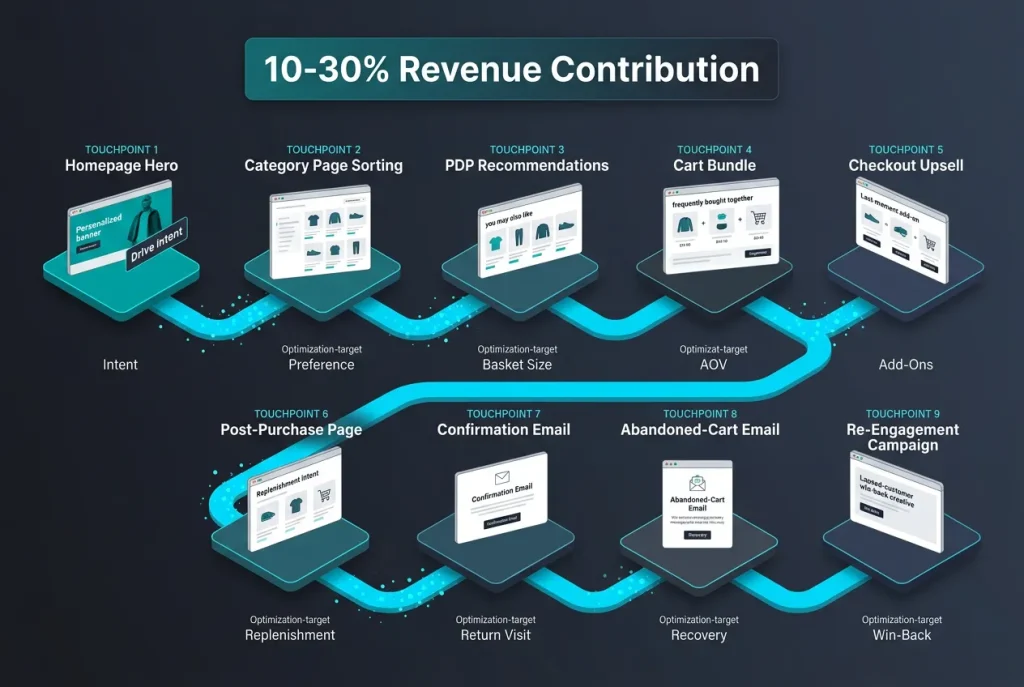
Recommendations are simultaneously the most-discussed and most-misunderstood domain in e-commerce AI. The misunderstanding is that "personalization" means "the homepage shows different products to different users." The reality is that mature personalization runs across nine touchpoints with different optimization targets per touchpoint.
The full personalization surface:
- Homepage hero (drive immediate intent)
- Category page sorting (rank by inferred preference)
- Product detail page "you may also like" (drive basket size)
- Cart page "frequently bought together" (drive AOV)
- Checkout page upsell (capture last-moment add-ons)
- Post-purchase confirmation page (drive replenishment intent)
- Order confirmation email (drive related-product return visit)
- Abandoned-cart email (recover lost sessions)
- Re-engagement campaign (win back lapsed customers)
Mature recommendation systems run different models on each touchpoint with different optimization goals. The homepage optimizes for engagement; the cart page optimizes for AOV; the post-purchase email optimizes for return visit. Treating personalization as one decision instead of nine is the most common reason retailers see 5 percent revenue lift instead of 30 percent.
The data foundation that makes this work: identity resolution across logged-in and anonymous sessions, clean product catalog data (accurate attributes, lifecycle stage, inventory by location), clean order history, and behavioral telemetry (page views, search queries, dwell time) tied to the resolved identity.
Dynamic Pricing Without the PR Risk
Dynamic pricing is the domain where the technology is mature and the operating discipline is the gating constraint. Done well, dynamic pricing lifts margin 2 to 8 percent on covered SKUs. Done badly, it generates the news story about the customer who saw a different price than her friend did three minutes earlier.
The guardrails that prevent the PR risk:
- Category-by-category enablement. Some categories tolerate dynamic pricing well (electronics, fashion, marketplace-listed items). Some do not (essential goods, regulated products, premium-positioned brands). Enable category-by-category, not blanket.
- Floor and ceiling constraints. No price can move below configured floor or above configured ceiling. The floor protects margin; the ceiling protects against runaway algorithmic behavior.
- Customer-level consistency. The same customer should not see different prices in the same session unless the price actually changed for a documented reason (sale window, inventory shift). Session-stable pricing is the minimum bar for trust.
- Regulatory compliance review. Consumer protection regulations vary by jurisdiction. Run dynamic pricing policy through legal review per region before enablement.
- Audit trail. Every price change logged with the inputs that drove it. When a customer asks "why was this $5 more yesterday," the merchant has the answer.
These guardrails are not optional. The retailers who skip them produce the PR stories that make the rest of the industry harder to operate in.
| Domain | Primary Metric | Typical Lift | Time to ROI Signal |
| Demand forecasting + inventory | Overstock reduction | 30 to 40 percent | 60 to 90 days |
| Personalized recommendations | Share of revenue | 10 to 30 percent of total | 30 to 60 days |
| Dynamic pricing (with guardrails) | Margin lift | 2 to 8 percent on covered SKUs | 90 to 120 days |
| Customer service automation | Cost per ticket | 60 to 80 percent reduction | 60 to 90 days |
| Fraud detection | Chargeback loss | 40 to 70 percent reduction | 90 to 180 days |
| Post-purchase retention | Retention rate | 15 to 30 percent lift | 120 to 180 days |
The Agentic Commerce Conversation
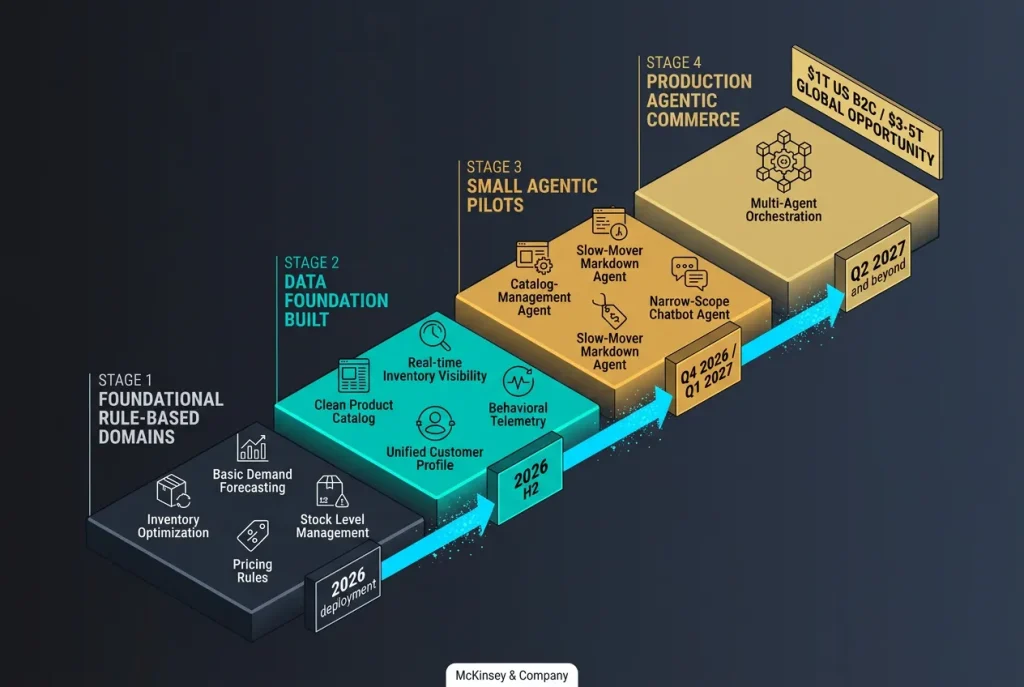
The McKinsey trillion-dollar projection is what should make agentic commerce a board-level conversation in 2026 rather than an experiment buried in the e-commerce team's roadmap.
Agentic commerce in production looks like an AI agent that monitors inventory, demand, pricing, and competitor moves continuously, then takes action across reordering, promotional placement, dynamic pricing, and customer service without explicit rule-based decisions for every scenario. The agent reports its decisions to leadership for review but does not require approval for each individual action within defined budget and policy boundaries.
For most merchants, the right 2026 framing is:
- Deploy the foundational AI domains (inventory, recommendations, pricing, service) as rule-based and confidence-thresholded systems
- Build the data foundation that an agentic system will eventually need (clean catalog, real-time inventory, unified customer profile, behavioral telemetry)
- Run small agentic pilots in low-risk categories (catalog management, slow-mover markdown, narrow-scope chatbot decisions) to build the operational muscle
- Expect Q4 2026 and 2027 to be when production agentic deployments become competitive necessities in the most-adopted categories
The merchant who has the foundational stack live by Q4 2026 has the option to move to agentic when their category demands it. The merchant who is still arguing about whether to deploy recommendations does not.
Picking the First Domain for Your Operation
The diagnostic logic that produces the right starting wedge:
| Operational Symptom | Starting Domain | Why |
| Revenue per visitor below benchmark | Personalized recommendations | Fastest revenue ROI signal |
| High overstock or low inventory turn | Demand forecasting + inventory | Largest working-capital impact |
| Support ticket volume overwhelming team | Customer service automation | Fastest operational relief |
| High chargeback losses | Fraud detection | Direct dollar recovery |
| Low retention despite traffic acquisition | Post-purchase workflows | Compounding LTV lift |
| Margin compression by competitor pricing | Dynamic pricing (with guardrails) | Direct margin defense |
Match the symptom to the domain, deploy carefully, prove the math, expand. The retailers who try to deploy all six simultaneously produce six half-built systems and zero measurable lift.
Key Takeaways
- Per McKinsey, 88 percent of retailers use AI regularly, 62 percent experimenting with AI agents; agentic commerce projected at $1 trillion US B2C orchestrated revenue by 2030, $3 to $5 trillion globally
- The right first domain depends on the operational symptom (low revenue per visitor → recommendations, low inventory turn → forecasting, high ticket volume → service automation, etc.)
- Personalization runs across nine touchpoints with different optimization targets per touchpoint; treating it as one decision misses most of the lift
- Inventory AI deploys in three layers (forecasting, reordering, markdown); the 30 to 40 percent overstock reduction comes mostly from forecasting plus markdown working together
- Dynamic pricing needs five guardrails (category enablement, floor/ceiling, session consistency, regulatory review, audit trail) to avoid the PR disasters that hurt the whole industry
- Most retailers should deploy foundational AI domains now (rule-based, confidence-thresholded) and build the data foundation that agentic commerce will eventually need
- The merchant with the foundational stack live by Q4 2026 has the option to move to agentic when their category demands it
Frequently Asked Questions
What does McKinsey say about AI in e-commerce in 2026?
Per McKinsey's retail research, 88 percent of retailers now use AI regularly (up from 78 percent the prior year), 62 percent are experimenting with AI agents, and agentic commerce is projected at $1 trillion in US B2C orchestrated revenue by 2030 with global projections of $3 to $5 trillion. The numbers position AI as a market-structure-changing force, not an operational efficiency tool.
What is agentic commerce?
Per McKinsey, agentic commerce is "shopping powered by intelligent AI agents capable of anticipating, personalizing, and automating every step of the process to create frictionless, proactive experiences." In retail operations, it means AI agents that monitor inventory, demand, pricing, and competitor moves continuously, then take action across the operations stack within defined budget and policy boundaries.
Which AI domain should an e-commerce operation deploy first?
The one matching the largest operational symptom. Low revenue per visitor: personalized recommendations. Low inventory turn or high overstock: demand forecasting. Support ticket volume overwhelming team: customer service automation. High chargeback losses: fraud detection. Low retention: post-purchase workflows. Margin compression: dynamic pricing.
How much revenue do AI recommendations actually drive?
For retailers with mature personalization across the full nine-touchpoint surface (homepage, category, PDP, cart, checkout, post-purchase, email, abandoned cart, re-engagement), 10 to 30 percent of total revenue is typical. The 5 percent that less-mature retailers see usually comes from treating personalization as a single homepage decision rather than nine different optimization problems.
What are the nine personalization touchpoints?
Homepage hero (drive immediate intent), category page sorting (rank by inferred preference), product detail page recommendations (drive basket size), cart page bundle suggestions (drive AOV), checkout upsell (capture last-moment adds), post-purchase confirmation page (drive replenishment intent), order confirmation email (drive return visit), abandoned-cart email (recover sessions), re-engagement campaigns (win back lapsed customers).
How does AI inventory management work?
Three layers: forecasting (per-SKU demand prediction from historical sales, seasonality, lead times, demand signals), reordering (automated PO recommendations within configured parameters), and markdown/slow-mover management (identifies trending-below-forecast SKUs and recommends discount timing and depth). The 30 to 40 percent overstock reduction comes mostly from forecasting plus markdown working together.
How do I run dynamic pricing without PR disasters?
Five guardrails: category-by-category enablement (not blanket), floor and ceiling price constraints, customer-level session consistency, regulatory compliance review per region, and complete audit trail with inputs logged. Skip any one and you risk the news story that makes the rest of the industry harder to operate in.
Should I deploy agentic commerce now or wait?
Most merchants should deploy foundational AI domains (inventory, recommendations, pricing, service) as rule-based and confidence-thresholded systems first, build the data foundation an agentic system needs (clean catalog, real-time inventory, unified customer profile), and run small agentic pilots in low-risk categories. Production agentic commerce becomes a competitive necessity in 2027 for the most-adopted categories.
What commerce platform should I use?
Shopify Magic, BigCommerce AI, Salesforce Commerce Cloud Einstein, and Adobe Commerce AI all ship strong native AI capabilities in 2026. The native AI is the lowest-friction starting point. Best-of-breed AI tools (Klaviyo, Algolia, Nosto, Bloomreach for personalization; Inventory Planner, Cogsy for inventory; Forter, Riskified for fraud) layer on top for domains where native AI is too thin.
What does success look like at 12 months?
Three foundational domains deployed and producing measurable lift; the data foundation (catalog, inventory, customer profile, telemetry) clean enough that agentic pilots are technically feasible; at least one agentic pilot running in a low-risk category; revenue per visitor, inventory turn, or both moving meaningfully against the operational baseline you set at month zero.
Conclusion
The McKinsey trillion-dollar projection is not a far-future scenario. It is the 2030 market the AI-deployed retailers are positioning for now. The discipline is to start with the domain that matches your biggest operational gap, deploy carefully, prove the math, expand methodically, and build the data foundation that agentic commerce will eventually require. The merchant who lands at three deployed domains by end of 2026 has options. The merchant who is still arguing about whether to deploy recommendations does not.
Book your AI E-Commerce Automation Assessment today. See what the 3 to 4 percent revenue uplift looks like on your stack.